如何测试儿童使用风车的安全性?
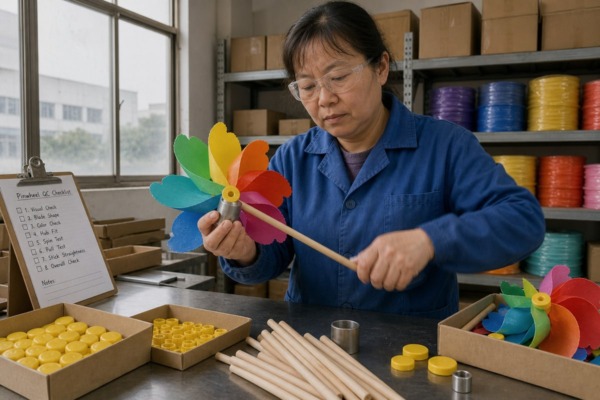
一个松动的盖子就能把一件欢乐的花园玩具变成召回产品。在浙江运行多年风车生产线后,我在任何儿童订单发货前都会测试风车安全性。
要测试儿童风车玩具的安全性,请验证CPSC合规性和ASTM F963标准,对端盖和轮毂进行小零件圆柱测试,筛查油漆中的铅和邻苯二甲酸盐含量,检查是否有锐利边缘,并拉扯每个紧固件以确认没有部件脱落。
风险从来不是风车概念本身。风险来自设计、组装和年龄不匹配。下面,我详细介绍我在自己生产线上使用的确切检查方法,这样你也可以对任何供应商提出同样的要求。
在为孩子们订购风车之前,我应该核实哪些安全标准?
去年春天,美国的一位采购经理在WhatsApp上给我发消息,只问了一个问题:哪些证书能证明我们的彩虹风车对儿童是合法的?她的谨慎很明智。
在您下任何风车订单之前,请验证ASTM F963机械和物理性能标准、CPSIA铅和邻苯二甲酸酯含量限制、CPSC合规文件(如儿童产品证书)、来自CPSC认可实验室的第三方实验室测试,以及正确的适龄标签。
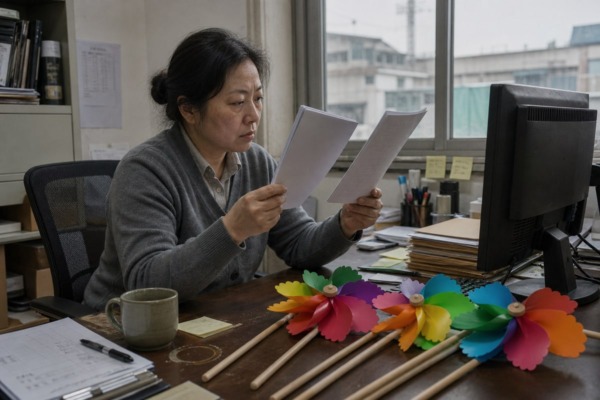
作为儿童玩具销售的风车是受监管产品,而不是简单的装饰品。这一区别很重要。当我们为美国订单报价时,我们首先确认的是风车是否会面向儿童营销。如果是,完整的 玩具安全框架 1 适用。如果它纯粹作为成人花园装饰品销售,规则则较宽松。许多买家吃亏,是因为他们以为装饰品规则覆盖玩具渠道。事实并非如此。
各市场的核心标准
| 市场 | 关键标准 | 涵盖内容 |
|---|---|---|
| 美国 | ASTM F963(CPSC强制要求) | 机械和物理性能、尖锐尖端、小零件、化学限值 |
| 美国 | CPSIA | 基材和涂层中的总铅、邻苯二甲酸酯含量、追踪标签 |
| 欧洲 | EN 71(第1–3部分) | 物理、易燃性和化学迁移要求 |
| 南美洲 | 因国家而异,通常基于ISO 8124 | 类似的物理和化学检查 |
你应该要求的文件
在支付定金前要求三样东西。第一,一份 儿童产品证书 2 其中注明CPSC认可的实验室。第二,实际测试报告,而不仅仅是通过信。第三,零售包装上适龄标签的证明,包括如果风车不适用于3岁以下儿童时的小零件警告。根据我对美出口的经验,跳过文书阶段的买家 later 在港口扣留和退货上花费 far more。一页证书检查只需一个下午。被扣留的集装箱需要一个月。
我如何测试风车材料是否含有有毒化学物质或涂料?
我们的花瓣叶片最初是成卷的彩色塑料薄膜。在任何一卷进入我们浙江车间之前,我们都会向供应商索取 材料安全报告。这个习惯很早就开始了。
通过将叶片、油漆和涂层送至第三方实验室进行总铅、重金属和邻苯二甲酸酯含量筛查,来测试风车材料。要求材料无毒且符合ASTM F963化学限值认证,并要求每批新颜色或新供应商批次提供最新的测试报告。
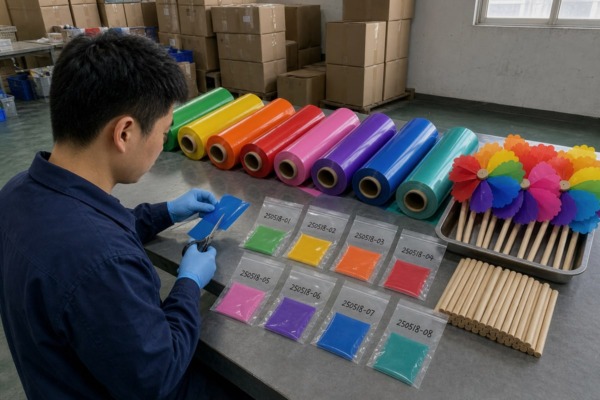
化学风险隐藏在风车最漂亮的部分。我们的八瓣彩虹设计使用绿色、黄色、橙色、红色、粉色、紫色、蓝色和青色薄膜,并带有白色条纹印刷。每一种颜色都是单独的颜料,每一种颜料都是单独的化学问题。这就是为什么批次级测试比单一金样报告更重要。供应商可能在一月通过测试,却在六月悄悄改用更便宜的油墨。我们通过将颜料来源锁定在采购合同中,并在任何颜色或树脂变更时重新测试来控制这一点。
每项测试涵盖的内容
| 测试 | 筛查内容 | 在风车上的适用位置 |
|---|---|---|
| 总铅(基材) | 基础塑料或木材中的铅 | 叶片、轮毂、木杆 |
| 总铅(涂层) | 油漆和表面油墨中的铅 | 印刷条纹、涂漆木杆 |
| 邻苯二甲酸酯 | 软PVC部件中的增塑剂 | 柔性叶片、握把、盖子 |
| 重金属迁移 | Elements that leach when mouthed | All accessible surfaces |
Practical steps for a buyer
You do not need your own lab. You need a sampling plan. Pull random units from the actual production run, not from a prepared sample box. Send them to an accredited lab yourself, or hire a third-party inspector to draw the samples. Also ask the factory which parts are coated wood versus raw wood. Our natural dowel sticks ship unpainted for exactly this reason: raw, smooth wood removes an entire coating-related risk category. Finally, put non-toxic materials into the product spec sheet in writing. A verbal promise about ink safety is worth nothing at customs.
为避免小零件造成窒息危险,我应该要求哪些QC检查?
One recall report changed how our QC team works. A toy pinwheel was pulled from shelves because its fastener cap could detach, creating a choking hazard for toddlers.
对每个盖子、轮毂、垫圈和珠子使用小零件圆柱体进行窒息危险评估,并对每个紧固件进行扭矩和张力测试。任何在标准拉力下脱落的部件均不符合三岁以下儿童的QC标准。
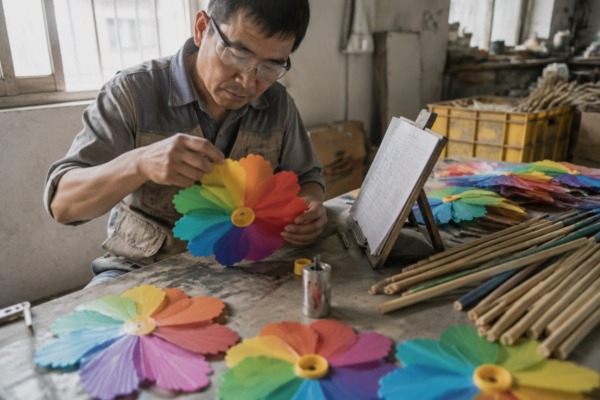
The recalled pinwheel I mentioned was dangerous to children up to 36 months, and the flaw was one tiny cap. That detail shaped our entire inspection routine, and it aligns with a check I insist on personally: look for sharp corners and small parts that can fall off, then confirm the product meets CPSC children's toy safety standards, so kids face no swallowing or cutting risk. Here is the five-step protocol I ask every buyer to write into their QC instructions.
The five-step small-parts protocol
- 检查项 the age grading first. Confirm the packaging carries age-appropriate labeling and a small-parts warning if the pinwheel is not suitable for under-3s. A wrong label is a compliance failure even if the toy itself is solid.
- Tug every cap, hub, grommet, and decorative end by hand, then with a calibrated gauge. The torque and tension test simulates a determined toddler. On our lines, the yellow hub grommets get pulled on every sampled unit.
- Spin the wheel. A stiff pinwheel tempts children to twist and yank on the weakest joint, so free rotation is itself a safety feature.
- Inspect any part that came loose against the small parts cylinder. If it fits fully inside the cylinder, it is a choking hazard for young children, full stop.
- Retest after a simulated-use cycle. Repeated play loosens fasteners, so we re-run the tug test on units that have been spun and handled.
Ask your inspector to sample across cartons, not just the top layer. Loose caps cluster in specific production shifts, and random sampling is how you catch them.
我如何确保风车棍和边缘不会伤害儿童?
There is a real trade-off between a stiff stick and a safe one. A hard dowel spins beautifully in the wind, but a snapped end can become a sharp spear.
根据 ASTM F963 通过锐边测试和锐尖测试确保棍棒和边缘安全,圆头或加帽的销钉端部,光滑无毛刺的模切刀片边缘,完全封闭的销钉,以及确认棍棒弯曲或变钝而非碎裂的弯曲测试。
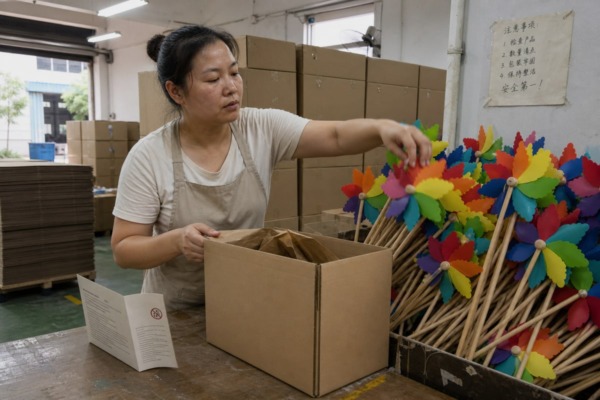
Puncture and cut hazards behave differently depending on how the pinwheel was built. A store-bought toy usually hides its pin inside an enclosed hub. A DIY craft kit, like the assembly sets we produce with die-cut petals, a pin tool, and grommets, exposes the sharp element during assembly. The tests must match the type.
| 类型 | Main risk | Best test | Best fit |
|---|---|---|---|
| Store-bought toy pinwheel | Detachable small parts | Tug test, cylinder check, label check | Older toddlers and kids, fully intact units |
| DIY kit with pin or brad | Exposed sharp point, loosening over time | Sharp point test, spin test, retest after use | School-age kids with adult assembly |
| Pin-free DIY design | Lower injury risk, loose parts remain possible | Detachment and edge check | Ages 2–5 with supervision |
Testing the stick
Run a fingertip pass along the full dowel length. Any splinter, crack, or rough saw-cut end is a reject. We sand and round both ends of our natural wooden dowels, and we flex-test samples from each lot to confirm the wood bends or blunts rather than shattering into a point. For toddler-market orders, ask whether the factory can cap the handle end.
Testing the edges
Sharp edge testing should cover every accessible blade edge. Die-cut plastic film can leave micro-burrs when the cutting die wears down, so we replace dies on a fixed schedule. Also confirm the pin tip in the hub cannot be reached by a child's finger from any angle, before and after 100 spins. For DIY kits sold to families with very young children, recommend pin-free builds using glue dots or pipe cleaners, and keep adult-only assembly instructions printed on the packaging.
结论
Pinwheel safety fails at the smallest component. Verify standards, test materials, pull every cap, and check every edge. Test the exact product in hand, never the category name.
脚注
1. Comprehensive overview of international toy safety regulations and the history of safety standards. ↩︎
2. Official CPSC guidance on the mandatory certification required for children’s products imported into the United States. ↩︎
更多文章
你可能也会觉得这些有帮助。
如何远程验证锻铁插入式组件工厂的生产能力?
Learn how to test pinwheel safety for children with expert checks on CPSC standards, small parts, lead content,…
阅读更多 →
采购锻铁嵌件时如何评估工厂的生产能力?
Learn how to test pinwheel safety for children with expert checks on CPSC standards, small parts, lead content,…
阅读更多 →
应该向锻铁嵌件供应商提出哪些问题以尽早识别不可靠的供应商?
Learn how to test pinwheel safety for children with expert checks on CPSC standards, small parts, lead content,…
阅读更多 → English
 Spanish
 German
 Arabic
 Chinese