What Fire Retardant Certifications Should I Check When Buying Pinwheels?

Fire retardant certifications for pinwheels are easy to fake and easy to miss. On our Zhejiang production line, one wrong certificate can strand an entire container at US customs.
Check five things when buying pinwheels: CPSC flammability compliance for toys, NFPA 701 for film or paper blades, UL 94 V-0 for plastic parts, EN 71-2 for EU toy sales, and California Title 19 or ASTM E84 for public venue displays. Match certificates to your exact SKU.
Here is the problem in plain terms. There is no single universal “fire retardant” certificate. It is a family of standards. Each one tests a different material for a different use. A paper pinwheel, a mylar pinwheel, and a molded plastic pinwheel all answer to different rules. In the sections below, I will walk you through which standards apply, how to spot fake documents, and exactly what to demand before you wire a deposit.
Which fire retardant certifications are required for pinwheels sold in the US market?
Last spring, a procurement manager in Texas messaged us on WhatsApp: her customs broker had flagged a pinwheel shipment for missing flammability paperwork. That conversation reshaped how we document everything.
For the US market, pinwheels sold as toys must comply with CPSC flammability rules under 16 CFR 1500.44. Decorative pinwheels for public venues typically need NFPA 701 testing, California Title 19 registration, or ASTM E84 Class A ratings, while plastic blades should carry UL 94 V-0 documentation.
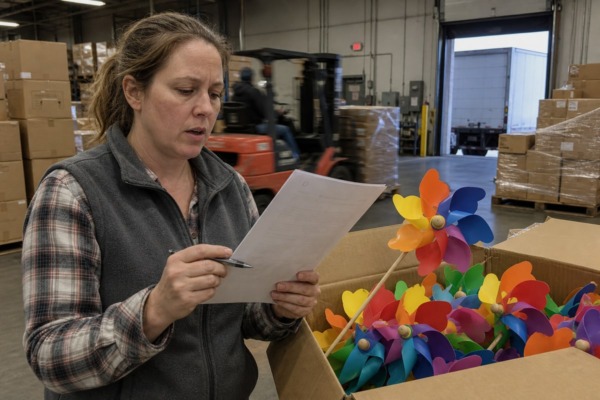
The US market does not treat all pinwheels the same way. Classification decides everything. Our team learned this rule the practical way: children's products in the US point to CPSC, and party decorations point to fire retardant and flame resistance requirements. So the first step is always to confirm which category your pinwheels fall into, then confirm the matching certifications are complete.
Start With How the Pinwheel Is Classified
If your pinwheel is marketed to children — like our rainbow flower-petal garden pinwheels on wooden dowels — it is a toy under CPSC jurisdiction. Flammability testing for toys falls under 16 CFR 1500.44 1, which screens out dangerously flammable solids. It does not "certify" flame resistance. It simply blocks the worst materials from the shelf.
If your pinwheels sell as party or event decor, venue rules take over. Public assembly safety codes care about documented compliance, not marketing labels. That is where NFPA 701, California Title 19, ASTM E84, and even local Fire Marshal approval come into play.
Standards That Apply by Use Case
| Standard | What It Tests | When It Applies to Pinwheels |
|---|---|---|
| NFPA 701 (Method 1) | Flame propagation of textiles and films | Mylar or film blades sold as decoration |
| California Title 19 | State Fire Marshal-registered treatments | Decor in California venues; respected by inspectors nationwide |
| ASTM E84 / UL 723 | Surface burning and smoke density | Panel-mounted displays; Class A is the top rating |
| UL 94 V-0 | Self-extinguishing behavior of plastics | Molded plastic blades, hubs, and grommets |
| FDNY flame-resistant rules | Treated decorations in NYC occupancies | Event decor in New York City buildings |
For buyers supplying hotels, schools, or retail chains, commercial grade decor with a Title 19 registration is the safest bet. Inspectors across the country treat it as the gold standard.
How do I verify a supplier's fire retardant certification documents are authentic?
A film supplier once sent our QC team a flame test report with a lab logo that looked slightly off. One phone call confirmed the report was fabricated.
Verify authenticity by matching the report's SKU, material description, and photos to your exact product, confirming the lab's accreditation through ILAC or CPSC-accepted lab lists, contacting the lab directly with the report number, and checking issue dates against the current material formulation.

That incident changed our sourcing process permanently. Now we verify every raw material report before it enters our factory, and we encourage our distributors to run the same checks on us. Trust is good. Verification is better. Here is the five-step process we recommend to every procurement manager.
A Five-Step Verification Process
- Match the paperwork to the product. The report must name the exact product, SKU, material, thickness, and coating. A certificate for a "similar" pinwheel is not a certificate for your pinwheel. A change in film thickness or coating formulation can void the result.
- Check the lab's accreditation. Look for ILAC MRA membership, A2LA, or CNAS accreditation. For children's products, the CPSC publishes a list of accepted third-party labs 3. If the lab is not on it, the toy report carries no legal weight.
- Contact the lab directly. Every genuine report has a report number. Email or call the lab and ask them to confirm it. Legitimate labs answer this question every day.
- Check the dates. Flammability testing reflects the formulation at the time of testing. If the supplier changed film vendors last year, an old report may no longer describe the product you are buying.
- Look up Title 19 registrations. California's State Fire Marshal maintains a searchable registry of approved flame-retardant chemicals and treated fabrics. Fire Marshal approval you can look up yourself beats any PDF a supplier emails you.
Red Flags Our QC Team Watches For
| Red Flag | Why It Matters |
|---|---|
| Certificate covers a "product family," not your SKU | Substrate or coating changes can invalidate results |
| No report number or lab contact details | The document cannot be independently verified |
| Test date older than the current formulation | The tested material may no longer match production |
| Blurry or edited lab logos and stamps | A common signature of forged documents |
| One-page certificate with no full report behind it | Full reports contain raw data that is hard to fake |
What testing standards like CPSC or EN71 apply to pinwheel materials?
Choosing between mylar film and molded plastic blades is a trade-off we weigh on every OEM project, because each material answers to a completely different flammability standard.
CPSC flammability rules under 16 CFR 1500.44 apply to pinwheels sold as US toys, while EN 71-2 governs flame spread for EU toys. Material-specific standards include NFPA 701 for films, UL 94 V-0 for plastics, and CPAI-84 for outdoor synthetic fabrics.

Our garden pinwheels combine several materials in one small product: film or plastic petals, a plastic hub, yellow grommets, a metal pin, and a wooden dowel. Each component can trigger a different test. That is why "Is it fire retardant?" is the wrong question. The right question is: certified to what standard, for which material, by whom, and for what end use?
Matching Each Component to Its Standard
| Pinwheel Component | Typical Material | Relevant Standard |
|---|---|---|
| Petal blades | Mylar/PET film or paper | NFPA 701 Method 1; 16 CFR 1500.44 if sold as a toy |
| Blades or hub | Molded plastic | UL 94 V-0 for self-extinguishing properties |
| Shaft | Wooden dowel | Low risk alone; ASTM E84 for panel installations |
| Fabric versions | Coated textile | California Title 19 treated-fabric registration |
| Outdoor synthetics | Outdoor-rated fabric | CPAI-84 ember and open-flame resistance |
CPSC Versus EN 71-2: Two Different Philosophies
The two toy regimes measure different things. CPSC's 16 CFR 1500.44 screens whether a solid burns dangerously fast. EN 71-2, mandatory for EU toy sales 4, regulates the rate of flame spread specifically so a child has time to drop the item before injury. A pinwheel can pass one and still fail the other. If Olivia in the US and a sub-distributor in Germany buy the same SKU from you, we run both tests. European venue buyers may also ask about a B1 fire rating under German classification, which sits outside the toy rules entirely.
Outdoor Use Changes the Chemistry
Some buyers assume any treated product stays protected forever. It does not. Many topical fire retardants are water-soluble and wash away in rain. Solar radiation also degrades standard treatments over time. For permanent garden or storefront displays, ask for UV-stabilized treatments or inherently flame resistant materials with leach-resistant chemistry. Modern compliance also favors halogen-free, phosphorus-based retardants over older brominated compounds like PBDEs, which supports REACH compliance and reduces toxic smoke risk.
Can I request fire retardant test reports before placing a bulk pinwheel order?
Early in our export business, we learned that sharing test reports upfront closes deals faster than any price discount. Serious buyers always ask; serious suppliers always answer.
Yes, reputable suppliers will provide fire retardant test reports before a bulk order. Request the full report naming the standard, the accredited lab, your exact SKU and material, testing dates, and any thickness or coating limits. Refuse suppliers who only offer a one-page certificate.
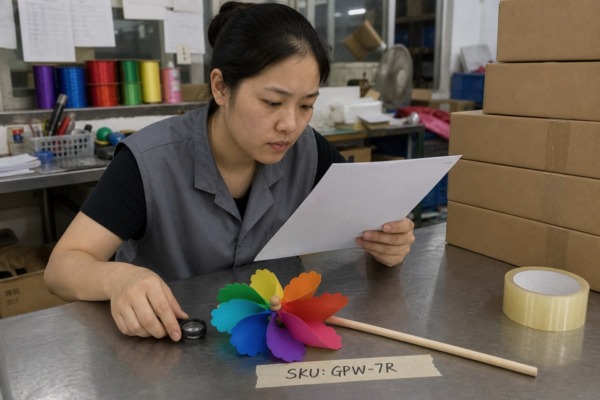
You have every right to see documentation before committing to a container. When distributors ask us, we send existing reports within a day or two. If a custom OEM design uses a new film or coating, we quote fresh third-party testing, and we tell buyers honestly that new flammability testing takes several weeks. Building that into the production timeline beats discovering a gap at customs.
What to Request, Exactly
Send your supplier this checklist before the deposit:
- Which fire standard was tested: NFPA 701, UL 94, ASTM E84, EN 71-2, or CPSC 16 CFR 1500.44?
- Is the certificate for my exact SKU, or only a similar product line?
- Was the item tested after treatment, or only the raw material?
- Is the test lab accredited, and can I contact it to confirm the report number?
- Are there limits on thickness, coating, or substrate stated in the report?
- Will my customer install these in a public venue with separate local fire codes?
Special Cases That Need Extra Paperwork
If your end customers install pinwheels in schools, hotels, or auditoriums, ask for a Certificate of Flame Resistance that venue inspectors can file. And think about density. A single certified pinwheel behaves differently from a "pinwheel wall" of hundreds packed together. Grouped items raise the cumulative fuel load, and the stack effect can turn many small safe items into one large hazard. For high-density displays, ask whether any system-level fire testing exists, not just per-unit certificates. We flag this to every event-decor buyer, because individual fire retardant certifications alone may not satisfy an inspector reviewing a dense installation.
Conclusion
Fire retardant certifications for pinwheels only protect you when the standard, the lab, and the exact SKU all match. Demand full reports before ordering, and never settle for a label.
Footnotes
1. Official government electronic code for the flammability testing standard for solids. ↩︎
2. California State Fire Marshal’s official page for flame-retardant registration and Title 19 compliance. ↩︎
3. CPSC database for verifying accredited third-party laboratories for product safety testing. ↩︎
4. Wikipedia overview of the EN 71 safety standards for toys sold in the EU. ↩︎
More Articles
You might also find these helpful.

Wie überprüfe ich die Echtheit von Prüfberichten beim Kauf von Windturbinen?
Learn which fire retardant certifications (CPSC, NFPA 701, UL 94, EN 71-2) to verify before buying pinwheels, so…
Read More →
Wie kann ich prüfen, ob Windrad-/Windmühlenmaterialien schädliche Chemikalien enthalten?
Learn which fire retardant certifications (CPSC, NFPA 701, UL 94, EN 71-2) to verify before buying pinwheels, so…
Read More →
How Can I Tell If a Supplier's Quote Includes Certification Fees?
Learn which fire retardant certifications (CPSC, NFPA 701, UL 94, EN 71-2) to verify before buying pinwheels, so…
Read More → English
  Spanish
  German
  Arabic