How to Create a Windmill Procurement Checklist to Avoid Missing Key Steps?
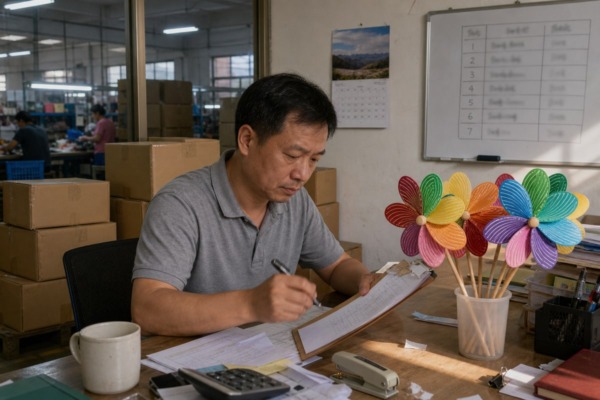
Our Zhejiang production line ships windmills worldwide, yet buyers still lose entire selling seasons over one skipped step. A solid windmill procurement checklist prevents exactly that pain.
Um eine Checkliste für die Beschaffung von Windmühlen zu erstellen, organisieren Sie Aufgaben in sieben Module – Produktspezifikationen, Kosten, Qualität, Lieferzeit, Konformität, Logistik und Kundendienst – und weisen Sie dann jedem Punkt einen Verantwortlichen, erforderliche Nachweise und ein Fälligkeitsdatum zu, und haken Sie jede Zeile ab, bevor Sie die Bestellung freigeben.
That sounds simple on paper. In practice, most order failures trace back to a line that nobody wrote down. In this article, I will walk you through each part of the checklist. I will show you what to include, how to verify quality, which logistics details matter, and how to lock down customization. You can adapt every step to your own orders.
Was sollte ich in meine Checkliste für die Beschaffung von Windmühlen aufnehmen, um wichtige Schritte nicht zu übersehen?
A buyer in Ohio once sent me a photo of her previous supplier's container: thousands of windmills with stakes too short for retail displays. One missing checklist line caused that.
Sieben Module umfassen: Produktspezifikationen und Materialien, Gesamtkostenaufschlüsselung, Qualitätsstandards und Inspektionspläne, bestätigte Lieferzeiten, behördliche Konformität, Logistik- und Verpackungsdetails sowie Bedingungen nach dem Verkauf. Fügen Sie jeder Zeile einen Verantwortlichen, erforderliche Nachweise und eine Frist hinzu, damit nichts durchrutscht.
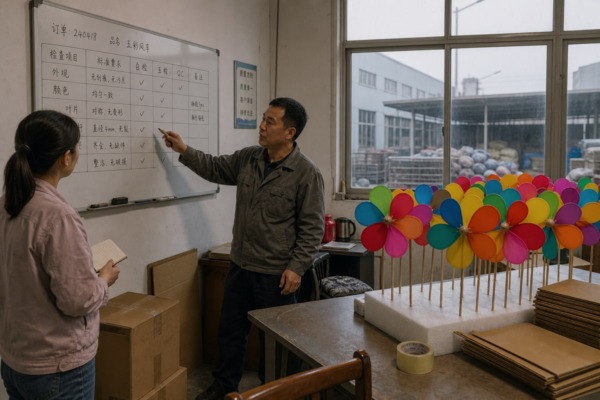
The biggest mistake I see is timing. Buyers build their checklist after they pick a supplier. That is backwards. The checklist should exist before you send a single inquiry, because it shapes the questions you ask. Procurement is not just a buying exercise. It is a risk-control process for technical fit, compliance, lifecycle cost, and long-term supportability.
Build It Around Seven Modules
In my own factory workflow 1, we mirror the same seven modules our buyers use. Here is the framework I recommend, with the risk you take if you skip each one.
| Module | Key items to check | Risk if skipped |
|---|---|---|
| Produkt | Blade material, petal count, dowel length, hub type, spin performance | Wrong product arrives; returns pile up |
| Kosten | Unit price, tooling, packaging, freight, duties | Budget overruns discovered too late |
| Quality | Inspection standards, sampling plans, defect definitions | Disputes with no agreed benchmark |
| Vorlaufzeit | Production days, sample time, booking cut-offs | Missed selling season |
| Compliance | Safety standards for your market, labeling rules | Goods held at customs |
| Logistics | Incoterms, carton specs, container plan | Shipping delays and damage |
| After-sales | Replacement terms, claim windows, spare parts | No remedy when problems appear |
Give every line an owner, required evidence, and a due date. A checklist without evidence columns is just a wish list.
Scale the Checklist to Your Project
One objection I hear often: a generic template cannot fit every project. That is true, and it is why the modules stay fixed while the line items change. A decorative garden windmill order and a power-generating turbine project use the same skeleton with very different flesh.
| Module | Decorative windmill order | Utility-scale wind project |
|---|---|---|
| Technical fit | Spec sheet and sample approval | Wind resource assessment and turbine class verification |
| Compliance | Market safety and labeling rules | Grid interconnection requirements and grid code compliance |
| Kosten | Landed cost per unit | Life cycle cost analysis including Balance of Plant |
| After-sales | Replacement stock terms | Operations and maintenance (O&M) strategy with availability guarantees |
The lesson scales both ways. Even for a container of garden pinwheels, think in lifecycle terms, not just unit price.
Wie überprüfe ich den Qualitätskontrollprozess eines Lieferanten, bevor ich meine Windmühlen-Bestellung aufgebe?
On our inspection line in Zhejiang, every petal blade batch passes a spin test and a color check before assembly. Most buyers never ask how we run those checks.
Verifizieren Sie die Qualitätskontrolle eines Lieferanten, indem Sie deren Inspektionsablauf-Dokumente anfordern, Eingangsmaterialprüfungen überprüfen, nach AQL-Stichprobenstandards fragen, frühere Prüfberichte Dritter untersuchen, Vorserienmuster bestellen und bestätigen, dass Sie vor der Schlusszahlung eine unabhängige Vorversandkontrolle beauftragen können.
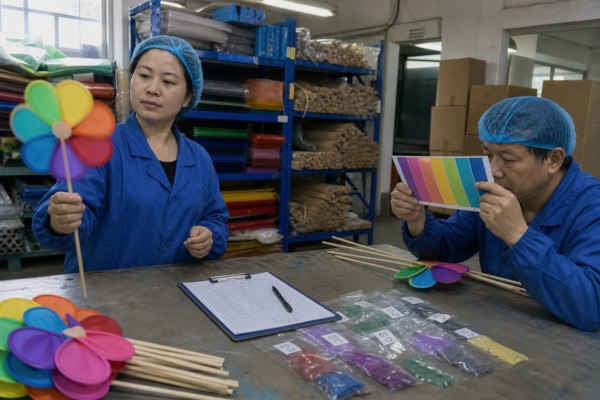
Quality claims are cheap. Evidence is not. When a new distributor evaluates our factory, the serious ones always follow the same pattern: they ask for documents first, samples second, and independent inspection 2 third. That order works, and I recommend it to every buyer, even the ones who never buy from us.
Start with Supplier Pre-Qualification Criteria
Before you discuss price, run the supplier through basic pre-qualification criteria. Ask how long they have produced windmills specifically, not decorations in general. Ask for reference orders shipped to your market. This mirrors advice from the utility-scale wind world: audit real fleet performance data instead of trusting marketing power curves. For decorative windmills, the equivalent rule is simple. Trust real production samples 3 and shipment records, not catalog renders. If you are buying power-generating machines instead, replace toy-market paperwork with IEC 61400 compliance certificates and full wind turbine technical specifications.
Map the Three QC Checkpoints
A trustworthy factory inspects at three points, not one. Here is what to verify at each stage.
| QC stage | What the factory should check | Evidence you should request |
|---|---|---|
| Incoming materials | Plastic film thickness, dowel straightness, colorfastness | Material inspection records, supplier certs |
| In-Prozess | Blade cutting accuracy, hub assembly, spin test | Process check sheets, defect logs |
| Vor Versand | AQL sampling, packaging drop test, carton labeling | Inspection report with photos |
Then tie the final checkpoint to money. Structure payment so the balance is due only after a passed Vorversandinspektion 4, whether by your own agent or a third-party service. A supplier who resists independent inspection is telling you something. And beware the lowest-price objection here: a cheaper factory that skips incoming-material checks will cost you more in returns than you saved on unit price.
What logistics details should I confirm to prevent shipping delays on my windmill shipments?
Every peak season, I weigh the same trade-off with clients: cheaper sea freight with tight cut-off dates, or costly air freight that rescues a late spring launch.
Confirm production lead time, booking cut-off dates, Incoterms, carton dimensions and weights, container loading plans, port congestion risks, customs documentation, HS codes, and the consignee's receiving requirements. Build buffer time into the schedule and agree on penalty or remedy terms for late shipments.
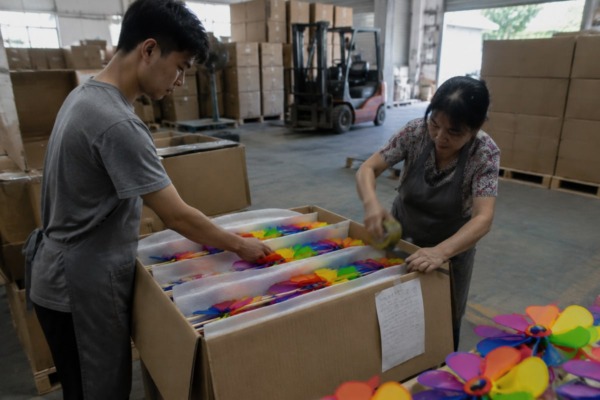
Shipping delays are the number one pain point our US and European buyers mention, and most delays are preventable. They come from small unconfirmed details, not from storms or strikes. In our export experience across the United States, South America, and Europe, the shipments that arrive on time are the ones where every logistics line was confirmed in writing before production even started.
Confirm These Details Before You Book
| Checkpoint | Zu stellende Frage | When to confirm |
|---|---|---|
| Vorlaufzeit | How many production days after deposit? | Before the PO |
| Cut-off dates | When must goods reach the port for the target vessel? | At order placement |
| Incoterms | FOB, CIF, or DDP — who owns which risk? | In the contract |
| Carton specs | Dimensions, weight, units per carton? | Before packaging design |
| Container plan | How many cartons fit a 40HQ? Any wasted space? | Two weeks before loading |
| Documents | Invoice, packing list, certificates, HS codes ready? | One week before departure |
Windmills and pinwheel strings are light but bulky, so container space planning matters more than weight. A smart carton design can cut your freight cost per unit noticeably.
Packaging That Survives the Journey
Damaged packaging causes returns, and returns destroy distributor margins. Ask your supplier for a packaging drop test before shipment. Confirm inner protection for the wooden dowels, which snap when cartons are stacked badly. Specify carton strength in writing.
For contrast, utility-scale buyers face heavy-haul logistics planning: bridge clearances, port-to-site road permits, and specialized transport for oversized blades and nacelles, plus Balance of Plant (BoP) items like crane pads and laydown areas. Your decorative windmill order is simpler, but the principle is identical. Map the physical journey early, and confirm the receiving end can actually accept what you ship.
How can I make sure my customization requirements are covered when sourcing windmills from a new supplier?
Early in our OEM work, we learned a hard lesson: a verbal color agreement produced pinwheels two shades off the client's brand purple. Now everything gets documented.
Cover customization by documenting a full specification sheet, approving physical pre-production samples, signing off Pantone colors and artwork files, defining tolerance ranges, locking packaging and labeling requirements in writing, and adding the approved sample as a quality reference in your purchase contract.
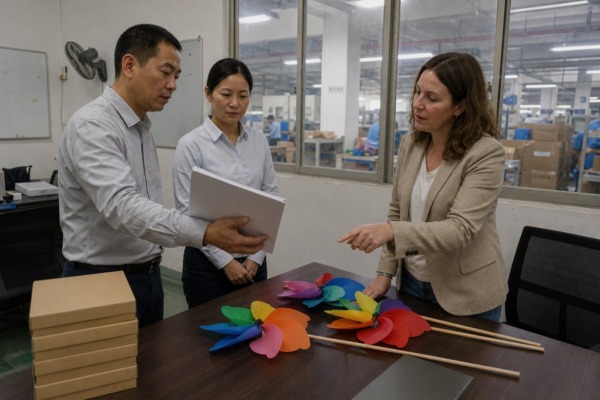
Customization is where new supplier relationships succeed or collapse. Our ODM team develops new petal shapes, rainbow gradients, and print patterns with brands every season, and the smooth projects all follow the same disciplined sequence. Here is the process I recommend to any procurement manager working with a new windmill supplier.
- Write the specification sheet first. Cover blade material, petal count and shape, gradient colors, dowel length and finish, hub type, and assembly method. For a DIY kit version, list every component: dowel, pin tool, die-cut petals, and grommets. Vague specs invite supplier interpretation.
- Request digital proofs, then physical samples. A render confirms design intent. Only a physical pre-production sample confirms spin performance, color accuracy, and material feel. Never approve production from images alone.
- Define tolerances in numbers. Acceptable color deviation, dowel length variance, and blade alignment should all have measurable limits. Tolerances turn subjective arguments into objective checks.
- Lock packaging and labeling. Custom retail packaging, barcodes, and market-required warnings belong in the same approval loop as the product itself.
- Seal a golden sample. Both sides keep an identical signed sample. Your contract should name it as the quality benchmark for mass production.
- Involve your technical people. Procurement teams that exclude design and operations colleagues write incomplete specs. Large wind projects solve this with detailed EPC contract terms; for decorative windmill orders, a sample-sealed OEM agreement does the same job at smaller scale.
One warning about speed. Rushing a new supplier to skip sampling saves two weeks and risks the whole order. In my experience, buyers who invest in one extra sample round almost never face customization disputes later.
Fazit
A windmill procurement checklist turns risky guesswork into a controlled process. Cover the seven modules, verify quality, lock logistics, and document customization. Miss nothing, and every order lands on time.
Fußnoten
1. NIST provides institutional guidance on manufacturing workflows and operational excellence. ↩︎
2. The WTO oversees international trade agreements, including those related to pre-shipment inspection. ↩︎
3. ISO provides international standards for quality management and production consistency. ↩︎
4. The WCO provides standards for customs procedures and inspection protocols for international trade. ↩︎
Weitere Artikel
Diese könnten Ihnen auch helfen.
Wie kann man die Produktionskapazitäten einer Fabrik für Schmiedeeisen-Steckkomponenten aus der Ferne überprüfen?
Build a windmill procurement checklist with seven key modules covering specs, cost, and compliance, plus owners and deadlines…
Weiterlesen →
Wie beurteilt man die Produktionskapazität einer Fabrik bei der Beschaffung von Schmiedeeisen-Einsätzen?
Build a windmill procurement checklist with seven key modules covering specs, cost, and compliance, plus owners and deadlines…
Weiterlesen →
Welche Fragen sollten Sie Schmiedeeisen-Einsatz-Lieferanten stellen, um unzuverlässige frühzeitig zu erkennen?
Build a windmill procurement checklist with seven key modules covering specs, cost, and compliance, plus owners and deadlines…
Weiterlesen → English
  Spanish
  German
  Arabic