How to Confirm a Wind Spinner Supplier Knows US Retail Inspection Standards?

Last year, a US buyer rejected a full container because her wind spinner supplier missed labeling rules. On our Zhejiang pinwheel line, we see that risk every export season.
Para confirmar que un proveedor de molinetes de viento conoce los estándares de inspección minorista de EE. UU., solicite documentos de cumplimiento como un Certificado General de Conformidad, revise su proceso de inspección previa al envío basado en AQL, haga preguntas específicas sobre auditorías de fábrica y pruebe muestras contra estándares de niebla salina, UV, caída y químicos antes de hacer un pedido al por mayor.
That single sentence covers a lot of ground. The details matter, though. A supplier can look professional on a video call and still fail your retailer’s inspection. In my experience, the only reliable proof is written documents, a visible process, and tested samples. The four acceptance areas US retailers actually check are packaging, labeling, appearance, and safety. This article walks through each verification step so you can approve a supplier with confidence, not hope.
¿Qué certificaciones debo pedirle a mi proveedor de molinetes de viento para demostrar el cumplimiento en EE. UU.?
A procurement manager in Texas once messaged me one line: send your GCC first. Her previous vendor had no paperwork, and her retailer refused the goods.
Solicite un Certificado General de Conformidad para molinetes de viento que no son para niños, informes de pruebas de laboratorio de terceros para las sustancias químicas de la Proposición 65 de California, certificación ASTM F963 si el producto está dirigido a niños, certificados de pruebas de niebla salina y UV, y prueba de que el proveedor se está preparando para la presentación electrónica ante la CPSC en 2026.

Some buyers push back here. They say a small garden decoration does not need heavy compliance scrutiny. I understand the instinct, but it is wrong. CPSC staff are authorized to enter retail stores during normal business hours and review books and records. If your supplier cannot produce documentation, that exposure lands on you, not the factory. Weak paperwork on a simple item still creates chargebacks, returns, and compliance disputes.
The Core Document: GCC vs. CPC
Most wind spinners are non-children's consumer products. That means the baseline is CPSC compliance and a General Certificate of Conformity. But your supplier must know when the line shifts. Our pinwheel kits with small grommets and pin assemblies can be marketed as children's crafts. The moment a product targets kids twelve and under, ASTM F963 safety standards apply, and a Certificado de Producto Infantil 1 replaces the GCC. A supplier who cannot explain this difference is guessing.
Chemical and Coating Paperwork
Chemical documentation is the second layer. California Prop 65 covers lead, cadmium, and phthalates 2, and knowledgeable suppliers test proactively rather than waiting for a demand letter. Lead and phthalate content reports from an accredited lab carry far more weight than a factory's own claim.
| Documento | Applies To | Qué demuestra |
|---|---|---|
| Certificado General de Conformidad | Non-children's wind spinners | Meets applicable US consumer product safety rules |
| Certificado de Producto Infantil | Kid-targeted pinwheel kits | ASTM F963 and CPSC children's requirements |
| Prop 65 test report | All items sold into California | Lead, cadmium, and phthalates below limits |
| PFAS screening report | Coated or water-resistant finishes | Meets 2025–2026 Amazon and Walmart mandates |
| Salt spray and UV certificates | Metal and coated components | Outdoor durability claims are real |
Two trends matter for the next contract cycle. First, PFAS-free coating verification 3 is becoming a requirement under new 2025–2026 mandates from major US retailers. Second, CPSC's mandatory eFiling 4 of compliance certificates for US Customs entry starts in 2026. When we prepared our own digital certificate library, several US buyers told us that alone separated us from competing quotes. Ask your supplier whether certificates are available on a dedicated webpage, because digital access is now the expectation, not paper files.
¿Cómo puedo verificar que el proceso de control de calidad de mi proveedor cumple con los estándares de seguridad del comercio minorista de EE. UU.?
Our final inspection room in Zhejiang keeps a defect library with photos of every failure mode we have logged since we began exporting pinwheels to the US.
Verifique el proceso de QC solicitando un SOP de inspección por escrito, informes recientes de inspección previa al envío utilizando muestreo AQL bajo ISO 2859-1, registros de clasificación de defectos que se dividen en defectos críticos, mayores y menores, archivos de trazabilidad de lotes e informes de acciones correctivas que muestren cómo se aislaron los productos no conformes.
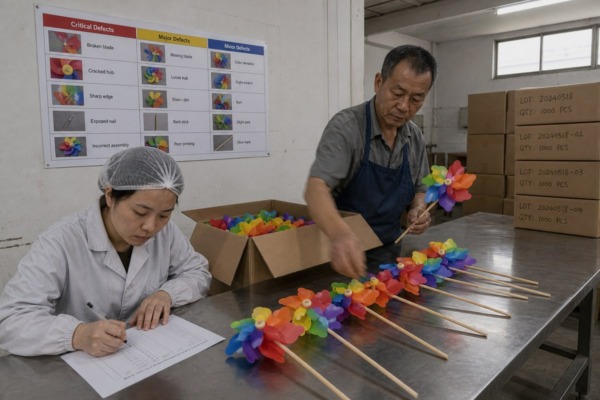
Here is a distinction I explain to every new buyer. Compliance testing, factory QC, and pre-shipment inspection are three different things. Compliance testing proves the product is legally saleable. Factory QC catches defects during production. Pre-shipment inspection confirms the finished lot matches your specification before it leaves. A supplier can be strong at one and weak at another. You need evidence of all three, because that is what US retail inspection standards actually demand.
Some suppliers will tell you inspection means a visual check before packing. That claim is a red flag by itself. Retail readiness requires defined criteria, statistical sampling, documentation, and traceability. A glance at the product satisfies none of those.
How AQL Sampling Levels Work for Wind Spinners
Credible sampling follows ISO 2859-1. The inspector pulls a defined number of units from each lot based on lot size and the chosen AQL sampling levels 5. Then every defect found gets classified. Here is how we classify defects on our own pinwheel and wind spinner lines:
| Clase de defecto | Wind Spinner Examples | Typical Handling |
|---|---|---|
| Crítico | Sharp exposed pin points, coating flaking into loose fragments, banned chemical content | Zero tolerance; lot held immediately |
| Mayor | Blades that fail to spin, cracked petals, wrong labeling, off-color gradients | Lot rejected above the acceptance limit |
| Menor | Small print smudges, slight dowel color variation, minor packaging scuffs | Accepted within a defined limit |
Ask what happens when defects exceed the acceptance number. The right answer involves isolating the lot, a documented corrective action report, rework, and re-inspection. Ask which records are retained and for how long. In our factory, incoming material inspection records, lot traceability files, and inspection reports stay linked to each production lot. If a supplier cannot show these records, the honest conclusion is that the inspection system does not exist.
¿Qué preguntas debo hacer durante una auditoría de fábrica para confirmar el conocimiento de inspección?
Years ago, an auditor stumped our team with a single question about sampling plans. That awkward moment taught us what real inspection knowledge sounds like.
During a factory audit, ask which US standards apply to the wind spinner, what sampling plan approves shipments, how defects are classified and handled, who signs final release, whether third-party lab testing is used, and request a recent inspection report and corrective action record.

An audit is not about catching people. It is about listening for fluency. A supplier who truly knows US retail inspection standards answers in specifics. A supplier who is improvising answers in generalities. Here are the ten questions I would ask, in the order I would ask them:
- What US standards or retailer requirements apply to this specific wind spinner?
- Can you provide the certificate of conformity or equivalent compliance paperwork right now?
- What inspection stages do you run: incoming, in-process, final, and pre-shipment?
- What are your critical checkpoints for balance, finish, welds, moving parts, and packaging?
- What sampling plan do you use for shipment approval?
- How do you classify major, minor, and critical defects?
- What happens when defects exceed the acceptance limit?
- Can you share a recent inspection report and a corrective action record?
- Who signs off on final release, and what training does that person have?
- Do you use a third-party lab, or in-house inspection only?
Some buyers argue that price and lead time should decide the order. I compete on budget-friendly pricing myself, so I understand the pull. But cheap sourcing with weak inspection competence usually costs more later through chargebacks, product returns, and damaged-goods claims. The audit is where you find that out before the deposit, not after.
Red Flags That Reveal an Improvising Supplier
| Señal de alerta | What It Usually Means |
|---|---|
| No written inspection SOP | Quality depends on individual workers, not a system |
| Cannot name a sampling standard | Pre-shipment inspection is informal or skipped |
| No defect library or photos | Defect criteria change from lot to lot |
| Refuses to share a factory audit report | Something in the process will not survive scrutiny |
| No calibration or training records | Measurements and judgments are unverifiable |
Turn these answers into a simple approval scorecard. Score documents, process, traceability, and responsiveness separately. US retailers are already moving this direction, with multi-tier supplier mapping, certificate management, and even AI-based document validation replacing verbal assurances. Your scorecard should do the same: trust records, not promises.
How Do I Test Sample Products to Ensure They Pass US Retail Standards Before Bulk Ordering?
Every sample run forces a trade-off on our line: ship the prototype fast, or hold it a week for full testing. We now always choose the testing.
Test samples with ASTM B117 salt spray for 48 to 96 hours, Xenon arc UV stability tests, ISTA 3A or ISTA 6-Amazon drop testing, lead and phthalate content screening, plus performance checks for start-up wind speed under 3 mph and structural survival at 50 mph.

A sample that looks perfect on your desk proves very little. Our rainbow-gradient pinwheels have eight petal blades in thin plastic film mounted on a wooden dowel. They look flawless out of the box. The real questions are what happens after six months of sun, one drop in a parcel truck, and one summer storm. Sample testing answers those questions before you commit to a bulk order.
The Five Tests That Matter Most
| Test | Standard | Pass Target | Por Qué Importa |
|---|---|---|---|
| Salt spray testing | ASTM B117 | 48–96 hours, no corrosion | Metal parts and coatings face humid US coastal climates |
| UV stability test | Xenon arc exposure | No fading or cracking | High-UV US regions destroy cheap pigments fast |
| Transit drop testing | ISTA 3A or ISTA 6-Amazon | Fins and bearings intact | Small-parcel delivery is brutal on delicate blades |
| Chemical screening | Prop 65 protocols | Lead and phthalate content below limits | Protects the California market and your listings |
| Performance check | Start-up and survival wind speed | Spins below 3 mph; survives 50+ mph | US consumers expect motion in light breezes and safety in storms |
The performance metrics deserve extra attention because most suppliers skip them. Expert factories measure a specific start-up wind speed, typically under 3 mph, because a wind spinner that sits still in a light breeze generates returns. On the other end, high-velocity structural testing at 50 mph or more confirms the spinner will not shed blades or become a projectile during a storm. We balance every petal assembly on our line for exactly this reason.
Do not run only one round. Test the golden sample, then pull random units from the pilot production lot and test again. ISTA packaging standards matter here too, because damaged packaging is one of the most common complaints I hear from US procurement managers. Where possible, send samples to a third-party lab rather than relying on factory-supplied results. Independent data closes the loop between what the supplier claims and what your retailer will actually accept.
Conclusión
Confirming a wind spinner supplier knows US retail inspection standards takes four steps: verify documents, review QC processes, audit with sharp questions, and test samples. Documented quality beats promised quality.
Notas al pie
1. Official CPSC portal for mandatory certification requirements for children’s products in the US. ↩︎
2. California’s OEHHA provides the definitive list of chemicals regulated under Proposition 65. ↩︎
3. The EPA is the primary authority for regulations regarding PFAS chemicals in consumer product coatings. ↩︎
4. Official information on the new electronic filing requirements for product safety certificates at US Customs. ↩︎
5. The ISO provides the international standards for AQL-based statistical sampling used in quality control. ↩︎
Más artículos
También podrían resultarle útiles.

¿Cómo verificar remotamente las capacidades de producción de una fábrica para componentes enchufables de hierro forjado?
Ensure US retail compliance for wind spinners with proper certifications, AQL inspections, and durability testing before bulk orders…
Leer más →
¿Cómo evaluar la capacidad de producción de una fábrica al obtener insertos de hierro forjado?
Ensure US retail compliance for wind spinners with proper certifications, AQL inspections, and durability testing before bulk orders…
Leer más →
¿Qué preguntas debe hacer a los proveedores de insertos de hierro forjado para detectar a los poco fiables a tiempo?
Ensure US retail compliance for wind spinners with proper certifications, AQL inspections, and durability testing before bulk orders…
Leer más → English
  Spanish
  German
  Arabic