
Which Pinwheel Material Is Best for Your Party Supplies Company?
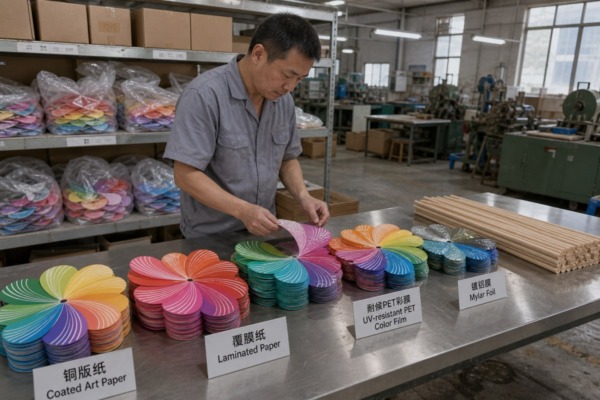
The wrong pinwheel material can sink a whole season of sales. On our production line in Zhejiang, we have watched buyers learn this the hard way: faded blades, torn petals, returns.
The best pinwheel material depends on use case: coated art paper delivers sharp custom printing at the lowest cost for indoor party supplies, while UV-resistant PET color film is best for outdoor durability. Mylar foil wins on shelf sparkle, and laminated paper offers a balanced middle ground.
That short answer hides a lot of detail. Below, I will break down each material by use case, durability, cost, branding potential, and QC survival. Let us go step by step.
How do I decide between plastic, paper, and mylar pinwheels for my party supplies inventory?
A procurement manager in Texas once messaged me on WhatsApp with a simple question: why did her paper pinwheels sell indoors but flop at every outdoor event?
Decide by matching material to end use: choose paper or cardstock for indoor decor and promotional giveaways, plastic or PET film for outdoor durability, and mylar for high-sparkle display products. Segment your inventory by scenario instead of picking one material for everything.
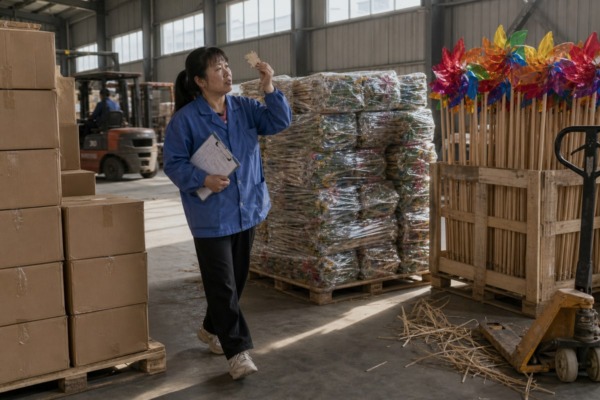
Her problem was not quality. It was mismatch. She had ordered one material for two very different retail scenarios. Here is the comparison framework I now send to every new buyer before we quote:
| Material | Best Use Case | Weakness | Typical Price Tier |
|---|---|---|---|
| Coated art paper | Indoor party decor, themed party packs | Humidity, rain, tearing | Lowest |
| Cardstock | Kids' crafts, sturdier indoor items | Still weak in wet conditions | Low |
| Laminated paper | Semi-outdoor use, light moisture | Higher cost than plain paper | Middle |
| PET color film / plastic | Outdoor event decor, garden use | Harder to position as eco-friendly | Middle-high |
| Mylar foil | Display sparkle, seasonal merchandising | Limited fine print detail | High |
| Stiffened fabric | Luxury event rentals, reusable decor | Highest cost, slower production | Premium |
Match the material to the buying moment
A standard pinwheel starts as a single square sheet folded and secured at the center. That simple structure means the sheet itself defines the product. Thin craft paper works fine for short-term promotional giveaways used once at an indoor party. Plastic and PET survive wind and repeat handling in a backyard. Mylar earns its price on a bright retail shelf, not in a goodie bag.
Raise the objections early
Some suppliers will tell you paper is always best because it is cheap and printable. Others push plastic as the only serious option because it lasts. Both views are half right. In our export experience across the US, South America, and Europe, buyers who split their line — paper indoors, film outdoors — see fewer complaints than buyers who standardize on one material. There is also the eco-friendly party supplies angle: biodegradable paper fits green branding naturally, while reusable plastic needs a "buy once, use for years" story to justify itself. Decide which story your customers actually want before you order.
Which pinwheel material gives me the best durability without increasing my per-unit cost?
Every quote we prepare starts with the same trade-off: a thicker blade survives more spins, but it also adds grams, film cost, and freight weight to every carton.
PET color film gives the best durability-to-cost ratio for pinwheels. It resists water, tearing, and UV fading, yet costs only slightly more than laminated cardstock. For strictly indoor lines, coated art paper stays cheapest; for outdoor lines, weather-resistant PET pays for itself in fewer returns.
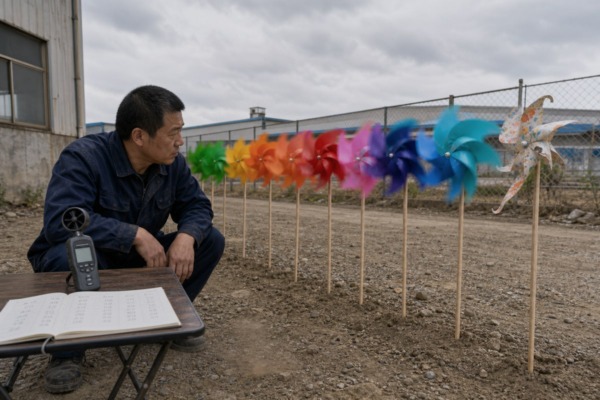
Durability is not one property. It is at least four: moisture resistance, tear strength, UV resistance, and spin performance. Each material scores differently, and the score that matters depends on where the product ends up.
The durability ladder, from weakest to strongest
| Material | Moisture | Tear Strength | UV Fading | Relative Unit Cost |
|---|---|---|---|---|
| Thin craft paper | Poor | Poor | Fades fast | 1.0x baseline |
| Cardstock | Poor to fair | Good | Fades | ~1.3x |
| Laminated paper | Good | Good | Moderate | ~1.6x |
| Polypropylene sheets | Excellent | Very good | Needs stabilizers | ~1.8x |
| UV-stabilized PET film | Excellent | Excellent | Best in class | ~2.0x |
Why spin performance changes the math
A pinwheel's rotational efficiency comes down to its weight-to-stiffness ratio. The blade must stay light enough to catch a breeze but rigid enough to resist bending during high-speed spins. Regular paper fails here first: it softens in humidity, droops, and stops spinning long before it visibly tears. This is why sun-resistant PET color film 1 is our default recommendation for any outdoor event decor line. UV-stabilized polymer resins prevent color degradation and brittleness, which extends both shelf life and, for rental clients, the number of rental cycles per unit.
Now, the durability-first objection: "just use the thickest plastic available." I push back on this in almost every development call. Thicker weather-resistant plastic raises bulk manufacturing costs, raises freight weight, and can actually spin worse because of the extra mass. For eco-conscious buyers, PLA-based bioplastics offer a genuine middle ground — near-plastic weather resistance 2 with a compostable profile — though they carry a price premium today. The cheapest durable pinwheel material is usually the thinnest film that still holds its shape, not the thickest sheet on the price list.
What material choice makes it easier to customize colors and designs for my brand?
Last year our print room ran the same rainbow petal design on three substrates in one afternoon — coated paper 3, PET film, and mylar — just to see the difference.
Coated art paper is the easiest material to customize because it accepts high-resolution offset printing with sharp, vivid custom patterns at low cost. PET film supports bright silk-screen and gradient printing for outdoor lines, while mylar limits fine detail but adds an eye-catching metallic foil finish.
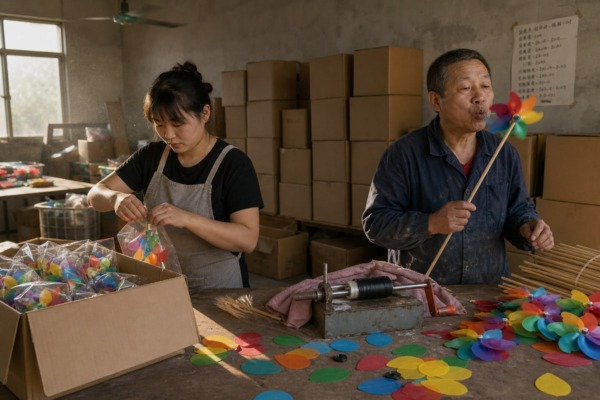
The results of that three-substrate test still shape how I advise clients. On coated art paper, fine white stripe details stayed crisp at small sizes. On PET film, the rainbow gradient — green through yellow, orange, red, pink, purple, blue, and teal — came out saturated and glossy. On mylar, tiny details blurred, but the reflective shine made the whole piece pop from across the room. Our house rule follows directly from this: prioritize coated art paper or color film when print clarity drives the sale, and prioritize sun-resistant PET film when the product lives outdoors.
Printing capability by material
| Material | Print Method | Detail Level | Branding Strength |
|---|---|---|---|
| Coated art paper | Offset, digital | Very high | Full-color custom printed patterns, double-sided |
| Cardstock | Offset, digital | High | Strong, slightly muted colors |
| PET color film | Silk-screen, gravure | Medium-high | Vivid gradients, glossy surface |
| Mylar foil | Limited overprint | Low-medium | Metallic foil finish, holographic effects |
Trends worth building into your line
Double-sided scrapbook-style printing keeps coming up in buyer requests, and for good reason: a spinning blade shows both faces, so double-sided custom printed patterns 4 photograph well and look finished from every angle. On the premium end, photochromic and thermochromic coatings now let us build "smart" pinwheels that shift color in sunlight or with temperature changes — a strong fit for immersive event experiences and a good talking point for wholesale party favors catalogs. For OEM and ODM projects, we usually prototype on coated paper first because sampling is fast and cheap, then move the approved artwork to film for the outdoor SKU. One design, two substrates, two price points. That approach keeps your brand consistent across the whole range without doubling development cost.
How do I make sure the material I choose passes strict QC and survives shipping without damage?
One crushed carton taught us more than any audit checklist. Years ago, a shipment of ours arrived in Miami with bent blades, and we rebuilt our whole packing spec afterward.
Choose materials with shape memory, such as PET film or synthetic paper, and pair them with a written QC checklist covering blade stiffness, grommet security, spin testing, and edge smoothness. Then protect shipments with flat-pack designs, inner dividers, and drop-tested export cartons.
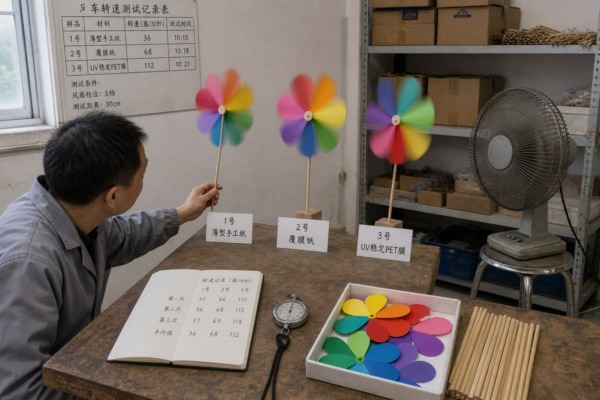
Material choice and shipping survival are the same decision, not two separate ones. A blade that creases permanently in transit is a return waiting to happen, no matter how good it looked at the factory. This is exactly why high-memory synthetic papers and PET films matter: they allow flat-pack shipping and repeated assembly without the permanent creasing or tearing common in traditional paper products. Here is the process we follow on every export order:
- Incoming material check. We verify sheet thickness, color consistency, and UV resistance ratings on film before cutting begins. Off-spec polypropylene sheets get rejected at this stage, not after printing.
- Assembly QC. Every garden spinner assembly gets checked at the hub. For children's market orders, we use plastic grommets or safety bearings instead of exposed metal pins, and we inspect for smooth edges and secure fasteners on every sampled unit.
- Spin testing. Sampled pinwheels go through a rotation test. A blade that wobbles or stalls signals a stiffness problem in the material batch.
- Flat-pack configuration. Where the design allows, blades ship flat with dowel sticks bundled separately. This cuts carton volume, lowers freight cost, and removes the crush risk that ruined that Miami shipment.
- Carton drop test. Export cartons get drop-tested with inner dividers in place before we approve the packing spec for a new SKU.
For buyers whose biggest pain points are damaged packaging and product returns, my honest advice is this: ask your supplier for their packing spec in writing before you compare unit prices. A cheap pinwheel material that arrives bent is the most expensive material you can buy.
Conclusion
Material choice decides whether your pinwheels delight buyers or become returns. Match coated paper to indoor lines, PET film to outdoor decor, mylar to sparkle — then test everything.
Footnotes
1. Technical background on the chemical properties and durability of PET used in manufacturing. ↩︎
2. Authoritative source for the environmental standards and material properties of compostable PLA bioplastics. ↩︎
3. Explains the composition and printing advantages of coated papers for high-quality graphic applications. ↩︎
4. ISO standards govern the quality and consistency of commercial offset printing processes mentioned in the text. ↩︎
More Articles
You might also find these helpful.

¿Qué certificaciones de resistencia al fuego debo verificar al comprar molinetes?
Compare pinwheel materials by use case, cost, and durability to cut returns and pick the right coated paper,…
Read More →
¿Cómo verificar la autenticidad de los informes de prueba al comprar turbinas eólicas?
Compare pinwheel materials by use case, cost, and durability to cut returns and pick the right coated paper,…
Read More →
¿Cómo comprobar si los materiales de los molinetes contienen químicos dañinos?
Compare pinwheel materials by use case, cost, and durability to cut returns and pick the right coated paper,…
Read More → English
  Spanish
  German
  Arabic