
How to Turn Usage Requirements into a Spec Sheet for Wrought Iron Fittings?
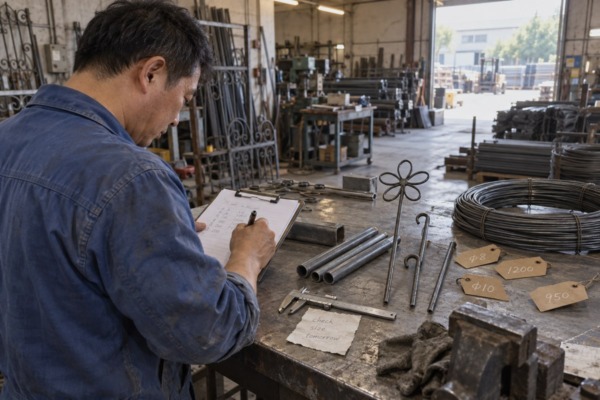
Vague briefs sink orders. Every season, our Zhejiang production line receives requests that just say “strong and pretty.” A proper spec sheet for wrought iron fittings prevents the costly rework that follows.
Para convertir los requisitos de uso en una hoja de especificaciones para accesorios de hierro forjado, cuantifique cuatro bloques: grado del material y grosor del alambre o tubo, dimensiones estructurales con tolerancias, tratamiento superficial con códigos de color, y función más detalles de embalaje. Adjunte fotos de referencia anotadas y reemplace cada adjetivo con un número medible.
That four-block method is the backbone of this article. Below, I walk through each block step by step. I also share the mistakes I see most often from buyers, and how to fix them before you place an order.
¿Qué detalles debo incluir al convertir mis requisitos de uso en una hoja de especificaciones de accesorios de hierro forjado?
Last spring, a US procurement manager messaged me on WhatsApp with one line: "strong sunflower stakes, nice finish." We spent three days turning that sentence into real numbers.
Incluya cuatro bloques: material (grosor del alambre, especificación del tubo, grado de acero como Q235); dimensiones estructurales (longitud total, diámetro del orificio, posiciones de curvatura, tamaño del tubo de acoplamiento); tratamiento superficial (recubrimiento en polvo o galvanizado en caliente, código de color, protección contra óxido); y función más embalaje (capacidad de carga, bordes desbarbados, cantidad por caja).
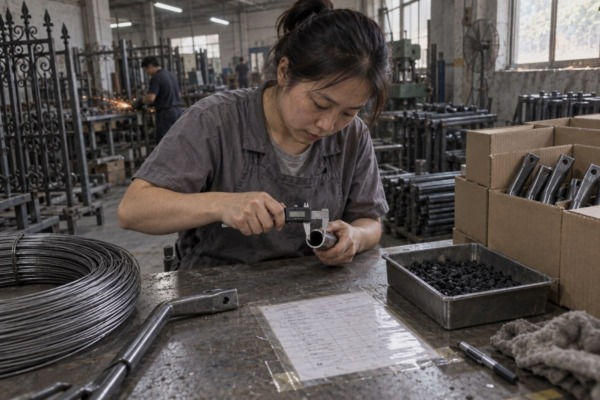
My rule at the factory is simple: never write "good-looking" or "sturdy" on a document that goes to production. Those words mean nothing to a bending machine. A spec sheet for wrought iron fittings is a translation tool. It converts your intent into data a fabricator can quote, make, and inspect against.
The Four-Block Checklist We Use
Here is the exact structure I give buyers, based on years of making metal garden stakes, rods, and mounting fittings for decorative products.
| Block | Qué especificar | Example Entry |
|---|---|---|
| 1. Material | Wire thickness, tube spec, steel grade | Q235 steel, round tube Ø10 × 1.0 mm wall |
| 2. Structural dimensions | Total length, hole diameter, bend positions, mating square/round tube size | Total length 900 mm; hole Ø6.5 mm; mates with 12 × 12 mm square tube |
| 3. Surface treatment | Powder coating or hot-dip galvanizing 1, color code, rust protection level | Powder coat, RAL 9005 matte black, outdoor grade |
| 4. Function & packaging | Load capacity, edge deburring, packing quantity | Holds 2 kg ornament head; all edges deburred; 24 pcs per carton |
Photos Beat Paragraphs
Attach reference photos and mark the critical points directly on them. Circle the bend radius. Draw an arrow to the hole. When we developed our layered sunflower stakes with U-shaped ground prongs, one annotated photo settled more questions than five emails. Add your quality assurance standards as a short note at the bottom, and version the document so everyone quotes from the same revision.
¿Cómo defino las especificaciones de material, recubrimiento y acabado para que coincidan con el uso previsto de mis accesorios de hierro forjado?
Our coating line once ran two batches of stake rods in "yellow." One came out lemon, one came out mustard. The buyer's spec sheet said only "yellow."
Adapte el material y el recubrimiento al entorno: especifique el grado de acero y la composición química, luego elija galvanizado por inmersión en caliente para instalaciones costeras o húmedas y recubrimiento en polvo epóxico para trabajos decorativos donde el color sea crítico. Indique el espesor del recubrimiento en micras, el código de color exacto y las horas de niebla salina requeridas.
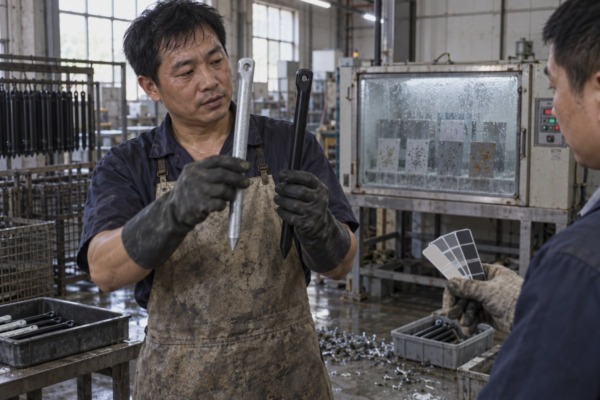
That yellow mix-up cost us a repaint and the buyer two weeks. Since then, I ask every customer three questions before we touch the material block. Where will the fitting live: indoors, in a garden, or near the coast? Does color accuracy matter more than corrosion life, or the reverse? And what steel grade does their market expect?
Name the Steel, Not Just "Iron"
The term "wrought iron fittings" is used loosely in the market. Most decorative fittings today are actually mild steel, not true wrought iron. So your sheet must name the grade. We run Q235 for most garden stake fittings, which is broadly comparable to common structural grades under ASTM standards. If your project requires a specific chemical composition 2 or a mill certificate, write that requirement down. It changes sourcing, and it changes price.
Choosing Between Powder Coating and Hot-Dip Galvanizing
| Factor | Epoxy Powder Coating 3 | Hot-Dip Galvanizing |
|---|---|---|
| Mejor para | Color-critical decorative work | Wet, coastal, or buried installations |
| Color options | Full RAL range, gradients possible | Silver-gray only (can be top-coated) |
| Corrosion protection | Good, depends on film thickness | Excellent, zinc sacrificial layer |
| Spec language | Coating thickness in microns + RAL code | Zinc coating weight + salt-spray hours |
| Typical use in our line | Ombre sunflower petals, colored rods | Ground prongs, structural brackets |
Write Corrosion Specs as Numbers
"Outdoor-safe" is not a spec. Convert it into a salt-spray hour target, a minimum coating thickness, and, for structural parts, a corrosion allowance on the wall thickness. If your site is coastal, say so; local salt exposure and UV levels justify a thicker coating system or a duplex finish. For our export orders to the US and Europe, we lock the color with a RAL number plus an approved physical sample. Never rely on a screen photo for color.
¿Qué dimensiones, tolerancias y requisitos de carga necesito especificar para accesorios de hierro forjado personalizados?
Tighter tolerances cost real money on our line. A ±0.2 mm hole needs slower drilling and extra checks compared with ±1 mm. So I always ask buyers what actually matters.
Specify total length, hole diameters, bend positions, and the exact mating tube size, each with a dimensional tolerance such as ±0.5 mm. For load-bearing fittings, add minimum tensile strength, a working load figure, and the connection method—welded, threaded, or slip-fit—so strength is verifiable.

Dimensions are where most quoting errors start. In my experience exporting to the US and South America, the single most common omission is the mating component size. A fitting never exists alone. It connects to something. Write down what that something is.
The Dimensions That Must Be on the Sheet
- Total length and overall height of the fitting.
- Every hole diameter and its center position.
- Bend positions, bend angles, and bend radius.
- The mating square or round tube spec, including outer diameter and wall thickness.
- Nominal size versus actual measured size, clearly labeled, so nobody confuses the two.
Set Dimensional Tolerances That Match the Function
| Feature | Decorative Fit | Precision Fit |
|---|---|---|
| Total length | ±2.0 mm | ±0.5 mm |
| Hole diameter | +0.3 / −0 mm | ±0.1 mm |
| Bend position | ±1.5 mm | ±0.5 mm |
| Mating tube clearance | 0.5 mm slip fit | 0.2 mm snug fit |
Loose dimensional tolerances lower cost. Tight ones raise it. Only pay for precision where the part actually mates with another component.
Decorative Load vs Industrial Pressure
Be careful with terminology here. If your "wrought iron fitting" is actually a pressure-rated pipe fitting, you are in a different world. Those parts follow standards like ASME B16.11 4, need stated pressure-temperature ratings and a design pressure, and the choice of threaded vs socket weld connections affects sealing and inspection. Our garden decor fittings do not carry fluid, so we specify a working load instead: for example, a stake fitting must hold a 2 kg spinner head in wind without bending. State the minimum tensile strength of the material if the part is structural, and define how the load will be tested.
How can I add clear QC and inspection standards to my wrought iron fittings spec sheet before ordering?
One returned container taught me more about QC than any handbook. The stakes were fine; the cartons were not. Since then, packaging sits inside every spec sheet we write.
Add QC standards by defining an AQL sampling level, listing measurable checkpoints—dimensions, coating thickness, adhesion, edge deburring—and requiring documents such as a material test report and salt-spray results. State inspection timing: incoming material, in-process, and pre-shipment, plus packaging drop-test criteria.

A spec sheet without acceptance criteria is only half a document. It tells the factory what to make, but not how you will judge the result. The buyers who get the fewest surprises from us are the ones who write the inspection plan into the sheet itself. Then the quote, the production order, and the final inspection all reference the same numbers.
Build an Inspection Table Into the Sheet
| Etapa | What Is Checked | Reference Document |
|---|---|---|
| Incoming material | Steel grade, wire and tube dimensions, chemical composition | Material test report from the mill |
| In-process | Bend positions, hole sizes, weld quality, edge deburring | Annotated drawing with tolerances |
| Post-coating | Coating thickness, color match to RAL sample, adhesion | Approved color sample, test record |
| Antes del envío | AQL sampling of full lot, function and load check | Signed spec sheet, packing list |
Also state which quality assurance standards your supplier should operate under, and ask whether their system is certified. Request the material test report before production starts, not after the goods ship. Some buyers now go further and ask for QR-coded traceability on each batch, linking to heat numbers and test records. It is an emerging practice, and it is worth requesting on structural parts.
Treat Packaging as a QC Item
Damaged packaging causes returns just as surely as bad welds. Specify carton quantity, inner protection for coated surfaces, and a simple drop-test expectation. On our decorated stake lines, deburred edges plus paper sleeves between painted heads cut transit scratches dramatically. Write the packing quantity per carton on the sheet, and have the final inspection verify it.
Conclusión
Vague words cause quotes to miss, parts to mismatch, and containers to come back. Quantify material, dimensions, finish, and packaging, attach annotated photos, and your spec sheet protects every order.
¿Interesado en obtener los productos mencionados en este artículo? Vea los detalles y solicite una cotización aquí:
Notas al pie
1. The American Galvanizers Association is the primary authority on hot-dip galvanizing for corrosion protection. ↩︎
2. ASTM provides the international standard specifications for the chemical composition of steel grades. ↩︎
3. The Powder Coating Institute provides technical standards for epoxy and decorative powder coating finishes. ↩︎
4. Official ASME standard for forged fittings, providing technical context for pressure-rated industrial components. ↩︎
Más artículos
También podrían resultarle útiles.

¿Cómo verificar remotamente las capacidades de producción de una fábrica para componentes enchufables de hierro forjado?
This guide shows how to convert vague usage requirements into a precise wrought iron fittings spec sheet using…
Leer más →
¿Cómo evaluar la capacidad de producción de una fábrica al obtener insertos de hierro forjado?
This guide shows how to convert vague usage requirements into a precise wrought iron fittings spec sheet using…
Leer más →
¿Qué preguntas debe hacer a los proveedores de insertos de hierro forjado para detectar a los poco fiables a tiempo?
This guide shows how to convert vague usage requirements into a precise wrought iron fittings spec sheet using…
Leer más → English
  Spanish
  German
  Arabic