
How Do I Test If Pinwheel Samples Deform in Humid Environments?
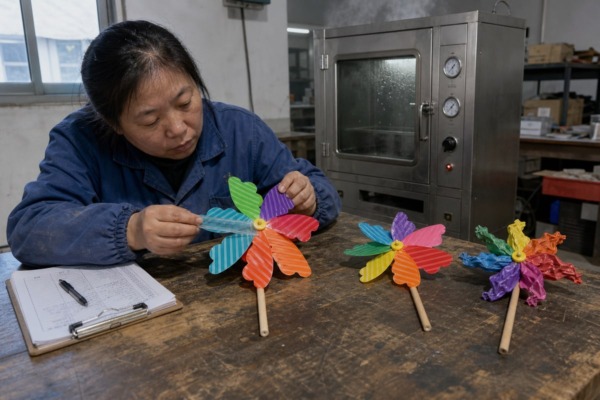
Last spring, a batch of our pinwheel samples returned from Florida with curled blades. That single complaint pushed our Zhejiang workshop to rebuild how we test humidity resistance.
To test if pinwheel samples deform in humid environments, measure baseline dimensions, expose the samples in a controlled humidity chamber at high relative humidity or soak them, then re-measure after drying. Compare wrinkling, warping, fading, and dimensional change against a dry control to confirm permanent deformation.
That is the short answer. But the details matter. The humidity level, the material, the test duration, and the inspection method all change your results. Below, I walk through each step the way we run it in our own lab, so you can copy the workflow for your own samples.
What Humidity Levels Should I Simulate to Match My Target Market's Climate?
A procurement manager in Houston once asked why her pinwheels looked perfect in Zhejiang but sagged in Texas. The answer was relative humidity, and it changed our sampling conversations.
Simulate 60–75% relative humidity for temperate markets like Europe, 80–90% RH for tropical or coastal regions, and use the 85% RH accelerated screening test for worst-case checks. Match your chamber settings to the wettest season your target market experiences, not to its yearly average.
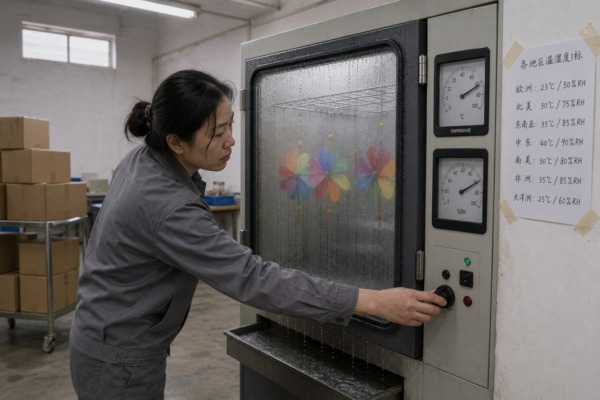
The biggest mistake I see buyers make is testing at one generic humidity number. A pinwheel string hanging in a garden in Miami lives in a very different climate than one in Berlin. So we always start climatic chamber testing by asking one question: where will this product actually be displayed?
Match the Chamber to the Market
Here is the reference table we use when a distributor tells us their destination region.
| Target Market | Suggested RH | Suggested Temperature | Test Style |
|---|---|---|---|
| US Gulf Coast / Florida | 85–90% | 35–40°C | Static hold plus cyclic |
| Tropical South America | 85–95% | 30–38°C | Static high-humidity hold |
| Northern and Central Europe | 60–75% | 20–25°C | Cyclic wet/dry swings |
| Worst-case screening | 85% | Elevated heat | Accelerated 85/85-style aging |
The industry-standard 85% RH / 85°C reliability test, often called the 85/85 test, is a useful benchmark. But I add a caution here. At 85°C, thin plastic and mylar blades can distort from heat alone, not moisture. That confuses your data. For garden toys, we usually cap the temperature at 40–45°C and hold the 85% RH figure, so any deformation we see truly comes from moisture.
There is a second caveat worth raising. Some buyers assume humidity is always the main culprit. Research on environmental exposure shows temperature is sometimes the dominant driver, with humidity secondary. That is exactly why we pair heat with humidity in the chamber instead of testing wet conditions at room temperature only. If your samples pass a combined humid-hot test, they will pass a mild one too.
Finally, do not forget cycling. Coastal markets swing between humid days and drier air-conditioned storage. Cyclic exposure between roughly 50% and 90% RH reveals accumulative deformation that a single steady soak can miss.
Which Materials Hold Up Best When I Test Pinwheels for Moisture Resistance?
Every quotation we prepare involves a quiet trade-off: mylar film costs more than thin PVC, but it shrugs off moisture far better. Choosing wrong means returns later.
PET/mylar film and polypropylene blades resist moisture best, showing minimal hygroscopic expansion. PVC holds shape but can fade. Uncoated wooden dowels absorb moisture and may warp or swell, so sealed or lacquered wood performs better. Paper and cardboard pinwheels deform fastest under high humidity.
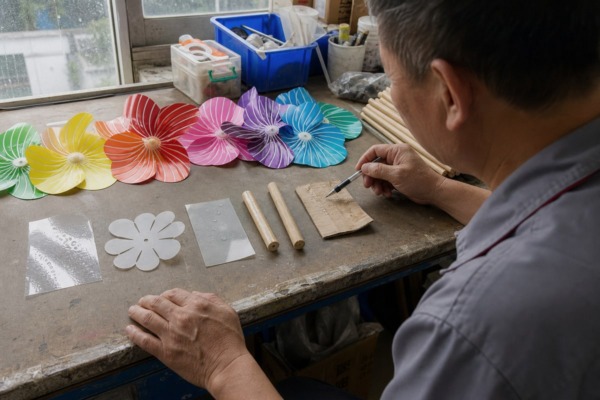
When we test pinwheel samples for moisture resistance, material ranking comes first. Here is the order we see most often, from best to worst:
- PET/mylar film blades
- Polypropylene molded petals
- PVC sheet blades
- Sealed or lacquered wooden dowels
- Uncoated wooden dowels
- Paper or cardboard blades
Why Each Material Behaves Differently
Different materials fail in different ways. Plastics can absorb small amounts of water that act as a plasticizer, softening the sheet so blades droop under their own weight. Wood is hygroscopic, so it swells and shrinks as moisture content 1 changes. Paper wrinkles almost immediately. The table below summarizes what we watch for.
| المادة | Typical Use in a Pinwheel | Water Uptake Tendency (per ASTM D570 style testing) | Common Humidity Failure |
|---|---|---|---|
| PET/mylar film | شفرات البتلات | Very low | Slight curl at edges, minor fading |
| Polypropylene | Molded petals, hubs, grommets | Very low | Hub loosening if tolerances are tight |
| PVC sheet | Die-cut petals | منخفض | Softening, color bleed, gradual droop |
| Coated wood | Dowel stick | معتدل | Slight swelling at exposed ends |
| Uncoated wood | Dowel stick | عالية | Warping, splitting, grain raising |
| Paper/card | Budget blades | Very high | Wrinkling, sagging, delamination |
A few technical points deepen this picture. Molded hubs and grommets carry residual stress 2 from injection molding shrinkage, and moisture plasticization can release that stress and distort the part. Each polymer also has its own coefficient of moisture expansion, which is why a plastic petal riveted to a wooden stick can develop stress at the joint when the two expand at different rates. And for biodegradable options like PLA, humidity plus heat accelerates hydrolysis, a form of polymer degradation that makes parts brittle over time. On our export orders to South America, we default to PET blades with lacquered dowels for exactly these reasons.
How Long Should I Run Humidity Tests Before Trusting the Results?
I once approved a sample after a 12-hour humidity check. Three weeks in a coastal warehouse proved me wrong. Since then, our lab never trusts short exposures.
Run static high-humidity chamber tests for at least 72–96 hours, and extend accelerated humid-hot aging to a week or more for export-grade confidence. A soak test needs 24–48 hours. Always add a 24-hour dry recovery period before final measurement to separate temporary swelling from permanent deformation.
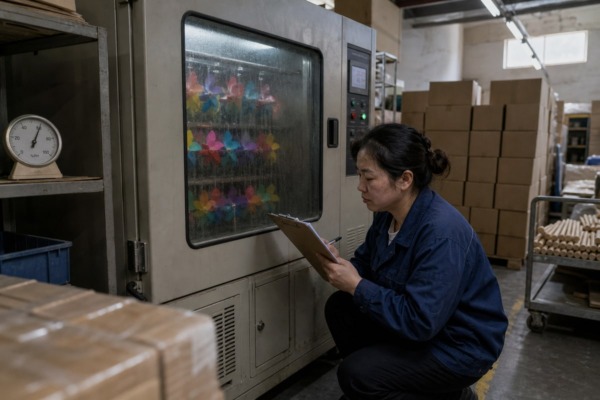
Duration is where most quick tests fail. Moisture moves into materials slowly, and the moisture absorption rate 3 flattens out only when the sample approaches equilibrium. Stop early, and you measure a half-saturated sample that looks fine. Here is the sequence we follow in our own lab.
- Precondition for 24 hours. Hold all samples at a known temperature and RH first. Uncontrolled starting moisture can hide or exaggerate deformation later.
- Record the baseline. Log dimensions, mass, and photos. Note how the hub spins and how the grommets fit.
- Expose the samples. Use a controlled chamber, not a damp corner of the office. Space the samples apart so they do not shield each other or create local microclimates. Record temperature and RH at defined intervals.
- Check mass and dimensions every 24 hours. When two consecutive readings match, the sample has stabilized. That is your true exposure endpoint, not an arbitrary clock time.
- Dry and recover for 24 hours. Re-measure after recovery. Change that remains after drying is permanent deformation. Change that disappears was reversible swelling.
- Compare against the dry control. A control sample handled on the same schedule separates humidity effects from handling effects.
For fluctuating climates, add cyclic rounds. Repeated wet/dry swings expose accumulative set that one soak misses. And when a buyer needs long-term assurance, we run hydrothermal aging, combining heat and humidity, because the pairing is more severe than humidity alone.
| Test Type | Typical Duration | ما الذي تثبته |
|---|---|---|
| Water soak | 24–48 hours | Basic surface resistance, fading, wrinkling |
| Static high RH hold | 72–96 hours minimum | Equilibrium swelling and softening |
| Cyclic wet/dry | 5–10 cycles | Accumulative deformation and residual set |
| Humid-hot aging | 1 week or more | Long-term durability, degradation pathways |
What Signs of Deformation Should I Watch for When Inspecting Wet Samples?
During a final inspection last summer, our QC team caught faint wrinkles on purple petals that everyone else had missed. Those wrinkles taught us to inspect wet samples systematically.
Inspect for blade wrinkling, curling, or warping; swelling or splitting of the wooden stick; color fading or bleeding; loose hubs caused by dimensional change; and surface blistering or cracking. Measure thickness and diameter before and after exposure, because small hygroscopic changes escape visual inspection.

Our own pass/fail routine grew directly from a simple habit: place the samples in a humid environment or full soak, then check for wrinkling, deformation, and fading to judge moisture resistance. Over time we formalized that habit into the checklist below.
| Sign | Where to Look | What It Means | الخطورة |
|---|---|---|---|
| Wrinkling or rippling | Blade surfaces | Film has absorbed moisture unevenly | معتدل |
| Curling or bowing | Blade edges and tips | Differential expansion across the film | Moderate to high |
| Fading or color bleed | Printed stripes and gradients | Ink or dye is not humidity-stable | Cosmetic but critical for retail |
| Swelling or splitting | Wooden dowel, especially cut ends | Hygroscopic expansion of the wood | عالية |
| Loose or stiff hub | Center pin and grommets | Dimensional change has ruined the fit | High, kills the spin |
| Crazing or fine cracks | Around the pin hole | Environmental stress cracking at stress points | عالية |
| Blistering or delamination | Laminated or coated blades | Moisture trapped between layers | عالية |
Go Beyond the Eye
Visual inspection alone is not enough. Small dimensional changes hide from the naked eye, so we run a basic warpage analysis with digital calipers 4: blade thickness at three points, dowel diameter at both ends, and hub clearance. Weight change is the most sensitive early indicator of moisture uptake. A functional spin test matters too, since a pinwheel that no longer turns freely has failed even if it looks fine. Labs with bigger budgets can use Digital Image Correlation to map full-field surface strain and catch localized bowing that point measurements miss. Whatever tools you use, always distinguish temporary swelling from permanent loss of dimensional stability by re-checking after the dry recovery period.
الخاتمة
Humid climates quietly ruin unprepared pinwheels. Test pinwheel samples with controlled humidity exposure, baseline measurements, and dry controls, and you ship products that keep spinning wherever customers live.
الحواشي
1. Authoritative Wikipedia entry defining moisture content and its measurement across various materials. ↩︎
2. ISO standards provide methodologies for measuring and managing residual stress in molded plastic components. ↩︎
3. ASTM International develops the standard test methods for determining the moisture absorption rate of plastics. ↩︎
4. Wikipedia provides technical details on the use of digital calipers for precision measurement in quality control. ↩︎
المزيد من المقالات
قد تجد هذه مفيدة أيضًا.

كيفية التحقق عن بُعد من قدرات إنتاج المصنع لمكونات التوصيل المصنوعة من الحديد المطاوع؟
Learn how to test pinwheel samples for humidity-induced deformation using controlled chambers, RH levels, and dimensional checks to…
اقرأ المزيد →
كيفية تقييم قدرة إنتاج المصنع عند توريد إدخالات الحديد المطاوع؟
Learn how to test pinwheel samples for humidity-induced deformation using controlled chambers, RH levels, and dimensional checks to…
اقرأ المزيد →
ما الأسئلة التي يجب أن تطرحها على موردي إدخالات الحديد المطاوع لاكتشاف غير الموثوقين مبكرًا؟
Learn how to test pinwheel samples for humidity-induced deformation using controlled chambers, RH levels, and dimensional checks to…
اقرأ المزيد → English
  Spanish
  German
  Arabic