
How to Test Pinwheel Safety for Children’s Use?
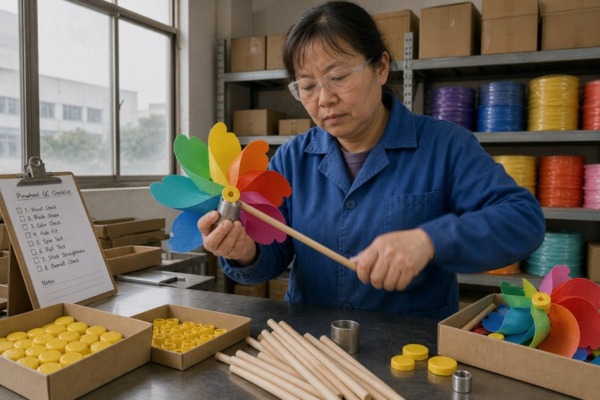
One loose cap can turn a cheerful garden toy into a recall. After years of running pinwheel production lines in Zhejiang, I test pinwheel safety before any children’s order ships.
لاختبار سلامة الدولاب الدوار للأطفال، تحقق من الامتثال لمعايير CPSC و ASTM F963، وقم بإجراء فحص أسطوانة الأجزاء الصغيرة على الأغطية والمحاور، وافحص الدهانات بحثًا عن محتوى الرصاص والفثالات، وافحص الحواف الحادة، واسحب كل مثبت للتأكد من عدم انفصال أي شيء.
The risk is never the pinwheel concept itself. The risk comes from design, assembly, and age mismatch. Below, I walk through the exact checks I use on our own lines, so you can demand the same from any supplier.
ما معايير السلامة التي يجب أن أتحقق منها قبل طلب الدوارات الورقية للأطفال؟
Last spring, a procurement manager in the US messaged me on WhatsApp with one question: which certificates prove our rainbow pinwheels are legal for children? Her caution was smart.
تحقق من معايير ASTM F963 للخصائص الميكانيكية والفيزيائية، وحدود CPSIA لمحتوى الرصاص والفثالات، ووثائق الامتثال CPSC مثل شهادة منتج الأطفال، واختبارات مختبر طرف ثالث من مختبر معتمد من CPSC، والملصقات الصحيحة المناسبة للعمر قبل تقديم أي طلب لطاحونة الهواء.

A pinwheel sold as a children's toy is a regulated product, not a simple decoration. This distinction matters. When we quote a US order, the first thing we confirm is whether the pinwheel will be marketed to children. If yes, the full toy safety framework 1 applies. If it is sold purely as garden décor for adults, the rules are lighter. Many buyers get burned because they assume the décor rules cover the toy channel. They do not.
The core standards by market
| السوق | Key standard | What it covers |
|---|---|---|
| الولايات المتحدة | ASTM F963 (mandatory under CPSC) | Mechanical and physical properties, sharp points, small parts, chemical limits |
| الولايات المتحدة | CPSIA | Total lead in substrate and coatings, phthalate content, tracking labels |
| أوروبا | EN 71 (Parts 1–3) | Physical, flammability, and chemical migration requirements |
| South America | Varies by country, often based on ISO 8124 | Similar physical and chemical checks |
Documents you should demand
Ask for three things before wiring a deposit. First, a شهادة منتج الأطفال 2 that names a CPSC-accepted lab. Second, the actual test reports, not just a pass letter. Third, proof of age-appropriate labeling on the retail packaging, including a small-parts warning if the pinwheel is not intended for children under 3. In my experience exporting to the US, buyers who skip the paperwork stage spend far more later on port holds and returns. A one-page certificate check takes an afternoon. A detained container takes a month.
كيف يمكنني اختبار مواد الدولاب الدوار للمواد الكيميائية السامة أو الطلاء؟
Our petal blades start as rolls of colored plastic film. Before any roll enters our Zhejiang workshop, we ask the supplier for a material safety report. That habit began early.
اختبر مواد الدولاب الدوار عن طريق إرسال الشفرات والطلاء والطبقات إلى مختبر طرف ثالث لفحص محتوى الرصاص الكلي والمعادن الثقيلة والفثالات. اطلب مواد غير سامة معتمدة وفق الحدود الكيميائية لمعيار ASTM F963، واطلب تقرير اختبار جديد لكل لون جديد أو دفعة مورد جديدة.
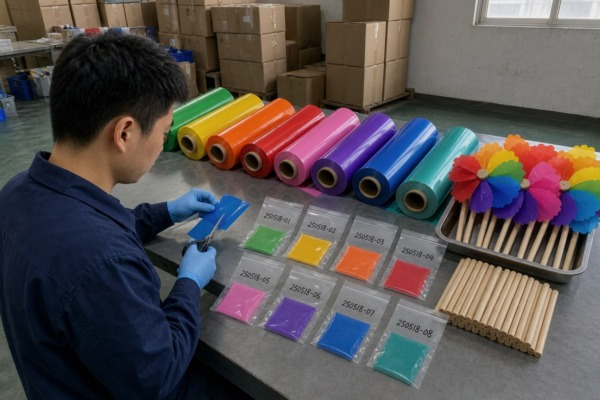
Chemical risk hides in the prettiest parts of a pinwheel. Our eight-petal rainbow design uses green, yellow, orange, red, pink, purple, blue, and teal film with white striped printing. Every one of those colors is a separate pigment, and every pigment is a separate chemical question. This is why batch-level testing matters more than a single golden-sample report. A supplier can pass a test in January and quietly switch to a cheaper ink in June. We control this by locking the pigment source in the purchase contract and retesting whenever a color or resin changes.
What each test covers
| الاختبار | What it screens | Where it applies on a pinwheel |
|---|---|---|
| Total lead (substrate) | Lead in the base plastic or wood | Blades, hub, dowel stick |
| Total lead (coatings) | Lead in paint and surface ink | Printed stripes, painted dowels |
| الفثالات | Plasticizers in soft PVC parts | Flexible blades, grips, caps |
| Heavy metals migration | Elements that leach when mouthed | All accessible surfaces |
Practical steps for a buyer
You do not need your own lab. You need a sampling plan. Pull random units from the actual production run, not from a prepared sample box. Send them to an accredited lab yourself, or hire a third-party inspector to draw the samples. Also ask the factory which parts are coated wood versus raw wood. Our natural dowel sticks ship unpainted for exactly this reason: raw, smooth wood removes an entire coating-related risk category. Finally, put non-toxic materials into the product spec sheet in writing. A verbal promise about ink safety is worth nothing at customs.
ما هي فحوصات ضبط الجودة التي يجب أن أطلبها لتجنب مخاطر الاختناق في الأجزاء الصغيرة؟
One recall report changed how our QC team works. A toy pinwheel was pulled from shelves because its fastener cap could detach, creating a choking hazard for toddlers.
Request a choking hazard assessment using the small parts cylinder on every cap, hub, grommet, and bead, plus a torque and tension test on each fastener. Any component that detaches under standard pull force fails QC for children under three years old.
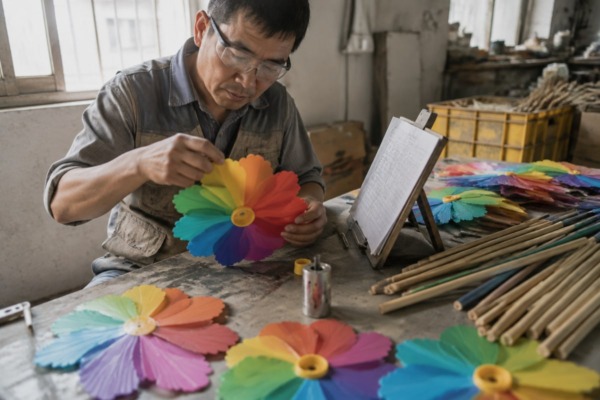
The recalled pinwheel I mentioned was dangerous to children up to 36 months, and the flaw was one tiny cap. That detail shaped our entire inspection routine, and it aligns with a check I insist on personally: look for sharp corners and small parts that can fall off, then confirm the product meets CPSC children's toy safety standards, so kids face no swallowing or cutting risk. Here is the five-step protocol I ask every buyer to write into their QC instructions.
The five-step small-parts protocol
- تحقق the age grading first. Confirm the packaging carries age-appropriate labeling and a small-parts warning if the pinwheel is not suitable for under-3s. A wrong label is a compliance failure even if the toy itself is solid.
- Tug every cap, hub, grommet, and decorative end by hand, then with a calibrated gauge. The torque and tension test simulates a determined toddler. On our lines, the yellow hub grommets get pulled on every sampled unit.
- Spin the wheel. A stiff pinwheel tempts children to twist and yank on the weakest joint, so free rotation is itself a safety feature.
- Inspect any part that came loose against the small parts cylinder. If it fits fully inside the cylinder, it is a choking hazard for young children, full stop.
- Retest after a simulated-use cycle. Repeated play loosens fasteners, so we re-run the tug test on units that have been spun and handled.
Ask your inspector to sample across cartons, not just the top layer. Loose caps cluster in specific production shifts, and random sampling is how you catch them.
How do I make sure pinwheel sticks and edges won't hurt children?
There is a real trade-off between a stiff stick and a safe one. A hard dowel spins beautifully in the wind, but a snapped end can become a sharp spear.
Ensure stick and edge safety through sharp edge testing and sharp point testing per ASTM F963, rounded or capped dowel ends, smooth die-cut blade edges with no burrs, fully enclosed pins, and a flex test confirming the stick bends or blunts instead of splintering.
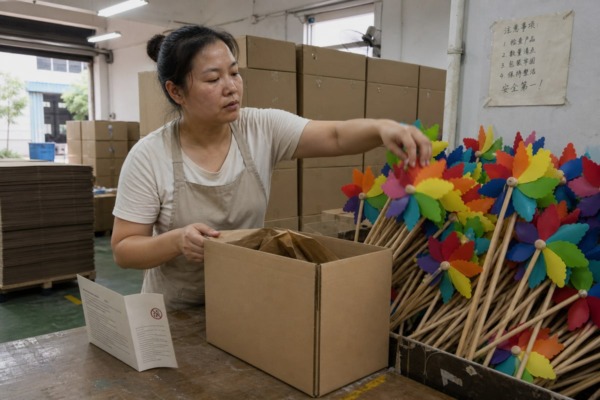
Puncture and cut hazards behave differently depending on how the pinwheel was built. A store-bought toy usually hides its pin inside an enclosed hub. A DIY craft kit, like the assembly sets we produce with die-cut petals, a pin tool, and grommets, exposes the sharp element during assembly. The tests must match the type.
| النوع | Main risk | Best test | Best fit |
|---|---|---|---|
| Store-bought toy pinwheel | Detachable small parts | Tug test, cylinder check, label check | Older toddlers and kids, fully intact units |
| DIY kit with pin or brad | Exposed sharp point, loosening over time | Sharp point test, spin test, retest after use | School-age kids with adult assembly |
| Pin-free DIY design | Lower injury risk, loose parts remain possible | Detachment and edge check | Ages 2–5 with supervision |
Testing the stick
Run a fingertip pass along the full dowel length. Any splinter, crack, or rough saw-cut end is a reject. We sand and round both ends of our natural wooden dowels, and we flex-test samples from each lot to confirm the wood bends or blunts rather than shattering into a point. For toddler-market orders, ask whether the factory can cap the handle end.
Testing the edges
Sharp edge testing should cover every accessible blade edge. Die-cut plastic film can leave micro-burrs when the cutting die wears down, so we replace dies on a fixed schedule. Also confirm the pin tip in the hub cannot be reached by a child's finger from any angle, before and after 100 spins. For DIY kits sold to families with very young children, recommend pin-free builds using glue dots or pipe cleaners, and keep adult-only assembly instructions printed on the packaging.
الخاتمة
Pinwheel safety fails at the smallest component. Verify standards, test materials, pull every cap, and check every edge. Test the exact product in hand, never the category name.
الحواشي
1. Comprehensive overview of international toy safety regulations and the history of safety standards. ↩︎
2. Official CPSC guidance on the mandatory certification required for children’s products imported into the United States. ↩︎
المزيد من المقالات
قد تجد هذه مفيدة أيضًا.
كيفية التحقق عن بُعد من قدرات إنتاج المصنع لمكونات التوصيل المصنوعة من الحديد المطاوع؟
Learn how to test pinwheel safety for children with expert checks on CPSC standards, small parts, lead content,…
اقرأ المزيد →
كيفية تقييم قدرة إنتاج المصنع عند توريد إدخالات الحديد المطاوع؟
Learn how to test pinwheel safety for children with expert checks on CPSC standards, small parts, lead content,…
اقرأ المزيد →
ما الأسئلة التي يجب أن تطرحها على موردي إدخالات الحديد المطاوع لاكتشاف غير الموثوقين مبكرًا؟
Learn how to test pinwheel safety for children with expert checks on CPSC standards, small parts, lead content,…
اقرأ المزيد → English
  Spanish
  German
  Arabic