How Can I Avoid Copyright Disputes With My Pinwheel Design?
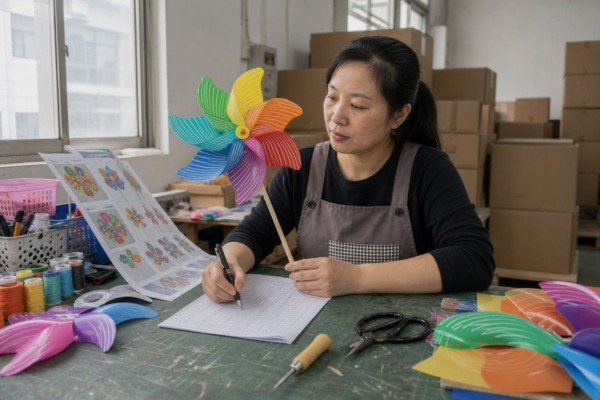
One borrowed cartoon character can turn a profitable [pinwheel design](https://zhufengpinwheels.com/?p=456) into a copyright dispute. On our production line in Zhejiang, I have watched clients dodge that bullet narrowly.
Um Urheberrechtsstreitigkeiten mit Ihrem Windrad-Design zu vermeiden, halten Sie die Kunstwerke originell, kopieren Sie niemals Cartoon-IPs oder Markenmuster, führen Sie vor der Produktion Marken- und Stand-der-Technik-Recherchen durch, holen Sie schriftliche Urheberrechtsgenehmigungen für alle lizenzierten Elemente ein, dokumentieren Sie Ihren Designprozess und registrieren Sie Ihre wertvollsten Designs.
That sounds like a lot of work. It is not, once you break it into steps. In this article, I will walk through the exact checks we run at our factory before any custom pinwheel goes to print. I will cover searches, supplier agreements, NDAs, and registration. Each section answers one question you are probably already asking.
Wie überprüfe ich, ob mein Windrad-Design das Patent oder die Marke eines anderen verletzt?
A U.S. buyer once asked us to print a famous cartoon mouse on a large pinwheel order. We declined and pushed for a rights check first. That request taught me plenty.
Prüfen Sie das Verletzungsrisiko, indem Sie eine Markenrecherche in der USPTO-Datenbank nach ähnlichen geometrischen Logos durchführen, eine Recherche zum Stand der Technik auf Google Patents für Designpatente sowie eine Rückwärts-Bildersuche nach vorhandener Kunst. Wenn Ihr Windradmuster einem geschützten Design ähnelt, gestalten Sie es neu oder holen Sie eine schriftliche Genehmigung ein.
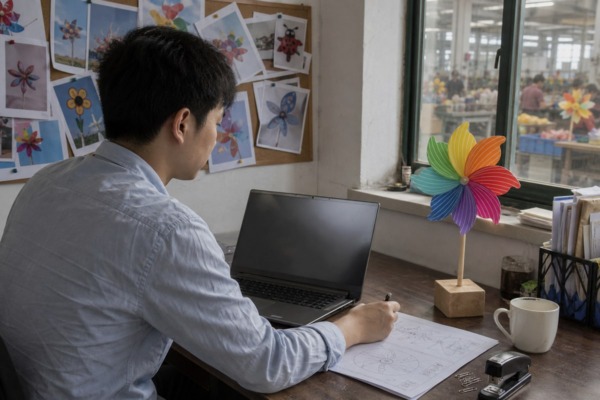
Different intellectual property rights protect different parts of a pinwheel. So you need more than one search. Here is how I break it down for clients before we open a mold or set up a print run.
| Was zu prüfen ist | What it protects | Where to search | Risk if you skip it |
|---|---|---|---|
| Copyright | Printed artwork, characters, patterns on the blades | Reverse image search, Copyright Office records | Infringement claim, marketplace takedown |
| Trademark | Brand names, logos, distinctive geometric marks | USPTO trademark database, EUIPO | Trademark infringement based on likelihood of confusion |
| Design patent | The ornamental shape of the blades or hub | Google Patents, USPTO prior art search | Patent claim, import seizure at customs |
Basic shapes are free, creative combinations are not
A plain eight-blade pinwheel shape belongs to everyone. Nobody owns the general idea of spinning petals. But a specific creative combination can meet the originality requirement and gain protection. Think of our rainbow gradient petals with fine white stripes. The gradient order, the stripe pattern, and the scalloped edges together form protectable expression. Courts also apply a separability test to useful articles. The pattern printed on a blade can exist as art on its own, so it usually qualifies for copyright even though the pinwheel itself is functional.
Why changing it a little does not make you safe
Buyers sometimes tell me they changed a design "about 10 percent," so it must be fine. That is a myth. Apparel industry guidance is blunt on this point: there is no fixed number or percentage of changes that guarantees safety. Under derivative work rules, a modified version of protected artwork can still infringe. If your starting point was someone else's design, alterations rarely cure the problem.
The fair use objection
Some sellers lean on the fair use doctrine. In my experience, that is a weak shield for commercial products. Fair use is narrow, fact-specific, and decided case by case. It is not a clearance strategy for a garden toy sold at retail. Treat it as a last-resort defense, never as a plan.
Welche Schritte kann ich unternehmen, um mein individuelles Windrad-Design zu schützen, wenn ich mit einem chinesischen Hersteller arbeite?
During sampling for a rainbow petal pinwheel last spring, our art team traced every gradient back to files the client created herself. That paper trail is the whole game.
Schützen Sie Ihr individuelles Windrad-Design, indem Sie Dateien unter einer unterzeichneten Vereinbarung senden, Kunstwerke als vertraulich kennzeichnen, ein datiertes Design-Entwicklungsprotokoll führen, schriftlich bestätigen, dass Sie das endgültige Werkzeug und Kunstwerk besitzen, und einen Lieferanten wählen, der die Urheberrechtsfreigabe für jedes dekorative Element überprüft.
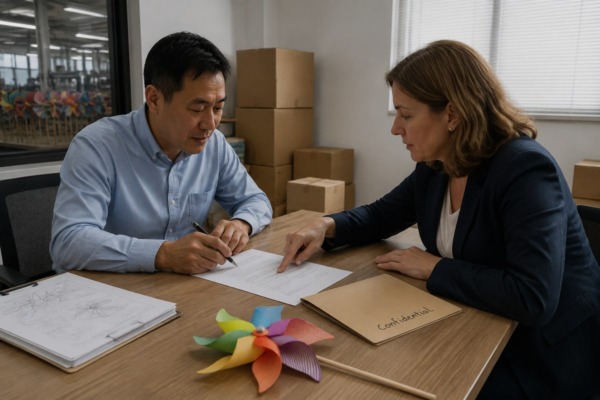
Protection works in two directions. You need to stop your design from leaking. You also need to make sure your supplier does not put infringing content on your product. Both failures land on you, the importer, when the goods reach the United States.
My own rule at Zhufeng is simple, and I tell every client the same thing. Keep pattern artwork 1 original whenever possible. Do not copy cartoon IP directly, no matter how well it sells. If a client insists on a licensed character, we ask for the copyright authorization letter before we print a single blade. That one habit has kept our U.S. customers clear of trademark and copyright infringement claims.
Build a design evolution log
The strongest current trend in design protection is process-based proof, not vague originality claims. If a dispute ever starts, you want dated evidence of independent creation. Here is what I recommend keeping.
| Evidence to keep | Was es nachweist | Practical format |
|---|---|---|
| Dated sketches and early drafts | Independent creation | Scans with timestamps |
| Layered source files | The design's full evolution | Original AI/PSD files, never just flat JPEGs |
| Mood boards and inspiration notes | Inspiration, not derivation | Folder with source links and license notes |
| License and authorization letters | Permission for borrowed elements | Signed PDFs from the rights holder |
| Purchase orders and emails | Ownership of intellectual property terms | Archived correspondence |
Verify every borrowed asset
Online content is not automatically free. Check that any public domain patterns you use are truly historical, not modern protected adaptations of old motifs. Read every Creative Commons license 2 carefully, because some forbid commercial use. If a freelancer drew your petals, sign a transfer so ownership is yours, not theirs. Licensing agreements should always be in writing, ideally with indemnity language from whoever supplied the artwork.
Sollte ich eine NDA- oder IP-Vereinbarung mit meinem Pinwheel-Lieferanten unterzeichnen, bevor ich mit der Produktion beginne?
Early in our export business, I learned that a standard NDA drafted for U.S. law does little in a Chinese court. That lesson changed how we sign contracts.
Yes, sign an agreement before sharing design files, but use an NNN agreement (non-disclosure, non-use, non-circumvention) governed by Chinese law rather than a standard U.S. NDA. It should name ownership of intellectual property, molds, and artwork, and set enforceable penalties for unauthorized use.
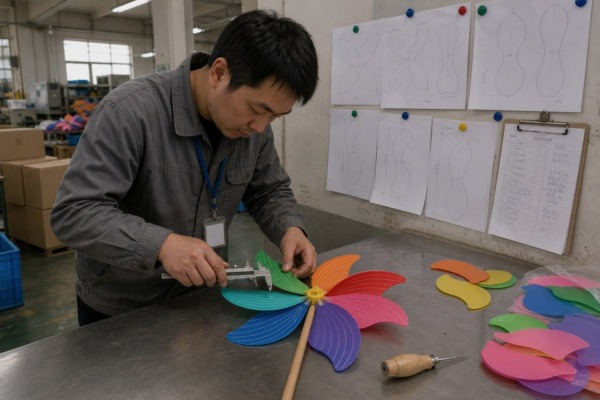
A regular NDA only stops a supplier from disclosing your design. It does not stop them from using it or selling around you. That is why an NNN agreement matters more in China sourcing. I sign these routinely with our distribution clients, and I consider a supplier who refuses to sign one a red flag.
Here is the sequence I recommend to procurement managers before production starts:
- Sign the NNN before sending any files. Not after sampling. Not after the deposit. Before your artwork leaves your computer.
- Make it enforceable in China. Choose Chinese governing law, include a Chinese-language version, and pick a Chinese court or arbitration body. A beautiful contract that cannot be enforced is decoration.
- Name the assets specifically. List your blade artwork, die-cut petal shapes, packaging designs, and any custom tooling. Vague contracts protect vaguely.
- Lock down mold and die ownership. If you paid for custom cutting dies for your petal shapes, the contract should say you own them and can move them to another factory.
- Extend confidentiality to sub-suppliers. Printing and film-cutting are sometimes subcontracted. Your agreement should require the same terms downstream.
- Add liquidated damages. A pre-agreed penalty figure gives the contract real teeth and speeds up enforcement.
One more point from our side of the table. The NNN protects you from us. But you should also add a clause protecting you from third-party claims: a warranty that the supplier will not substitute infringing artwork or unlicensed decorative elements into your order. Good factories will sign it without hesitation, because we already work that way.
How do I register or trademark my pinwheel design to prevent competitors from copying it?
Every season we weigh the same trade-off with clients: registration costs money up front, while copying costs far more later. Deadlines make that math urgent.
Register your original pinwheel artwork with the U.S. Copyright Office to unlock statutory damages and attorney fees, file a design patent for a unique blade shape before public disclosure deadlines pass, and file a trademark for your brand name and logo to block copycat listings.
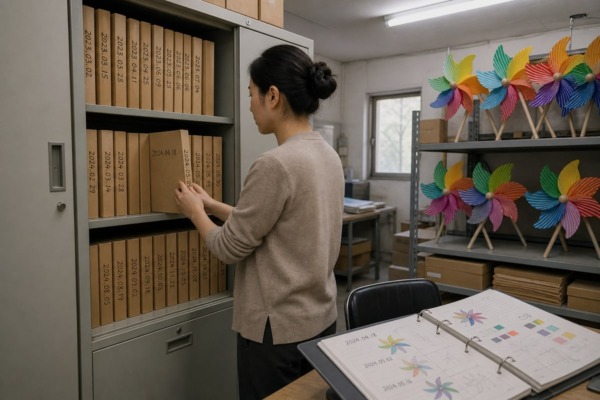
Your artwork is protected by copyright the moment it is fixed in tangible form. But that automatic protection is thin in practice. For U.S. works, you need registration before you can sue, and timely registration unlocks statutory damages 3 and attorney fees. Those remedies are what make an infringer settle quickly instead of calling your bluff.
Timing matters more than most sellers realize. One U.S. design-registration chapter closes your filing window just two years after public disclosure. Design patent protection also runs on a grace-period clock 4 that starts when you first show the product publicly. If you launched your pinwheel at a trade fair last year, some doors may already be closing. Move early.
| Protection type | What it covers on a pinwheel | Key benefit | Timing rule |
|---|---|---|---|
| Copyright registration | Printed patterns, petal artwork, packaging graphics | Statutory damages and attorney fees; right to sue for U.S. works | Protection exists at fixation, but register before disputes arise |
| Design patent protection | Ornamental blade shape, hub design, unique silhouette | Blocks lookalike shapes, supports customs seizure | File before disclosure windows expire |
| Trademark | Brand name, logo, distinctive mark on the product | Stops confusingly similar branding on marketplaces | First-to-file in China; register in both markets |
Enforce what you register
Registration is only step one. Use visual search monitoring tools to scan image-heavy marketplaces and social platforms for copies of your pattern. When you find one, a cease and desist letter backed by a registration number resolves most cases without court. Some of our clients now add blockchain provenance records too, creating an immutable timestamp of the creation date. Others build in algorithmic uniqueness, using procedural generation to create non-repeating geometric variations that are easy to prove as theirs. And one practical warning from our side: China is first-to-file for trademarks, so register your brand here as well, before someone else does.
Fazit
Original artwork, cleared licenses, enforceable agreements, and timely registration keep your pinwheel design dispute-free. If you want a supplier who checks copyright authorization before printing, our Zhufeng team is ready.
Fußnoten
1. U.S. government resource providing best practices for protecting original designs in international manufacturing. ↩︎
2. Official site for Creative Commons providing terms for various public copyright licenses. ↩︎
3. U.S. Copyright Office explanation of legal remedies including statutory damages for registered works. ↩︎
4. USPTO explanation of the grace period for filing design patent applications after public disclosure. ↩︎
Weitere Artikel
Diese könnten Ihnen auch helfen.
Wie kann man die Produktionskapazitäten einer Fabrik für Schmiedeeisen-Steckkomponenten aus der Ferne überprüfen?
Learn a practical checklist to avoid pinwheel design copyright disputes, from trademark searches to licensing, before your next…
Weiterlesen →
Wie beurteilt man die Produktionskapazität einer Fabrik bei der Beschaffung von Schmiedeeisen-Einsätzen?
Learn a practical checklist to avoid pinwheel design copyright disputes, from trademark searches to licensing, before your next…
Weiterlesen →
Welche Fragen sollten Sie Schmiedeeisen-Einsatz-Lieferanten stellen, um unzuverlässige frühzeitig zu erkennen?
Learn a practical checklist to avoid pinwheel design copyright disputes, from trademark searches to licensing, before your next…
Weiterlesen → English
  Spanish
  German
  Arabic