How to Continuously Monitor Supplier Compliance Through Annual Audits?

Three years ago, a film supplier’s expired certificate froze one of our pinwheel shipments at customs. Supplier compliance, I learned then, is never a one-time box to tick.
Überwachen Sie die Lieferantenkonformität, indem Sie das jährliche Audit als Ankerpunkt behandeln: Verifizieren Sie jährlich QS-Aufzeichnungen, Zertifizierungen und Produktionsqualifikationen, und integrieren Sie dann risikobasierte Überprüfungen, Live-Leistungs-Scorecards und dokumentierte Korrekturmaßnahmen-Tracking zwischen den Audits, wobei Lieferanten, die wiederholt keine Befunde schließen, entfernt werden.
That is the short answer. The longer answer is a working system. Below, I walk through the checklist we use, the cadence we follow, the red flags we hunt for, and how we verify fixes. Everything comes from running audits at our own pinwheel factory in Zhejiang and auditing the suppliers who feed our lines.
Was sollte ich in meine jährliche Lieferanten-Compliance-Checkliste aufnehmen?
Last spring, a batch of mylar film arrived at our Zhejiang factory with the wrong thickness. Our checklist caught it because we audit incoming materials against the supplier's own specs.
Eine jährliche Lieferanten-Compliance-Checkliste sollte gültige Zertifizierungen, Qualitätsmanagementsystem-Dokumente, Produktionslizenzen, Eingangsmaterial-Prüfprotokolle, Fehler- und CAPA-Historie, Arbeits- und ESG-Konformität, Offenlegungen von Unterauftragnehmern sowie Nachweise finanzieller Stabilität abdecken, wobei jeder Punkt bewertet und in einem zentralen Repository gespeichert wird.
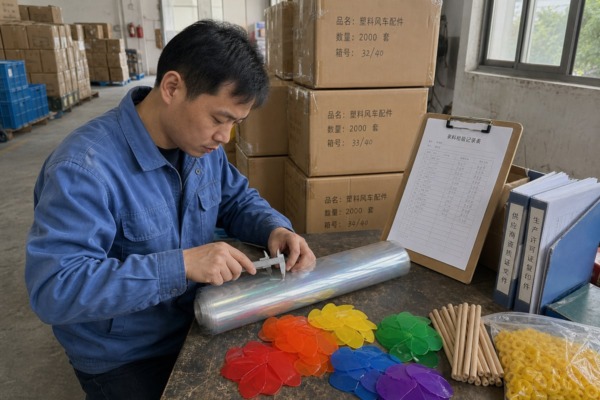
Every year, we run a full compliance audit on the suppliers behind our pinwheels: the plastic film mills, the dowel workshops, the grommet makers, and the packaging plants. We check three pillars every time. First, quality inspection records. Second, certifications. Third, production qualifications. Suppliers who fail and refuse to improve get removed from our approved list. That sounds harsh, but it protects our buyers in the United States, Europe, and South America from the delays and returns they fear most.
The Core Checklist Areas
Here is the structure we use, simplified for a distributor's procurement due diligence:
| Checklist area | What we verify | Evidence to collect |
|---|---|---|
| Certifications | Certificates are valid, current, and issued to this exact factory | Certificate copies, registry lookups, expiry dates |
| Production qualifications | Business license matches the production scope and address | License scans, site photos, capacity records |
| Quality control | Incoming, in-process, and final inspections actually happen | Inspection logs, AQL reports, defect-rate data |
| CAPA history | Past findings were closed with real fixes | Corrective Action Plan (CAPA) files, re-check records |
| Labor and ESG | Safe conditions, legal hours, waste handling | Payroll samples, safety records, ESG disclosures |
| Subcontractors | No undisclosed outsourcing of your order | Subcontractor list, purchase order trails |
| Stability | No ownership changes or payment disputes brewing | Credit checks, company registry updates |
Link the Checklist to Live Metrics
A checklist made only of documents goes stale fast. So we tie audit criteria to daily supplier performance metrics 1: on-time in-full delivery, defect rates at incoming inspection, and response time to complaints. If the paperwork says "compliant" but the OTIF number is falling, the paperwork is lying. Some larger programs now automate evidence collection through API links to certification databases, and a few even pull live ESG data from sensors in supplier facilities instead of trusting annual self-reports. We are smaller, with a team of 50, so we centralize everything in one shared digital repository. That single step alone keeps us audit-ready year-round and supports ESG reporting requirements when brand customers ask.
Wie oft sollte ich Audits planen, um Qualitätsprobleme frühzeitig zu erkennen?
Every audit day costs us production time and travel money. So I weigh audit depth against frequency carefully, and risk tiering is how I make that trade-off pay off.
Planen Sie ein vollständiges jährliches Audit für jeden aktiven Lieferanten, fügen Sie jedoch vierteljährliche Leistungsüberprüfungen für kritische Tier-1-Lieferanten hinzu, Überprüfungen alle ein bis zwei Jahre für mittelriskante Anbieter sowie ereignisgesteuerte Audits, wann immer Fehlerraten ansteigen, Zertifikate ablaufen oder sich die Eigentümerschaft ändert.

Here is the honest tension. Some buyers tell me annual audits are outdated, that continuous monitoring makes them pointless. Others insist a deep yearly on-site audit is the only check that matters. Both are half right. An annual audit tells you where a supplier stood. Continuous monitoring tells you where the supplier is now. You need both, because supplier risk changes between cycles: certificates lapse, subcontractors get swapped in quietly, and defect trends drift long before an auditor arrives. Risk managers call this "compliance drift," and it is the gap that hurts distributors with shipping delays and product returns.
Our Risk-Tiered Cadence
We segment our supply base the way most third-party risk management frameworks suggest:
| Risk tier | Example suppliers for our pinwheels | Formal audit | Ongoing monitoring |
|---|---|---|---|
| Tier 1: critical | Plastic film, printing, safety-relevant components | Full annual on-site audit plus quarterly reviews | Monthly scorecards, live defect alerts |
| Tier 2: important | Wooden dowels, grommets, retail packaging | Annual audit, or every two years if stable | Quarterly supplier performance metrics review |
| Tier 3: low-risk | Cartons, office and indirect supplies | Desk audit every two years | Yearly evidence refresh, event triggers only |
Triggers Beat the Calendar
Between scheduled audits, we run event-triggered reviews. A sudden jump in incoming defects, a late-delivery streak, a regulatory alert, or a change in factory ownership starts a vendor risk assessment 2 immediately, not at the next annual slot. Programs with automated alerting catch violations in hours instead of months, and that speed is exactly what catches quality issues early. This risk-based approach is now standard practice in supply chain risk management, and it costs far less than auditing everyone equally.
Welche Warnsignale sollte ich während eines Pinwheel-Fabrikaudits beachten?
A US procurement manager once audited our pinwheel line and asked to see our fire exits before our showroom. That visit taught me where sharp auditors look first.
During a pinwheel factory audit, watch for expired or borrowed certificates, blocked fire exits, missing incoming-inspection records, undisclosed subcontracting, inconsistent answers between managers and line workers, hidden production areas, sharp unfinished dowel edges, and quality logs filled in with identical handwriting or ink.
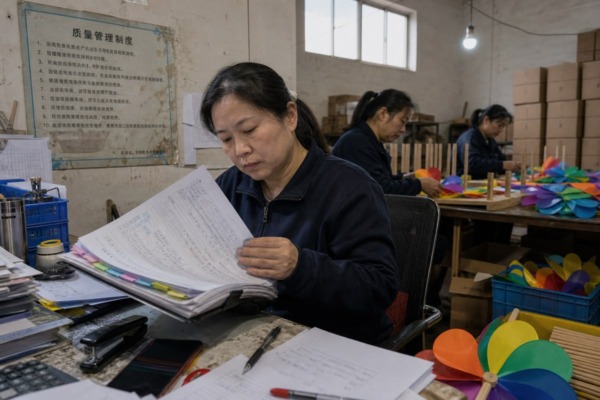
Because we host buyer audits ourselves and audit our own component suppliers, I see both sides of the table. The showroom never tells the truth. The production floor does. Strong on-site inspection protocols 3 always follow the product path: film in, cutting, pin assembly, dowel fitting, packing, container loading. Anything the factory steers you away from deserves a second look.
The Red Flags We Take Most Seriously
| Red flag | Warum es wichtig ist | What to do |
|---|---|---|
| Certificate name or address mismatch | The certificate may belong to a trading company or sister site | Verify against the official registry before the visit |
| Quality logs in one handwriting, one ink | Records were likely backfilled the night before | Cross-check dates against production and shipping records |
| Workers cannot describe the QC step | The written procedure exists only on paper | Interview line workers away from managers |
| Empty or "under renovation" workshop areas | Real production may be subcontracted out | Ask for the subcontractor list and purchase orders |
| Sharp dowel ends, exposed pin points | Direct child-safety risk on a toy product | Pull random units and test them yourself |
| Blocked exits, missing guards on cutters | Safety culture predicts quality culture | Treat it as a major finding, not a footnote |
Listen to the Floor, Not Just the Files
Behavioral signals matter as much as documents. Some advanced programs now analyze anonymous workforce sentiment and whistleblower reports to spot cultural risks that process checks miss. You can do a simple version yourself: talk to the person gluing petals onto hubs. If she knows the acceptance limits by heart, quality management systems 4 are alive in that factory. If she shrugs, the binder on the shelf is decoration, like one of our pinwheels, but far less useful.
How Can I Verify My Supplier Fixes Issues Found in Previous Audits?
I once accepted a dowel supplier's written promise to fix splinter defects. Six months later, the same defect returned. Now I never close a finding on paper alone.
Verify supplier fixes through a closed-loop CAPA process: assign each finding an owner and deadline, demand photo and document evidence, re-inspect on-site or via video within 30 to 90 days, then track the metric behind the finding for two more quarters before closing it.
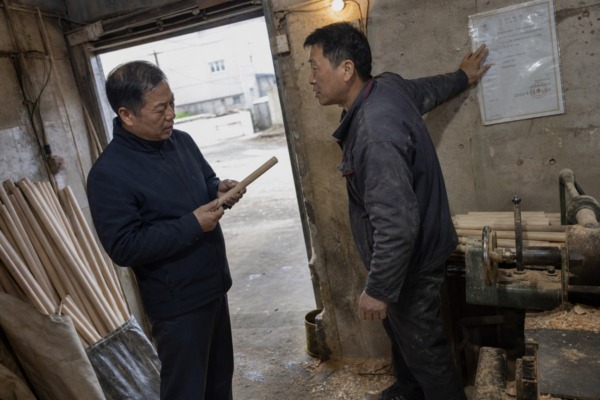
A finding without follow-through is just an expensive observation. After that splinter episode, we rebuilt our remediation process around closure evidence, not promises. The next annual audit then validates whether the whole loop actually worked, which is exactly the "anchor point" role an annual audit should play.
Our Closed-Loop Verification Steps
- Log the finding immediately. Every issue enters our register with a severity grade, a named owner at the supplier, and a deadline. No shared ownership, ever.
- Require root-cause analysis, not patches. Die Corrective Action Plan (CAPA) must explain why the defect happened. "We retrained the worker" is rarely a root cause.
- Collect closure evidence. We ask for photos, updated procedures, and sample inspection data before we mark anything resolved.
- Re-verify within 30 to 90 days. Minor findings get a video walkthrough. Major findings get an in-person re-inspection at the supplier's site.
- Watch the metric for two quarters. If the finding was a 4% defect rate, we track incoming defects on every shipment. Closure only counts if the number stays down.
- Confirm at the next annual audit. Repeat findings trigger probation. A second repeat means removal from our approved supplier list, the same rule we apply every year without exception.
Keep the Trail, and Watch the Horizon
All of this lives in one folder per supplier: findings, CAPAs, photos, re-inspection reports, and sign-offs. That audit trail documentation protects us when brand customers audit our sourcing, and it exposes suppliers who recycle the same excuse yearly. Looking ahead, some buyers are experimenting with smart contracts that hold payment automatically when a supplier falls out of a defined compliance state, and with supply chain digital twins that simulate how a rule change would hit compliance before it happens. You do not need those tools to start. You need owners, deadlines, evidence, and the discipline to cut suppliers who never close the loop.
Fazit
Annual audits tell you where a supplier stood; continuous monitoring tells you where they are now. Anchor your program in yearly audits, then keep watching, verifying, and cutting non-performers.
Fußnoten
1. Wikipedia entry defining the metrics used to evaluate and manage supplier behavior and efficiency. ↩︎
2. Wikipedia overview of the process for identifying and mitigating risks associated with third-party vendors. ↩︎
3. Official U.S. government resource on performing due diligence and inspections for international trade. ↩︎
4. Official ISO page for the global standard governing quality management systems in manufacturing. ↩︎
Weitere Artikel
Diese könnten Ihnen auch helfen.

Wie kann man die Produktionskapazitäten einer Fabrik für Schmiedeeisen-Steckkomponenten aus der Ferne überprüfen?
Verify supplier compliance year-round with a proven annual audit checklist covering certifications, QC records, CAPA tracking, and risk-tiered…
Weiterlesen →
Wie beurteilt man die Produktionskapazität einer Fabrik bei der Beschaffung von Schmiedeeisen-Einsätzen?
Verify supplier compliance year-round with a proven annual audit checklist covering certifications, QC records, CAPA tracking, and risk-tiered…
Weiterlesen →
Welche Fragen sollten Sie Schmiedeeisen-Einsatz-Lieferanten stellen, um unzuverlässige frühzeitig zu erkennen?
Verify supplier compliance year-round with a proven annual audit checklist covering certifications, QC records, CAPA tracking, and risk-tiered…
Weiterlesen → English
  Spanish
  German
  Arabic