
What First Order Quantity Balances Risk and Price for Wrought Iron Plug-In Parts?
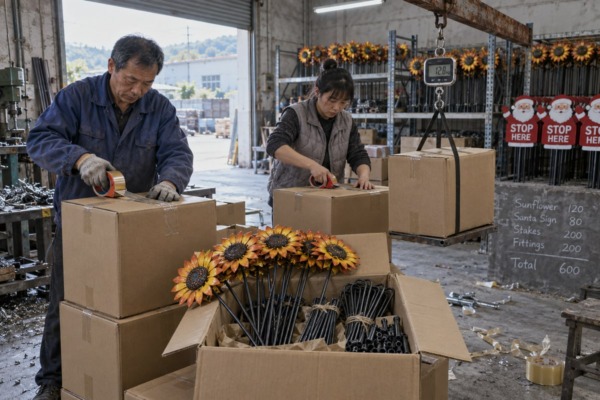
Buyers ask our Zhejiang workshop about [first order quantity for wrought iron plug-in parts](https://zhufengpinwheels.com/?p=444) weekly: go big for discounts, or small for safety quality control inspection 1? Guess wrong, dead stock eats your margin.
Die beste Erstbestellmenge für Schmiedeeisen-Steckteile ist die kleinste Staffel, die einen sinnvollen Preisnachlass bringt – in der Regel 100–500 Einheiten für Katalogartikel –, während Sie Qualität, Verpackung und Versandleistung validieren, bevor Sie größeres Geld binden.
That answer sounds simple, but the details decide whether you profit or struggle. Your procurement strategy needs a clear method, not a gut feeling. Let me walk you through the math, the price breaks, the quality tests, and the hidden costs, in that order.
Wie berechne ich die richtige MOQ für meine erste Bestellung von Schmiedeeisen-Steckteilen?
Last spring, a US procurement manager messaged me on WhatsApp: should she take our 100-piece minimum or jump to 1,000 for the discount? We ran the numbers together.
Berechnen Sie Ihre erste MOQ, indem Sie das Minimum des Lieferanten nehmen, prüfen, ob es etwa drei Monate prognostizierte Nachfrage plus Wiederbestellvorlaufzeit abdeckt, und bestätigen, dass die Barauszahlung innerhalb Ihrer Risikotoleranz bleibt – typischerweise 100–500 Einheiten für Katalogteile.

First, let's define the category clearly. Wrought iron plug-in parts include ground stakes, U-shaped prongs, plug-in rod sockets, and connector fittings. Our factory uses them daily for wind spinners, sunflower garden stakes, and holiday yard signs like our Santa stop-sign line. The exact part type matters, because catalog items, custom-finished items, and OEM-tooled parts carry very different Mindestbestellmenge rules.
Start With the Decision Formula
The right first order quantity for wrought iron plug-in parts must pass four tests at once. It qualifies for a real price break. It is large enough to test genuine demand. It covers you through the next replenishment lead time. And it does not create unacceptable inventory risk. If a quantity fails any test, adjust it.
The three-month supply benchmark is a useful anchor here. Ordering roughly three months of forecast demand protects you against typical first-order logistics or customs delays 2 without overloading your warehouse. Add modest safety stock levels only if your demand data supports it. Good lead time management matters more than raw volume.
Match Quantity to Part Type
| Part type | Typical MOQ range | Suggested first order |
|---|---|---|
| Stocked catalog stakes and prongs | 5–100 pieces | At MOQ, up to ~300 |
| Catalog items with custom finish | 200–500 pieces | 300–500 pieces |
| OEM-tooled custom plug-in parts | ~1,000 pieces | 1,000 pieces, lowest tier only |
My personal rule after years of exporting to the US, Europe, and South America: place your first order at the MOQ floor, or slightly above it. Never book a full container on round one. Treat the first order as a supply chain risk assessment 3 in physical form. Yes, the unit price runs a little higher. But you avoid the far larger losses from stock backlog, unsold styles, or a quality failure at scale. Batch size optimization comes later, once real sales data exists.
Welche Preisstaffelungen sollte ich bei unterschiedlichen Bestellmengen für diese Teile erwarten?
Every quote we send from our Zhejiang production line involves the same trade-off: deeper tiers reward volume, but the discount only pays off if the stock actually sells.
Expect the first meaningful unit-price break around 500 pieces, a second around 1,000, and the deepest tiers near 5,000, because forging and tooling setup costs spread across more units; custom-tooled parts show the sharpest early drops.
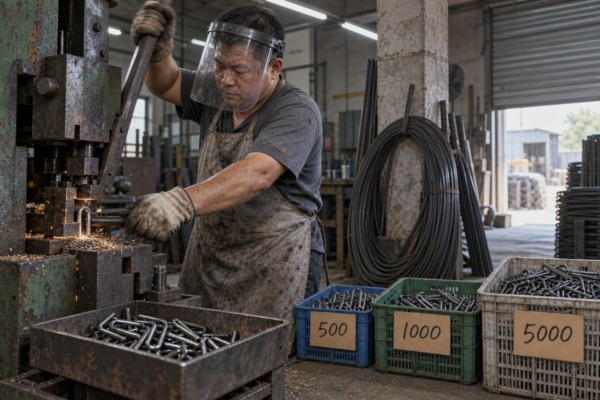
Tiered pricing is not a marketing trick. It reflects real production economics. When we set up a run of stake prongs or plug-in fittings, we pay fixed costs for die setup, batching, and packaging changeover before the first piece ships. Spreading those costs over more units is classic economies of scale 4, and it drives genuine unit cost reduction as quantity climbs.
Why the Curve Flattens
| Mengenstaffel | What usually happens to unit price | What to watch |
|---|---|---|
| At MOQ (100–200) | Baseline price; setup costs weigh heavily on each piece | Highest per-unit cost, lowest total risk |
| Around 500 | First meaningful break as batching efficiency kicks in | Good balance point for catalog items |
| Around 1,000 | Second break; tooling amortization largely complete | Common floor for OEM first runs |
| Around 5,000 | Deepest tier, but savings per extra unit shrink | Carrying costs can erase the discount |
Custom parts behave differently. For OEM plug-in parts, the first order often carries the full cost of the mold or die. That makes tiny quantities prohibitively expensive per unit. One workaround we offer buyers is insert-based modular tooling. Only the plug-in tip gets customized, while the main body uses our standard base molds. That lets you hit a lower MOQ without paying full tooling costs.
Now, the objection I hear most: "Just buy the biggest tier you can afford, the lowest unit cost wins over time." That logic holds only for standardized, non-perishable parts with proven, repeatable demand. On a first order, none of that is proven yet. Compare the cheapest unit price against total landed cost, not the list price. Suppliers now publish visible MOQ and price tiers online, which makes comparison easy—but it also tempts buyers to optimize around visible breaks instead of real delivered cost. Do not fall into that trap.
Wie kann ich die Produktqualität testen, bevor ich mich zu einer größeren ersten Bestellung verpflichte?
Our QC team once caught chipped powder coating on sunflower stake prongs during a pre-shipment check. That 300-piece pilot run saved the buyer a container-sized headache.
Testen Sie die Qualität durch einen Split-Batch-Ansatz: Bestellen Sie zuerst bezahlte Muster, dann einen kleinen Pilotlauf bei oder nahe der MOQ, um Passform, Oberflächenbeschaffenheit, Korrosionsbeständigkeit und Verpackungsüberleben zu überprüfen, und skalieren Sie erst nach echtem Marktfeedback.

The split-batch strategy is now the standard method for validating dimensional accuracy on plug-in parts. A small pilot run confirms the physical fitment, and a larger bulk order follows only after the pilot passes. Here is the exact sequence I recommend to every distributor we work with:
- Order paid samples first. Two to five pieces. Check the plug-in interface fit, the coating thickness, and the weld points by hand.
- Lock a written spec sheet. Agree on dimensions, finish standards, and packaging method before production starts. Vague specs cause most disputes.
- Run a pilot batch at or near MOQ. Samples are often hand-finished. Only a real production run shows batch consistency.
- Book a quality control inspection before shipment. Either a third-party inspector or documented photos and videos from the factory floor. We provide both on request.
- Audit the shipment on arrival. Count ocean-freight damage, check for surface rust, and photograph packaging condition. Iron parts on long US or South America routes take real abuse in transit.
- Track vendor performance metrics from day one. Record defect rate, on-time delivery, and packaging survival. These numbers justify—or block—your bulk reorder.
One newer trend worth noting: some buyers now use high-fidelity 3D simulations and digital twins of the plug-in interface to stress-test the connection virtually. That reduces mechanical failure risk and supports a more confident larger order. It complements a physical pilot run; it does not replace one. In my experience, the goals of the first order are simple—verify quality, lead time, packaging, and ocean shipping damage. When market feedback comes back positive, reorder immediately.
I learned this lesson the hard way early in my export career: a distributor compared only unit prices, ordered big, and then paid more in storage and rust losses than he saved.
Berücksichtigen Sie Frachtkosten für schweres Eisen, Lager- und Rostschutzkosten, im Lager gebundenes Kapital, Ausschuss- und Nacharbeitszuschläge, Zollverzögerungen und das Risiko langsam drehender Bestände – zusammen überwiegen diese versteckten Kosten oft den Stückrabatt einer größeren Staffel.
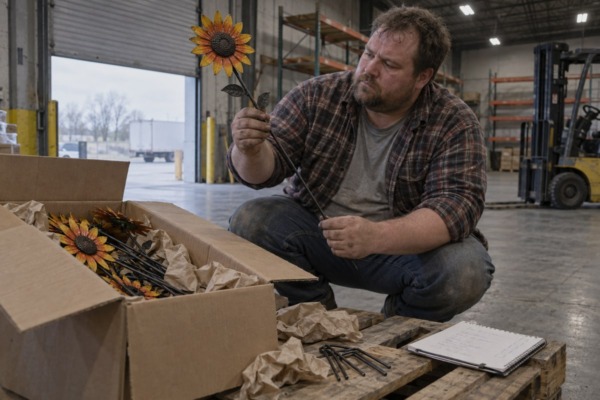
Wrought iron punishes careless buyers in two specific ways. It is exceptionally heavy, so freight charges scale brutally with quantity. And it is prone to oxidation, so slow inventory turnover invites surface rust damage sitting in a humid warehouse. A big first order magnifies both problems at once.
The Cost Lines That Change Your Quote
| Versteckte Kosten | Why it hits wrought iron hard | Wie man sie kontrolliert |
|---|---|---|
| Seefracht | Weight-based pricing; iron parts are dense | Start with a partial container, not a full one |
| Warehousing and carrying | Bulky stakes eat rack space for months | Size orders to ~3 months of demand |
| Rust-prevention packaging | Coastal shipping and humid storage cause oxidation | Specify coated finishes and sealed packaging |
| Defect and rework allowance | Faults surface only after unboxing at scale | Pilot run plus pre-shipment inspection |
| Cash tied up in stock | Capital frozen until sell-through completes | Keep the first order at or near MOQ |
| Customs and logistics delays | Late arrival can strand a seasonal product | Build lead time buffers into the plan |
Lagerhaltungskosten are the quiet killer. Buyers today watch working capital efficiency closely, and smaller test orders have become the norm when demand is uncertain. Supplier flexibility—ready stock, low MOQ, fast delivery—is now valued as much as per-unit savings. We restructured part of our own line around that demand.
Timing and Material Costs
Two advanced levers deserve a mention. First, raw material timing: some buyers use dynamic buffer indexing tied to scrap metal market volatility, placing the first order when raw iron prices sit at a cyclical low. That offsets the "new part" price premium of a small run. Second, sustainability math: factoring green steel scrap value and carbon footprint metrics into the calculation can justify the slightly higher per-unit cost of smaller, cleaner initial runs. Run the full comparison before you sign. If a sharp price break at a higher tier still beats your combined warehousing and carrying costs over the expected sell-through period, take it. If not, the smaller order wins.
Fazit
Chasing the deepest discount on day one invites dead stock and rust losses. Start at MOQ or slightly above, validate quality and logistics, then scale with real data behind you.
Möchten Sie die in diesem Artikel erwähnten Produkte beschaffen? Details ansehen und hier ein Angebot anfordern:
Fußnoten
1. ISO is the global authority for quality management standards and inspection protocols. ↩︎
2. Official US Customs authority providing guidance on import regulations and potential logistics bottlenecks. ↩︎
3. The International Trade Centre offers resources for small businesses managing international supply chain risks. ↩︎
4. Standard economic definition of how increasing production volume reduces per-unit costs. ↩︎
Weitere Artikel
Diese könnten Ihnen auch helfen.

Wie kann man die Produktionskapazitäten einer Fabrik für Schmiedeeisen-Steckkomponenten aus der Ferne überprüfen?
Find the right first order quantity for wrought iron plug-in parts: enough to unlock real price breaks, small…
Weiterlesen →
Wie beurteilt man die Produktionskapazität einer Fabrik bei der Beschaffung von Schmiedeeisen-Einsätzen?
Find the right first order quantity for wrought iron plug-in parts: enough to unlock real price breaks, small…
Weiterlesen →
Welche Fragen sollten Sie Schmiedeeisen-Einsatz-Lieferanten stellen, um unzuverlässige frühzeitig zu erkennen?
Find the right first order quantity for wrought iron plug-in parts: enough to unlock real price breaks, small…
Weiterlesen → English
  Spanish
  German
  Arabic