
What Cost Factors Should Guide Retail Pricing for Pinwheel Strings?
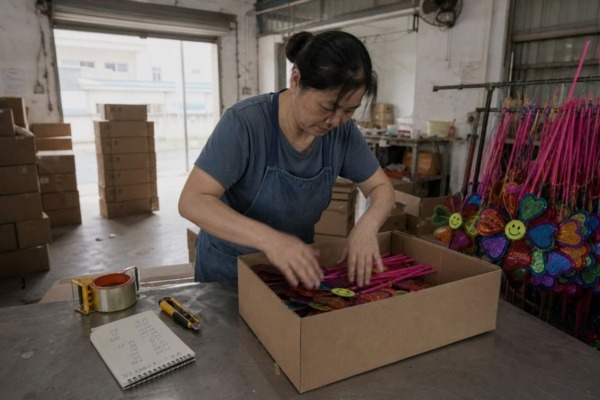
Retail pricing for pinwheel strings trips up more buyers than any spec sheet. On our production line in Zhejiang, I watch importers underprice these products almost every season.
Einzelhandelspreise für Windrad-Girlanden sollten auf den gesamten Landed Cost basieren — Fabrikpreis, Fracht, Zölle, Verpackung und Vertriebsgebühren — plus Gemeinkosten, Schwund und Arbeitskosten. Anschließend eine Ziel-Bruttomarge anwenden, angepasst an Materialqualität, fertige versus halbfertige Formate und Marktnachfrage.
The parts look cheap. Plastic film, a stick, a pin. That illusion is the trap. Below, I break down each cost layer so your final shelf price actually protects your business.
Wie berechne ich meine gesamten Landed Costs, bevor ich einen Einzelhandelspreis für Windrad-Schnüre festlege?
Last spring, a US distributor emailed me in a panic. Her freight invoice had nearly matched her product invoice. She had quoted retailers based on factory price alone. Our team helped her rebuild the numbers from scratch.
Berechnen Sie die gesamten Einstandskosten, indem Sie den Fabrikstückpreis, internationale Fracht, Zölle, Versicherung, Maklergebühren und lokale Anlieferung addieren und dann durch verkäufliche Einheiten teilen. Diese Zahl ist Ihre Gewinnschwelle; importierte Windradketten weisen oft Einstandskosten auf, die 15 %–30 % über dem Kaufpreis liegen.

Landed cost 1 is the true starting point for any retail markup formula. I tell every procurement manager the same thing: the price on my quotation is not your cost. Your cost is what a unit is worth when it sits in your warehouse, ready to sell.
The five layers of landed cost
Here is how I recommend structuring the math. Each layer must be assigned per unit, not left as a lump sum on a spreadsheet somewhere.
| Cost Layer | What It Includes | Typical Impact |
|---|---|---|
| Factory price | Ex-works or FOB unit price from your supplier | The base number |
| Freight | Ocean or air, plus fuel surcharges | Often the largest add-on |
| Duties and customs | Tariffs, brokerage, entry fees | Varies by HS code and origin |
| Domestic logistics | Drayage, warehouse receiving, transfer | Frequently forgotten |
| Loss allowance | Damaged, defective, or unsellable units | Budget for it up front |
One more point matters for this specific product. Pinwheel strings are bulky and light, so carriers charge by volumetric weight, not actual weight. A carton of pre-assembled strings can cost more to ship than the goods inside are worth. When we pack strings at our factory, we compress cartons as tightly as blade curvature allows, because every wasted cubic centimeter shows up in your shipping and logistics costs.
Also budget for shrinkage. US retail inventory shrink 2 averaged around 1.6% of total retail sales in one NRF-based figure. Breakage on delicate spinners can push your real loss rate higher, so build it into the floor price rather than treating it as an exception.
Welche Fertigungs- und Individualisierungsfaktoren beeinflussen meine Stückpreise bei Lieferanten wie Zhufeng am meisten?
The single biggest pricing question I ask new buyers is deceptively simple: do you want a finished product or a semi-finished one? That one answer shifts the unit economics more than almost any other spec on the order sheet.
Der Stückpreis wird von drei Faktoren bestimmt: ob die Windmühle fertig oder halbfertig ist, das für Flügel und Beschläge verwendete Material sowie die Seltenheit des Designs. Vormontierte Stränge, Premiumfolien und ungewöhnliche Sonderformen erhöhen die Kosten; flach verpackte Bausätze und Standard-PVC senken sie.

In my own experience quoting pinwheel strings for US and European buyers, these three levers — finished versus semi-finished, material, and rarity — explain most of the spread between a budget quote and a premium one. Let me walk through each.
Finished versus semi-finished
A finished, ready-to-hang string carries our assembly labor inside the price. A semi-finished kit — petals, dowel stick, pin, and grommets packed flat, like our DIY sets — pushes assembly to your side or to the end consumer. The trade-off is real. Flat-packed goods cut volumetric shipping weight 3 and factory labor, but "ready-to-hang" convenience commands a higher shelf price. You are balancing assembly overhead against retail value.
Material choices
Material sourcing expenses matter more than most buyers expect. Standard PVC film is cheap but can crack in cold climates. High-grade polypropylene resists cracking and holds color longer, but it costs more per roll. Our glittery holographic foils, like the sequin-textured petals on our flower spinners, sit at a premium above plain matte film.
Rarity of the design
A common eight-petal rainbow spinner is a commodity. A six-flower cluster with smiling-face caps and heart-shaped metallic petals is not. Rare or exclusive designs need custom molds and dies, and that tooling cost gets amortized across your order. Rarity also supports higher retail prices, because shoppers cannot comparison-shop an exclusive design.
| Factor | Budget Option | Premium Option | Pricing Effect |
|---|---|---|---|
| Format | Flat-packed DIY kit | Pre-assembled, ready to hang | Labor and freight shift between parties |
| Blade material | Standard PVC | Polypropylene or holographic foil | Higher cost, better durability and shine |
| Design rarity | Stock catalog shape | Exclusive custom mold | Tooling cost, but stronger margin protection |
| Stick material | Plastic pole | Natural wooden dowel | Small cost bump, handcrafted feel |
How should shipping, packaging, and MOQ costs influence my final retail markup?
A buyer once rejected a full container from a competitor because half the blades arrived flattened. She came to us afterward, and packaging became the first topic of our call — before price, before design.
Shipping, packaging, and MOQ terms should be priced into your markup before margin is added. Volumetric freight can exceed product value, crush-proof retail packaging cuts return rates, and tiered MOQ discounts let you protect margins on small packs while staying competitive on bulk.

These three cost centers connect directly to your inventory turnover rate and your net margin, so treat them as one system rather than three line items.
Packaging is a cost and a value signal
Packaging and labeling costs do double duty. A crush-proof carton with internal supports keeps blade curvature intact through the final mile of delivery. That reduces returns, which are one of the biggest hidden margin killers for decorative goods. But retail-ready packaging — backing cards, hang tags, printed sleeves — also raises perceived value, which supports a higher shelf price. Our factory offers both bulk poly-bag packing and retail-ready options, and I always show buyers the per-unit difference so they can price accordingly.
MOQ tiers and bulk purchase discounts
Bulk purchase discounts change your cost of goods sold at every tier. The smart move is tiered pricing on your side too: higher margins on small retail packs, sharper wholesale unit price for volume buyers. Here is a simplified structure I share with distributors:
| Order Tier | Buyer Type | Cost Behavior | Suggested Approach |
|---|---|---|---|
| Small (near MOQ) | Boutique retailers | Highest per-unit cost | Price for margin, not volume |
| Mid-tier | Regional chains | Freight efficiency improves | Moderate discount, hold margin |
| Bulk (container) | Sub-distributors | Lowest landed cost per unit | Competitive pricing, win on volume |
Measure by linear foot, not by string
One more practical tip. Price on cost per linear foot rather than cost per string. Pinwheel density and total coverage vary between designs, so per-string comparisons can mislead you when quotes come from different suppliers.
What pricing strategy will protect my profit margins while staying competitive in the US market?
The hardest lesson I have learned exporting to the US is this: some buyers race to the lowest price and lose money on every sale; others price on value and reorder every season. The difference is strategy, not luck.
Use margin-based pricing: Retail Price = Total Unit Cost ÷ (1 − Desired Gross Profit Margin). Let full landed cost set your floor and market positioning set your ceiling. Add premiums for durability, exclusivity, and warranties, and keep separate price lists for wholesale and direct retail.

Some sellers argue that a simple fixed multiplier — 2x, 2.5x, 3x on cost — is faster and good enough. I understand the appeal, and craft-pricing guides do recommend multipliers in the 2x to 4x range. But here is why I push back: a flat multiplier ignores channel fees, overhead allocation, and shrinkage, which vary too much between sellers. Marketplace and platform fees alone can eat 10% to 25% of the sale price. If your multiplier was calibrated for a fee-free channel, one marketplace listing can wipe out your gross profit margin.
Other buyers tell me price should simply follow what customers will pay. That is half right. Price elasticity of demand is real for decorative items — perceived value can far exceed input cost. But market-based pricing 4 without a cost floor is how sellers go broke on strong sales. The synthesis: cost sets the floor, positioning sets the ceiling.
A worked example
Suppose your total unit cost — landed cost plus overhead, packing labor, shrinkage allowance, and channel fees — comes to $2.40 per string. With a 50% target margin, the retail markup formula gives you $2.40 ÷ 0.50 = $4.80. At a 60% margin, $6.00.
Where to add premiums
Not every string should carry the same margin. Charge more where value is provable:
- Wind-load tested strings for coastal or rooftop installs.
- Multi-year no-fade materials, positioned as durable decor rather than disposable items — a competitive pricing strategy that shifts the conversation away from price.
- Exclusive designs and regional color palettes that match local aesthetic trends.
- Ready-to-hang convenience versus flat-packed kits.
Finally, keep wholesale and retail lists separate. Your wholesale unit price must leave room for the retailer's own margin — roughly half of a final retail price typically traces back to goods cost, with the rest covering supply-chain margins. If you quote sub-distributors your direct-to-consumer price, you have priced them out of the deal.
Conclusion
Underpricing pinwheel strings is easy because the parts look cheap. It quietly drains profit. Build from full landed cost, add every hidden layer, then apply a disciplined margin — and your pricing becomes an asset, not a gamble.
Footnotes
1. Official government resource for calculating total import costs and international trade duties. ↩︎
2. Authoritative statistics on retail inventory loss and shrinkage rates in the United States. ↩︎
3. Technical definition of dimensional weight used by carriers to price bulky, lightweight shipments. ↩︎
4. Overview of pricing strategies based on market conditions and consumer perceived value. ↩︎
More Articles
You might also find these helpful.

Welche Brandschutz-Zertifizierungen sollte ich beim Kauf von Windrädern prüfen?
Learn how landed cost, freight, and duties shape retail pricing for pinwheel strings, plus a simple formula to…
Read More →
Wie überprüfe ich die Echtheit von Prüfberichten beim Kauf von Windturbinen?
Learn how landed cost, freight, and duties shape retail pricing for pinwheel strings, plus a simple formula to…
Read More →
Wie kann ich prüfen, ob Windrad-/Windmühlenmaterialien schädliche Chemikalien enthalten?
Learn how landed cost, freight, and duties shape retail pricing for pinwheel strings, plus a simple formula to…
Read More → English
  Spanish
  German
  Arabic