
How to Check if Pinwheel/Windmill Materials Contain Harmful Chemicals?
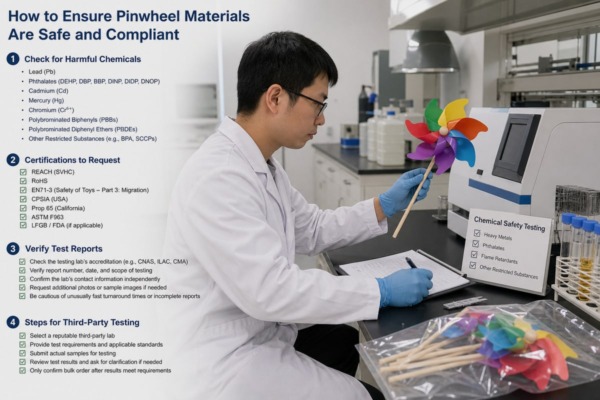
Every week, buyers ask me whether pinwheel materials contain harmful chemicals. On our production line in Zhejiang, one bad film batch can poison an entire shipment’s reputation.
To check if pinwheel or windmill materials contain harmful chemicals, request third-party test reports covering lead, phthalates, and heavy metals, verify ASTM F963 and CPSIA compliance, confirm a valid Children’s Product Certificate, and arrange independent lab testing on production samples before approving any bulk order.
That answer sounds simple. In practice, each step has traps. Fake reports exist. Vague “non-toxic” labels exist. Suppliers swap materials mid-order. This guide walks through each checkpoint, in the order a real procurement manager would face them. I will also explain which chemicals actually matter for a plastic-and-wood pinwheel, and which scary headlines belong to industrial wind turbine blades instead.
What certifications should I ask my pinwheel supplier to provide for chemical safety?
A procurement manager from Ohio once opened our WhatsApp chat with one blunt question: which papers prove your pinwheels are safe? Her directness saved both of us weeks.
Ask your pinwheel supplier for a Children's Product Certificate, ASTM F963 test reports from a CPSC-accepted lab, CPSIA compliance documentation covering lead and phthalates, EN71 reports for Europe, and a Material Safety Data Sheet for each plastic film, paint, and coating used.
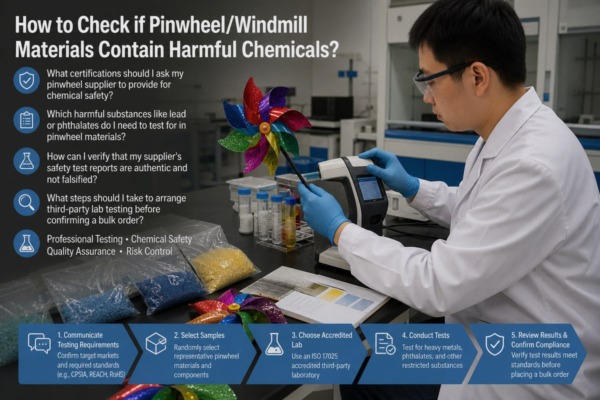
The paperwork matters because a pinwheel sold in the United States is almost always classified as a children's product. That classification triggers mandatory testing, not optional testing. When we ship to US distributors, we cannot legally rely on our own factory's word. The law requires third-party proof.
The core documents, ranked by importance
Here is how I rank the documents when a buyer like Olivia asks. The first two are non-negotiable for the US market.
| Document | What it proves | Market | Non-negotiable? |
|---|---|---|---|
| Children's Product Certificate (CPC) | The product passed third-party testing at a CPSC-accepted lab | United States | Yes |
| ASTM F963 certification report | Compliance with the US toy safety standard, including heavy metal testing | United States | Yes |
| CPSIA lead and phthalate reports | Lead and phthalate levels sit under federal limits | United States | Yes |
| EN71 test report | Compliance with the EU toy safety standard | Europe | Yes, for EU orders |
| Material Safety Data Sheet (MSDS) | Chemical composition of films, inks, glues, and coatings | Alle | Strongly recommended |
| REACH declaration | Restricted substances under EU chemical rules | Europe | Recommended |
Why a CPC is different from a marketing claim
A "non-toxic" sticker on packaging is a claim. A CPC is a legal certificate that names the manufacturer, the applicable rules, the test dates, and the accredited lab. If a supplier offers you the sticker but hesitates on the certificate, walk away. In our export files, every US-bound pinwheel SKU has its own CPC tied to specific lab report numbers. Also ask whether the supplier tracks Prop 65 warnings 1 if you sell into California, since Prop 65 covers listed chemicals beyond federal toy rules. Our team keeps a Prop 65 substance checklist for exactly this reason, because California retailers ask about it more than any other state.
Which harmful substances like lead or phthalates do I need to test for in pinwheel materials?
Last spring, our QC team rejected a full roll of red PET film because the pigment vendor changed formulas without notice. That near miss rewrote our incoming-material checklist.
Test pinwheel materials for total lead in substrates and lead-based paint, eight restricted phthalates including DEHP and DINP, cadmium and other heavy metals in pigments, BPA in polycarbonate parts, and volatile organic compounds in glues, inks, and surface coatings.

My own sourcing rule, built over years of exporting, is simple: demand a material test report from every upstream vendor, and focus the review on phthalates and heavy metals 2, because those are the substances US regulators actually control and customs actually checks. Everything else is secondary.
The substances and where they hide
A pinwheel looks like one product. Chemically, it is five or six. Each part carries its own risk profile.
| Substance | Where it hides in a pinwheel | US limit or rule |
|---|---|---|
| Lead | Painted wooden dowels, coated metal pins, colored films | 90 ppm in paint; 100 ppm in substrates under CPSIA |
| Phthalates | Soft PVC blades, flexible connectors, plasticized films | 0.1% max for each of eight restricted phthalates |
| Cadmium and heavy metals | Bright yellow, orange, and red pigments | ASTM F963 soluble heavy metal limits |
| BPA | Polycarbonate hubs or grommets (rare in our designs) | No federal toy limit, but buyers demand BPA-free plastics |
| VOCs and solvents | Glues, inks, strong-smelling coatings | Flagged by odor and lab screening |
Watch the recycling codes
Avoid blade films marked with recycling codes #3, #6, or #7. Code #3 is polyvinyl chloride 3 (PVC), the most common phthalate carrier. Codes #6 and #7 raise styrene and BPA questions. Our standard blades use PET or mylar film with polypropylene fittings, which sidesteps most of these issues by design. Also inspect holographic or glitter films for flaking, since those thin layers can shed heavy-metal pigments and microplastic particles that a toddler could ingest.
Do not confuse pinwheels with wind turbines
Online searches mix these topics together. Industrial wind turbine blades use fiberglass in epoxy resin, and critics note epoxy systems can contain 30–40% BPA by formulation, with debate over erosion releasing particles. Yet a 2024 Dutch field measurement found BPA behind a turbine at just 0.005 ng/m³, and fact-checkers found no evidence of dangerous emissions. Either way, none of that chemistry applies to a PET film pinwheel on a wooden stick. Test the product you are actually buying.
How can I verify that my supplier's safety test reports are authentic and not falsified?
Years ago, a forged lab report nearly cost one of our distribution partners a customs seizure. Since that scare, I verify every document twice, including our own factory's files.
Verify test reports by contacting the issuing laboratory directly with the report number, checking the lab appears on the CPSC-accepted list, matching product photos and dates inside the report to your actual order, and confirming any QR code resolves to the lab's official domain.
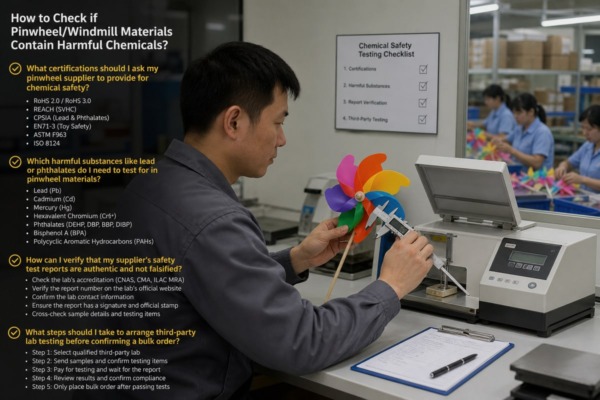
Falsified reports are more common than most new buyers expect. The forgeries fall into two types. The first is a fully fake PDF with a copied logo. The second is subtler and more dangerous: a genuine report borrowed from a different product, a different factory, or an expired testing year. Both types pass a casual glance. Neither survives a structured check.
My five-step verification process
- Call or email the lab, not the supplier. Major labs like SGS, Intertek, Bureau Veritas, and TÜV all run report-verification services. Give them the report number and ask them to confirm the client name, product description, and issue date.
- Check the CPSC-accepted lab list. If the issuing lab is not on the official CPSC list for the cited test, the report is worthless for US compliance even if it is real.
- Match the photos. Genuine reports include product photos. Compare them to your samples. A blue six-petal pinwheel in the report cannot certify your eight-petal rainbow design.
- Check dates against production. A report from three years ago does not cover this year's material batches. We re-test whenever a film, ink, or paint source changes.
- Scan the QR code carefully. Confirm it opens the lab's real domain, not a lookalike site. Fraudsters now build fake verification pages.
One more habit I recommend: request the raw MSDS documents alongside the reports. A supplier who can hand over material data sheets 4 for every film and coating usually has nothing to hide. A supplier who stalls on paperwork usually does.
What steps should I take to arrange third-party lab testing before confirming a bulk order?
Every bulk order forces the same trade-off in my planning meetings: independent testing costs money and about a week, while skipping it risks a rejected container at US customs.
Select a CPSC-accepted lab such as SGS, Intertek, or Bureau Veritas, pull random samples from actual production rather than golden samples, specify CPSIA lead and phthalate protocols plus ASTM F963, and make final payment conditional on passing results written into your purchase contract.
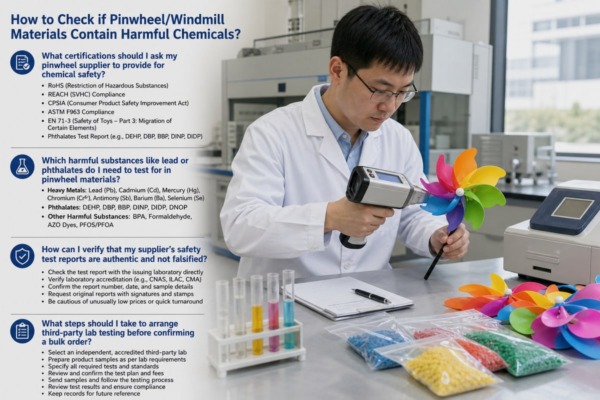
The single biggest mistake I see buyers make is testing the pre-production sample instead of the production run. Factories polish samples. Real risk lives in the bulk materials bought at scale, where a cheaper pigment or a switched film can slip in. When our own US clients arrange testing, we encourage them to have the lab or a third-party inspector draw samples randomly from finished cartons. It protects them, and honestly, it protects us too, because it documents that our line held spec.
A practical testing timeline
| Stage | Action | Typical timing |
|---|---|---|
| Before deposit | Agree on test scope in the contract: CPSIA lead, phthalates, ASTM F963 heavy metals | Day 0 |
| Pre-production | Confirm material list: film type, non-toxic finishes, ink and glue MSDS | Week 1 |
| Mid-production | Book the lab and schedule random sampling | Mid-run |
| End of production | Inspector pulls samples from sealed cartons | Final week |
| Before balance payment | Review passing report; release payment only after | About one week after sampling |
Scope the test to the whole product
Do not test the blades alone. Specify the painted wooden dowel, since lead-based paint risk lives there. Specify the metal pin and any anti-corrosive coating on it, because plated fasteners carry different hazards than the plastic parts. Specify glitter or holographic layers separately. Finally, if the pinwheel will live outdoors, mention UV exposure to the lab, since sun degradation can change how stable a plastic stays over a season. A complete scope costs slightly more but closes every gap a partial test leaves open.
Conclusion
Chemical risk hides in paperwork gaps, not appearances. Demand real certificates, test for lead and phthalates, verify every report, and tie payment to independent lab results.
Footnotes
1. Official California government site providing information on Proposition 65 chemical listing and warning requirements. ↩︎
2. Official CPSC portal for manufacturers providing guidance on safety standards, including heavy metal restrictions for toys. ↩︎
3. Authoritative NIH source providing comprehensive chemical identification and safety data for polyvinyl chloride. ↩︎
4. OSHA’s Hazard Communication standard which governs the requirements for Material Safety Data Sheets and safety documentation. ↩︎
More Articles
You might also find these helpful.

Welche Brandschutz-Zertifizierungen sollte ich beim Kauf von Windrädern prüfen?
Learn the exact certifications, tests, and red flags for verifying pinwheel and windmill materials are free of harmful…
Read More →
Wie überprüfe ich die Echtheit von Prüfberichten beim Kauf von Windturbinen?
Learn the exact certifications, tests, and red flags for verifying pinwheel and windmill materials are free of harmful…
Read More →
How Can I Tell If a Supplier's Quote Includes Certification Fees?
Learn the exact certifications, tests, and red flags for verifying pinwheel and windmill materials are free of harmful…
Read More → English
  Spanish
  German
  Arabic