How Can I Tell If a Supplier’s Quote Includes Certification Fees?
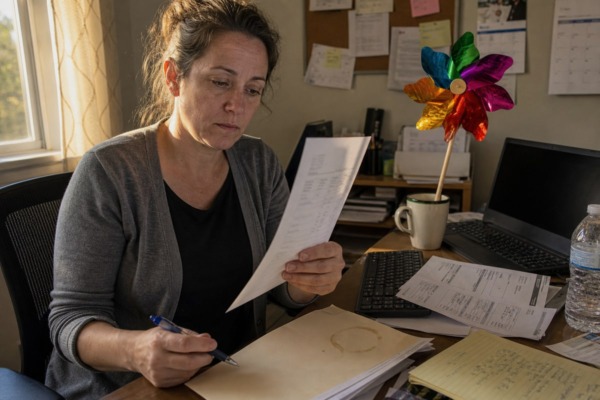
A supplier’s quote that includes certification fees looks identical to one that doesn’t — until the invoice arrives. On our pinwheel production line, I’ve watched buyers learn this the hard way.
Check whether the quote explicitly lists certification, testing, and inspection fees as included line items. If the quote shows only a unit price, or its terms say certifications are “excluded unless stated” or charged “if applicable,” assume the fees are not included and request an itemized revision.
That one habit prevents most disputes. Below, I’ll show you exactly where certification fees hide, what they cost on toy products like ours, and how to [compare quotes fairly](https://zhufengpinwheels.com/?p=683).
How can I get a supplier to break down certification costs in their quote?
Last spring, a US distributor messaged us on WhatsApp asking why our pinwheel quote listed testing separately. She thought it was a surcharge. Actually, it was transparency.
Add a mandatory cost breakdown analysis clause to your Request for Quotation (RFQ). Require the supplier to itemize unit price, tooling, testing, certification documents, and inspection separately, and to state in writing that no other compliance charges apply to your exact specification.

My own rule, which I share with every new buyer, is simple. Proactively ask whether the quoted price covers testing and certification fees, and demand a list of every certification item by name. Do this before you approve the order, not after. It is the only reliable way to avoid extra certification costs being added later.
Put the Requirement in the RFQ, Not the Email Thread
Buyers often ask about certification casually in chat. That is a mistake. Chat answers get lost. Instead, write the requirement into the Request for Quotation itself. Ask for a line item breakdown that names each document. In steel sourcing, buyers look for line items like "EN 10204 3.1" material certificates. In our toy world, you should look for named line items such as "EN71 test report," "ASTM F963 testing 1," "CoC," or "third-party testing reports." If those names appear with a price — or with the word "included" — you have clarity. If they appear nowhere, you have risk.
Wording That Signals Excluded Fees
Also read the assumptions and exclusions section. Suppliers frequently list compliance testing there as a buyer-side responsibility.
| Phrase in the quote | What it usually means | What you should do |
|---|---|---|
| "Excluded unless otherwise stated" | Certification is not in the price | Ask for a revised, itemized quote |
| "Charged if applicable" | Fees will appear later | Demand the exact amount now |
| "Buyer-specific certification extra" | Your market's documents cost more | List your documents by name |
| "Documentation charges apply" | Even paper certificates are billed | Get each charge quantified |
| "Prices include certification" | Fees are covered — confirm scope | Ask which certificates, in writing |
What certification fees should I expect when sourcing pinwheels from China?
Every new pinwheel design leaving our Zhejiang factory visits a third-party lab first. The dowel gets a sharp-point check; the petals get a phthalate screen. Someone pays for that.
Expect fees for third-party testing to ASTM F963 and CPSIA for the US, EN71 and CE marking for Europe, plus a Children's Product Certificate, Certificate of Origin, and optional pre-shipment inspection. These are usually one-time or per-batch charges billed separately from the unit price.
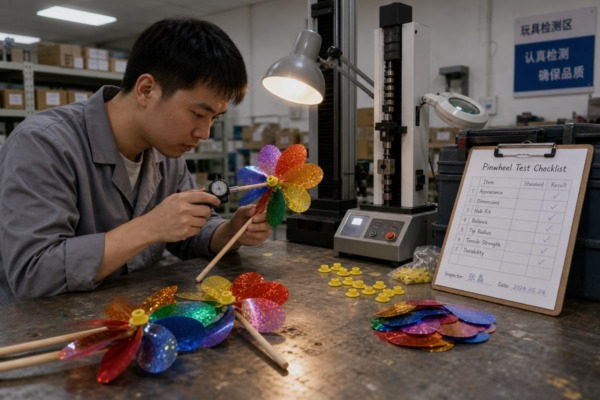
A pinwheel looks simple. It is a plastic flower on a wooden stick. But if children can hold it, regulators treat it as a toy, and product compliance documentation follows toy rules. Our eight-petal rainbow pinwheels get tested for sharp points on the dowel, small parts like the yellow hub grommets, and chemical content in the colored film.
Product Certifications vs. System Certifications
Here is a distinction that confuses many buyers. A quote may proudly mention the factory's ISO 9001 status. That is a system certification. It describes the supplier's quality assurance protocols 2, not your product. It does not replace batch-specific safety testing. Your shipment still needs its own third-party testing reports for your destination market. When a quote says "certified factory," always ask: certified system, or certified product?
| Fee type | Market | Typical billing basis |
|---|---|---|
| EN71 testing and CE marking requirements | Europe | One-time per design, retest on material change |
| ASTM F963 / CPSIA testing, CPC | United States | One-time per design, per age grading |
| Certificate of Origin | Global | Per shipment |
| Pre-shipment inspection | Buyer's choice | Per order |
| Factory audit fees (social or technical) | Brand programs | Annual or per audit |
Where One-Time Fees Hide
Watch the amortization strategy too. Some suppliers bury one-time certification costs — a form of NRE fee — inside the unit price of your first production run instead of billing a flat fee. Your first order looks expensive; your reorder looks cheap. Neither price is dishonest, but you should know which model you are being quoted.
How do I compare quotes when certification fees aren't clearly stated?
There's a trade-off I weigh whenever we quote: bundle testing into the unit price and look expensive, or quote it separately and risk looking complicated. Buyers face the mirror image.
Convert every quote to total landed cost. Add estimated testing, documentation, inspection, and freight to each supplier's unit price using the same Incoterms, quantity, and currency. Then compare the totals. A quote that omits certification fees should have your own estimate added before comparison.
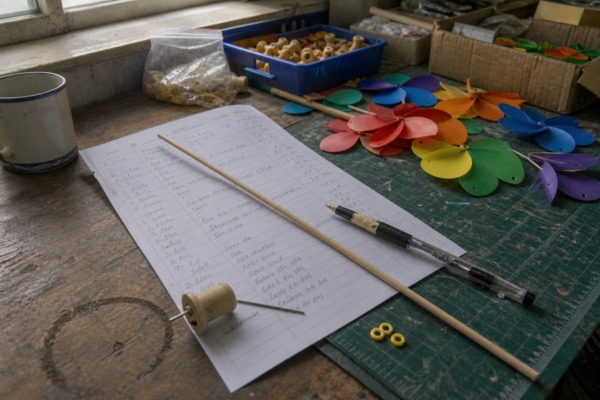
Never compare headline prices directly. Follow this sequence instead:
- Put every quote on the same Incoterms basis. An Ex Works quote 3 excludes the administrative and physical costs of export-required certifications, so it will always look cheaper than an FOB or DDP quote.
- Add certification and testing costs. If a supplier will not state them, request them; if they still will not, estimate them yourself and note the assumption.
- Add inspection, freight, duties, and any compliance surcharges.
- Compare the resulting landed totals, not the unit prices.
Build a Landed-Cost Worksheet
Here is a simplified version of what a suspiciously cheap quote can look like once hidden procurement costs surface:
| Cost element | Quote A (all-in) | Quote B (unit price only) |
|---|---|---|
| Unit price basis | Includes testing and CoC | Product only, Ex Works |
| Third-party testing | Included | Added later |
| Documentation charges | Included | Added later |
| Pre-shipment inspection | Included | Added later |
| Comparable landed position | Transparent from day one | Cheaper on paper, costlier in practice |
A suspiciously low unit price often omits exactly these items, including third-party witnessed inspections.
Watch for New-Style Surcharges
Quotes are also evolving. Some now carry compliance surcharges tied to ESG regulations, such as CBAM-related fees on carbon-intensive inputs, in place of traditional certification labels. Others list digital traceability fees for blockchain-backed Digital Product Passports instead of paper certificates. Regional documentation norms differ too: high-compliance manufacturing hubs often bundle certificates into a loaded machine rate, while other regions treat them as negotiable add-ons. A regulatory compliance audit of each quote's fine print keeps these from surprising you.
Years of exporting pinwheel strings to the US and Europe taught me one lesson: the questions buyers skip before ordering become the disputes we settle after shipping.
Ask five questions in writing: Is certification included in the quoted price? Which compliance documents come with the order? Are third-party testing, audit, and inspection costs covered? Will spec changes trigger new fees? Is the quote complete for my destination market? Keep the answers on record.
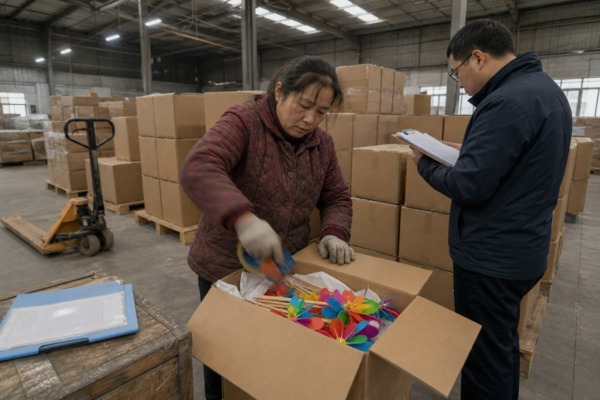
I encourage buyers to treat this like a script. Copy it into WhatsApp or email exactly as written, then archive the reply. Written answers become part of your supplier verification process and your audit trail if an invoice dispute ever arises.
- Is certification included in the quoted price? Yes or no. If the answer is "it depends," the answer is no.
- Which certification documents are included, by name? For our pinwheels, that means naming the EN71 report, the ASTM F963 report, the CPC, and the Certificate of Origin individually. "Full documents" is not an answer.
- Are third-party testing, audit, and inspection costs included? Factory audit fees and lab charges are separate cost centers. Ask about each one.
- Are follow-on charges possible if I change the specification? A new petal material or a longer dowel can trigger retesting. Know the retest price before you customize.
- Is this quote based on a standard specification or my buyer-specific requirements? A quote built on the supplier's standard spec may not cover your market's rules at all.
Get It in Writing
Finally, ask whether each fee is one-time or recurring, and whether it changes with quantity, destination, or standard version. Then request one closing sentence from the supplier: "This quote is complete for your exact specification and destination market." That sentence has saved my customers real money more than once.
Conclusion
If certification isn't listed as included, treat it as excluded. Demand a line item breakdown, confirm scope in writing, and compare landed cost — before you approve any pinwheel order.
Footnotes
1. Official CPSC guidance page for toy safety standards and mandatory ASTM F963 testing requirements. ↩︎
2. Official ISO page for the 9001 standard which defines quality assurance protocols for manufacturers. ↩︎
3. Official ICC resource defining international trade terms used to calculate landed costs and responsibilities. ↩︎
More Articles
You might also find these helpful.
Welche Brandschutz-Zertifizierungen sollte ich beim Kauf von Windrädern prüfen?
Learn to spot hidden certification fees in supplier quotes with a simple RFQ clause that itemizes testing costs…
Read More →
Wie überprüfe ich die Echtheit von Prüfberichten beim Kauf von Windturbinen?
Learn to spot hidden certification fees in supplier quotes with a simple RFQ clause that itemizes testing costs…
Read More →
Wie kann ich prüfen, ob Windrad-/Windmühlenmaterialien schädliche Chemikalien enthalten?
Learn to spot hidden certification fees in supplier quotes with a simple RFQ clause that itemizes testing costs…
Read More → English
  Spanish
  German
  Arabic