
How Corrosion-Resistant Is Pinwheel String Material for Humid Climates?
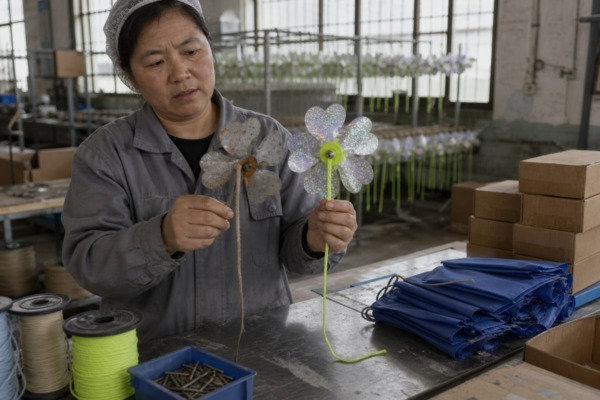
A distributor once sent me photos of rusty pinwheel strings drooping outside her beachfront shop, asking if our production line could do better. Pinwheel string material gets tested hard by humidity.
Pinwheel string material is highly corrosion-resistant in humid climates when it uses synthetic components—PP, Oxford cloth, UV-stabilized polyester, or nylon cord—paired with stainless steel or brass pivot pins. Plain or zinc-plated carbon steel parts corrode quickly, so material choice, not humidity, decides lifespan.
That short answer hides a lot of detail. Different components fail in different ways. A cord can rot while a pin rusts. Moisture absorption weakens some fibers, while salt attacks exposed metal. In this guide, I will walk through material selection, supplier verification, coastal risks, and the quality control steps we use in our own workshop.
What Materials Should I Choose to Prevent Pinwheel String Corrosion in Humid Climates?
Years ago, we shipped uncoated steel-core strings to a client in Florida. They rusted within one season. That failure reshaped how we source every material at our Zhejiang factory.
Choose polypropylene (PP) or PET for blades, UV-stabilized polyester or nylon for cords, Oxford cloth for fabric elements, and stainless steel or brass for pivot pins. PP and Oxford cloth both offer natural waterproof and anti-corrosion performance, making them reliable bases for humid climates.
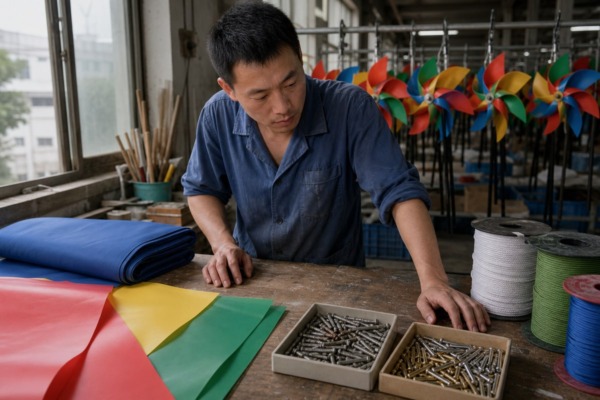
Not every part of a pinwheel string faces the same risk. The cord, the blades, the pivot pin, and the fasteners each degrade in their own way. So I always break the decision down by component. Humidity attacks metals through a thin moisture film that acts like an electrolyte. It attacks natural fibers through rot and mildew. Synthetics sidestep both problems.
The Material Hierarchy at a Glance
| Material | Moisture & Corrosion Resistance | Best Use | Notes |
|---|---|---|---|
| Polypropylene (PP) | Excellent; near-zero moisture absorption | Blades, string bases | Our default film; never wilts like paper |
| Oxford cloth | Very good; woven with a water-shedding finish | Fabric string banners | Resists rot and mold in damp air |
| UV-stabilized polyester/nylon | Very good | Suspension cords | Holds tensile strength 1 in tropical humidity |
| PVC-coated steel wire | Good, until the coating is cut | Long decorative string runs | Shield the core; inspect the jacket |
| Stainless steel (316) / brass | Excellent | Pivot pins | Prevents rust-lock at the spinning joint |
| Zinc-plated carbon steel | Limited | Sheltered, short-term use only | Coating wears off with friction |
| Plain carbon steel | Poor | Avoid outdoors | Rusts fast in persistent humidity |
Why PP and Oxford Cloth Anchor Our Product Lines
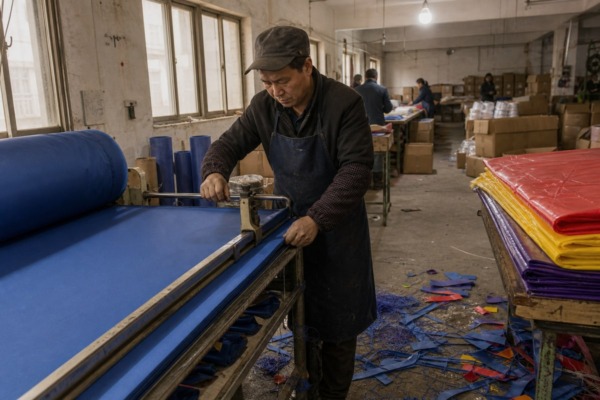
From my own hands-on experience, PP and Oxford cloth both carry a real degree of waterproof and anti-corrosion capability, which is exactly why we build most of our string products around them. PP film 2 simply does not drink water, so glittery holographic petals stay crisp instead of drooping. Oxford cloth adds toughness for larger banner-style strings while shrugging off condensation.
Premium Fibers and String Creep
For high-end lines, low-creep fibers like HMPE—the family that includes Dyneema fibers—keep cord tension constant even at 90%+ humidity. Standard cords can sag as air density shifts. Low string creep means the display keeps its snap between wet and dry days, though it does raise the unit cost.
How Can I Verify Corrosion Resistance Before Placing a Bulk Order with My Supplier?
A procurement manager once messaged me on WhatsApp: "How do I know your strings won't rust before I order 50,000 units?" Fair question. Here is exactly what I told her.
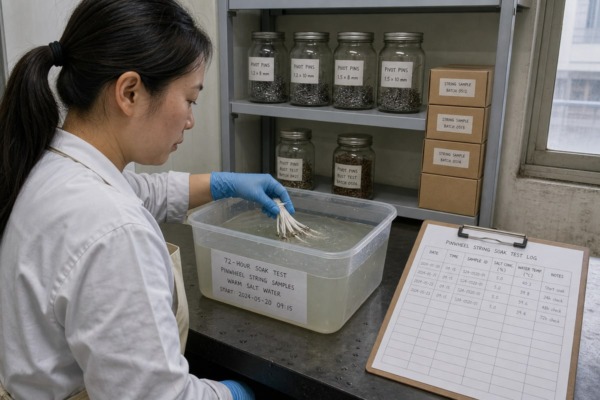
Verify corrosion resistance by requesting material spec sheets, salt spray or humidity test reports, and pre-production samples. Soak samples in warm salt water for 72 hours, then check for rust, tensile strength loss, and stiff rotation. Reliable suppliers document everything before bulk orders.
Trust is good, but documentation is better. In the archery world, a buyer can pull up a BCY 452X comparison chart and know the exact fiber blend inside a bowstring. Pinwheel strings have no such published standard. That gap means you must build your own verification process. Here is the sequence I recommend to every buyer who visits us.
- Request material spec sheets. Confirm the exact polymer for blades, the cord fiber type, and the pivot pin alloy. Vague answers like "metal pin" are a red flag.
- Ask for test documentation. Salt spray reports or humidity chamber results show the supplier has actually stressed the product, not just assembled it.
- Run a 72-hour soak test. Submerge samples in warm salt water. Then dry them and look for rust bloom, coating blisters, or discoloration.
- Check tensile strength after soaking. Pull the cord by hand against a fixed point. Any fiber that feels brittle or fuzzy has absorbed moisture and weakened.
- Test abrasion resistance. Rub the cord against the eyelet fifty times. If the surface frays or a plated pin shows bare steel, the finish will not survive wind vibration.
- Spin the wheel after wetting. A pin that turns stiffly when damp will rust-lock in the field.
- Order a small trial batch first. Field results from one season beat any lab claim.
We actively encourage this process because it filters out corner-cutting competitors before price negotiations even begin.
Will Coastal Humidity and Salt Exposure Affect the Lifespan of My Pinwheel Strings?
Salt changes everything. When we develop pinwheel strings for coastal shops in South America, we weigh chloride exposure against cost very differently than for inland garden retailers.
Yes, coastal humidity and salt air exposure shorten pinwheel string lifespan significantly. Salt acts as an electrolyte that speeds electrochemical corrosion on metal pins and coated wires. Synthetic cords handle salt well, but metal parts need 316 stainless steel, brass, or galvanic isolation to survive.
Some buyers tell me humidity alone will ruin any metal. That is too broad. Inland humidity is a slow stress. Salt air exposure is an aggressive one. The dissolved chlorides in coastal moisture attack protective oxide layers and pit even ordinary stainless grades. And no, not all stainless steel is equal. Common grades resist damp air well, but 316/A4 stainless 3 is the reliable choice once chlorides enter the picture. Here is how I map exposure severity for our export clients.
| Environment | Severity | Recommended Setup | What Fails First |
|---|---|---|---|
| Indoor or covered display | Low | PP blades, standard cord, zinc-plated pin acceptable | Very little within a season |
| Inland outdoor humidity | Moderate | PP/PET blades, polyester cord, stainless or brass pin | Zinc plating over repeated wet-dry cycles |
| Coastal towns near shore | High | 316 stainless or brass pins, synthetic cords only | Any plated carbon steel hardware |
| Boardwalk or direct sea spray | Severe | 316/A4 stainless, galvanic isolation, hydrophobic coating | Every coated steel part, then fasteners |
Galvanic Corrosion in Hybrid Builds
When dissimilar metals 4 touch—say, aluminum decorative parts against a steel pin—salt moisture creates a small battery, and one metal sacrifices itself. We solve this with non-conductive plastic spacers between dissimilar components, a simple design step that removes the galvanic pathway entirely.
Coatings That Actually Help
A weatherproof coating on exposed fasteners buys time, and emerging silica-based hydrophobic nano-coatings make water bead straight off cord fibers. PVC-coated steel wire also performs well on long string runs, provided the jacket stays uncut. But treat every coating as a delay tactic, not a cure. Once wind vibration abrades the surface, the base metal decides the outcome.
What Quality Control Steps Ensure My Pinwheel Strings Withstand Long-Term Moisture Exposure?
Every batch that leaves our Zhejiang workshop passes through a humidity soak check. One skipped test years ago cost us a full container reshipment, so we never skip it now.
Effective quality control includes incoming material verification, humidity chamber testing, spin tests after moisture exposure, abrasion resistance checks at pivot points, weatherproof coating inspection, and moisture-controlled packaging with desiccants. Together, these steps confirm pinwheel strings will survive long-term humidity before they ever ship.
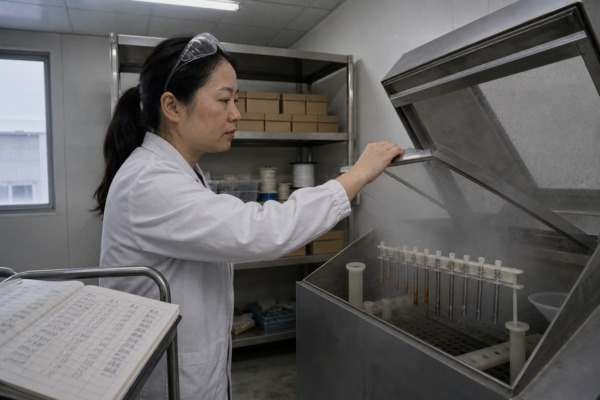
Corrosion resistance is not one decision. It is a chain of small checks, and the chain breaks at its weakest link. A perfect 316 stainless pin means nothing if the packaging traps condensation for six weeks at sea. So our QC team checks moisture performance at every stage, not just at final inspection.
| QC Stage | What We Check | Why It Matters |
|---|---|---|
| Incoming materials | PP resin grade, cord fiber type, pin alloy | Stops silent material substitution at the source |
| In-process assembly | Coating coverage, pin fit, eyelet smoothness | Rough eyelets destroy abrasion resistance fast |
| Humidity simulation | Wet exposure, then a free-spin test | Catches rust-lock before the customer does |
| Fiber integrity | Moisture absorption and pull checks on cords | Confirms tensile strength survives damp cycles |
| Packaging | Sealed OPP bags with desiccant sachets | Prevents mold and corrosion during ocean transit |
| Pre-shipment | Random sampling across cartons | Verifies the whole batch, not a golden sample |
A Lesson Borrowed from Bowstring Maintenance
Archers protect their fibers with string wax as part of routine bowstring maintenance, sealing out water before damage starts. We apply the same logic in reverse: the protection gets built in at the factory, so the end user never needs a maintenance routine. Antimicrobial additives blended into the polymer melt stop mildew from chemically breaking down the fibers over years of damp seasons. For procurement managers like the ones we serve in the United States and Europe, that built-in approach means fewer returns, fewer damaged-goods claims, and displays that still spin after their second rainy season.
Conclusion
Humid climates punish poor material choices fast. Pick PP, Oxford cloth, UV-stabilized cords, and stainless or brass pins, verify with real testing, and your pinwheel strings keep spinning.
Footnotes
1. ASTM International provides the standard testing methods for measuring the tensile strength of materials. ↩︎
2. ISO is the global authority for material standards, including polymer classifications like polypropylene. ↩︎
3. The World Stainless Association provides technical data on the corrosion resistance of specific stainless steel grades. ↩︎
4. Wikipedia offers a comprehensive overview of the electrochemical process of galvanic corrosion between different metals. ↩︎
More Articles
You might also find these helpful.

Welche Brandschutz-Zertifizierungen sollte ich beim Kauf von Windrädern prüfen?
Pinwheel string material resists corrosion in humid climates when made with PP, Oxford cloth, or UV-stabilized cords paired…
Read More →
Wie überprüfe ich die Echtheit von Prüfberichten beim Kauf von Windturbinen?
Pinwheel string material resists corrosion in humid climates when made with PP, Oxford cloth, or UV-stabilized cords paired…
Read More →
Wie kann ich prüfen, ob Windrad-/Windmühlenmaterialien schädliche Chemikalien enthalten?
Pinwheel string material resists corrosion in humid climates when made with PP, Oxford cloth, or UV-stabilized cords paired…
Read More → English
  Spanish
  German
  Arabic