
How to Define Exact Wind Turbine Specifications and Quantities When Purchasing?
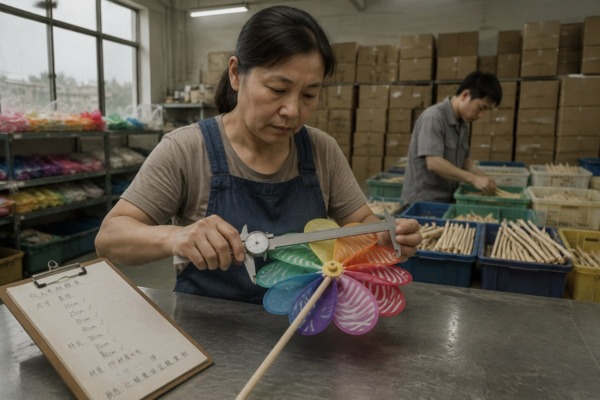
Defining exact wind turbine specifications and quantities sounds simple—until a vague order wrecks a season ASTM F963 1. On our Zhejiang pinwheel line, precise purchase orders prevent that pain.
To define exact wind turbine specifications and quantities, document size (rotor diameter), blade material, blade count, stick length, and color scheme, then set per-SKU quantities from sales forecasts and channel stocking needs, separate in-stock items from custom orders, and confirm QC and packaging standards in writing.
Utility wind farm buyers spend months on wind resource assessment, IEC wind class 2 selection, and grid connection studies before they sign anything. Your decorative pinwheel order deserves the same discipline, just scaled down AQL inspection levels 3. Below, I break the process into four practical steps: specifications, customization details, quantity planning, and QC with packaging standards.
How do I determine the exact size, material, and blade specifications for my pinwheel order?
Last spring, our QC team rejected a whole batch of 32cm heads because the petal curve was 2mm off and the spin stalled. Small dimensions decide everything in this product.
Determine pinwheel size by measuring rotor diameter (head width) and stick length, choose blade material (PET, PP, mylar film, or paper), specify blade count and shape, and confirm hub type, then request a physical sample to verify spin performance before mass production.
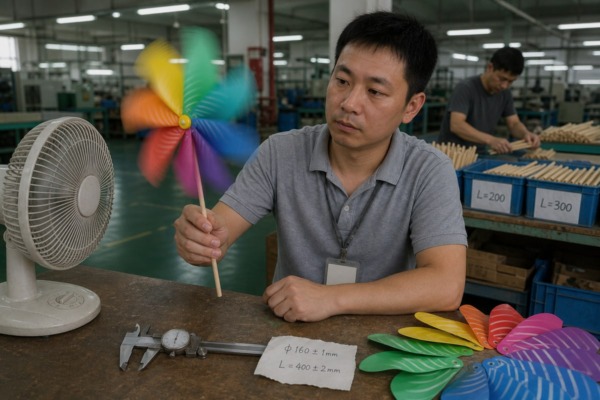
Our rainbow flower pinwheel is a good example. It has eight butterfly-wing petals in a gradient of green, yellow, orange, red, pink, purple, blue, and teal, a small yellow center hub, and a smooth wooden dowel stick. Every one of those details is a spec line on the purchase order. Each one changes cost, durability, and spin quality.
Core Dimensions to Lock Down
| Specification | Common Options | What to Confirm in Writing |
|---|---|---|
| Rotor diameter (head width) | 12 cm, 20 cm, 32 cm, 50 cm+ | Measured tip-to-tip across opposite petals |
| Stick length | 25–80 cm, wood or plastic | Straightness, splinter-free finish |
| Blade count | 4, 6, or 8 petals | Balanced weight for smooth rotation |
| Blade material | PET, PP, mylar film, laminated paper | UV and moisture resistance for outdoor use |
| Hub assembly | Pin-and-grommet or capped bearing | Free rotation in a light breeze |
Write down tolerances too. A petal die-cut that drifts even slightly can unbalance the head. That is why we keep cutting molds under regular calibration checks at our factory.
What Utility Wind Buyers Can Teach You
Serious turbine buyers never trust the nameplate rating. They run a wind resource assessment, match the machine to an IEC wind class, study the power curve at real site wind speeds, and specify hub height, because height and swept area drive output far more than the label does. They also check turbulence intensity near obstacles, since messy airflow kills performance. The scaled-down lesson for pinwheel buyers is the same. Do not buy on photos alone. Ask how the head starts spinning at low wind speed. A pinwheel with a tight hub is like a turbine with a high cut-in speed: it looks great and barely moves. And remember that a larger rotor diameter catches more air, but it also demands a thicker, stiffer stick—just as taller towers need heavier foundations.
What customization details should I include when requesting a quote for wind spinners?
A U.S. procurement manager once sent me a one-line WhatsApp request: quote me rainbow pinwheels. It took eleven messages to fill the gaps. A complete brief saves everyone days.
Include blade colors (Pantone codes), printing or patterns, logo placement, materials, stick type, packaging format, order quantity per SKU, target unit price, compliance needs such as EN71 or ASTM F963, sample requirements, and delivery timeline when requesting a wind spinner quote, so suppliers can price accurately.

In our OEM and ODM projects with brands in the United States, South America, and Europe, the fastest quotes always come from the most complete briefs. A structured request also lets you compare suppliers fairly, because everyone prices the same thing. Here is the sequence I recommend.
- Design and colors. Send Pantone codes, not screenshots. Our rainbow gradient with fine white striped patterns looks different on every monitor; a Pantone reference does not lie.
- Format: assembled or DIY kit. We produce both fully assembled pinwheels and craft kits with die-cut petals, dowel sticks, pins, and yellow grommets. Kits ship flatter and cheaper; assembled units are retail-ready. This single choice changes your unit price and freight cost.
- Materials and finish. Specify blade film type, thickness, and whether the stick is natural wood or plastic.
- Branding. Logo printing location, method, and color count.
- Packaging format. Polybag, header card, display box, or bulk.
- Quantity per SKU and total volume. Suppliers tier pricing by volume, so state both.
- Compliance. If your market treats pinwheels as toys, request test documentation upfront rather than marketing claims. Buyers today increasingly demand explicit technical documents, and good factories welcome that.
- Samples and timeline. Ask for a pre-production sample, and state your target delivery date and Incoterms 4.
Finally, flag which items are in-stock designs and which are custom developments. Stock items can ship in weeks; custom tooling and printing need longer lead times, and mixing the two in one vague request confuses every quote you receive.
How do I calculate the right order quantity to avoid overstock or running short?
Early in our export business, we let a distributor guess quantities. Half the stock sat unsold; the bestseller ran out by June. That lesson reshaped how we plan orders together.
Calculate order quantity by combining sales forecasts with channel stocking needs: multiply expected sell-through per store by store count and season length, add safety stock for reorders, check totals against supplier MOQs, and split the order between in-stock designs and custom production.
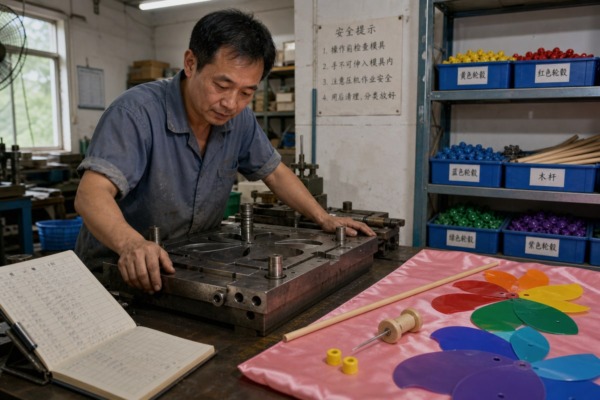
This is where defining exact wind turbine specifications and quantities becomes a forecasting exercise rather than a guessing game. In my experience, the buyers who avoid both overstock and stockouts all start from demand, not from the supplier's price list. The approach mirrors energy yield estimation in wind projects: professionals plan around realistic output, not the optimistic nameplate figure.
A Simple Forecast Formula
| Step | Input | Illustrative Example |
|---|---|---|
| Channels | Number of retail doors or accounts | 120 stores |
| Sell-through | Realistic units per store per week | 12 units |
| Season length | Peak selling weeks (spring/summer) | 16 weeks |
| Base demand | Stores × sell-through × weeks | 23,040 units |
| Safety stock | Buffer for reorders and displays | +3,000 units |
| Order total | Split across SKUs and colorways | ~26,000 units |
Wind engineers apply a capacity factor because turbines rarely run at full output. Apply the same honesty to your shelf: assume realistic sell-through, not your best-ever week. Then think like a Levelized Cost of Energy calculation—judge each SKU by total landed cost per unit actually sold, not by the FOB price alone. A cheap design that sits unsold is expensive.
One Hero SKU or a Full Assortment?
Some buyers push everything into one bestselling design; others spread thin across many. Both extremes hurt. Concentration risks a stockout with no fallback; over-spreading multiplies MOQs and slow movers. We usually suggest a phased approach: weight the initial order toward proven designs, keep custom items front-loaded because of their longer lead time, and hold budget for one in-season reorder of stock items. Good layout optimization at retail—placing pinwheels near seasonal displays—also lifts sell-through more than most buyers expect, so coordinate quantities with your merchandising plan.
What quality control and packaging standards should I specify to prevent damage during shipping?
Every packaging decision trades cost against protection. Thicker cartons add freight weight; thinner ones risk crushed petals. We weigh that balance on every export shipment leaving our Zhejiang warehouse.
Specify AQL inspection levels (commonly 2.5 for major defects), spin-function testing, color checks against approved samples, individual polybags or header cards, dividers between layers, double-wall export cartons, drop-test verification, and clear carton markings to prevent damage during shipping and reduce returns.
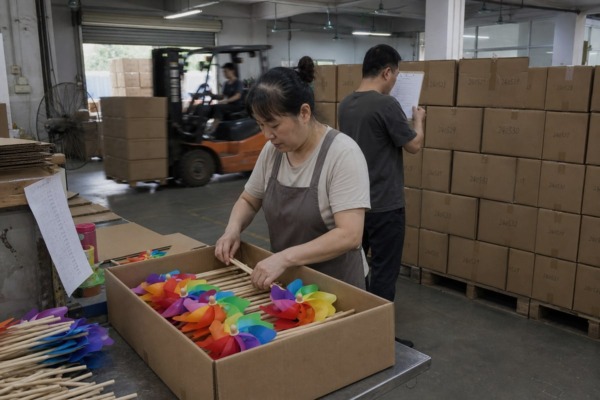
Damaged packaging and product returns are the two complaints I hear most from distribution buyers, and both are preventable at the purchase-order stage. Pinwheel petals are lightweight film. They survive wind beautifully and container pressure terribly. So your PO must treat QC and packaging as specifications, not afterthoughts.
QC Standards to Write Into the PO
State the inspection standard explicitly. AQL 2.5 for major defects and 4.0 for minor defects is a common baseline for consumer goods. Then define product-specific checks: every sampled unit must spin freely, petals must match the approved Pantone sample, grommets and pins must pass a pull test, and sticks must be smooth and splinter-free. Ask for pre-shipment inspection photos or book a third-party inspection. On our line, we run spin tests by batch precisely because a stalled pinwheel is a guaranteed return.
Packaging That Survives the Container
| Packaging Layer | Specification to Request | Purpose |
|---|---|---|
| Unit pack | Individual polybag or header card | Retail-ready, prevents scratching |
| Inner pack | Dividers or flat-pack sleeves between layers | Stops petals bending under weight |
| Export carton | Double-wall corrugated board | Survives stacking and rough handling |
| Verification | Carton drop test before loading | Confirms real transit durability |
| Markings | SKU, quantity, fragile labels, side-up arrows | Correct handling and easy receiving |
One more trade-off worth discussing with your supplier: DIY kit formats pack flat, cut freight volume, and arrive with far fewer bent petals than fully assembled units. If your channel accepts an assembly step, kits can lower both damage rates and landed cost at the same time.
Conclusion
Vague orders create overstock, stockouts, and damaged goods. Define exact wind turbine specifications and quantities upfront—sizes, materials, per-SKU counts, QC, packaging—and your pinwheel program runs smoothly all season.
Footnotes
1. Provides the standard consumer safety specification for toy safety required for market compliance. ↩︎
2. Authoritative source for international wind turbine safety and performance standards mentioned in the text. ↩︎
3. The international body defining standard sampling procedures for quality control inspections. ↩︎
4. Official organization responsible for defining international commercial terms used in global trade contracts. ↩︎
More Articles
You might also find these helpful.

Welche Brandschutz-Zertifizierungen sollte ich beim Kauf von Windrädern prüfen?
Learn how to lock down wind turbine specifications and quantities before purchasing, avoiding costly order mismatches with clear…
Read More →
Wie überprüfe ich die Echtheit von Prüfberichten beim Kauf von Windturbinen?
Learn how to lock down wind turbine specifications and quantities before purchasing, avoiding costly order mismatches with clear…
Read More →
Wie kann ich prüfen, ob Windrad-/Windmühlenmaterialien schädliche Chemikalien enthalten?
Learn how to lock down wind turbine specifications and quantities before purchasing, avoiding costly order mismatches with clear…
Read More → English
  Spanish
  German
  Arabic