
How to Spot Exaggerated Production Capacity When Sourcing Wind Turbines?
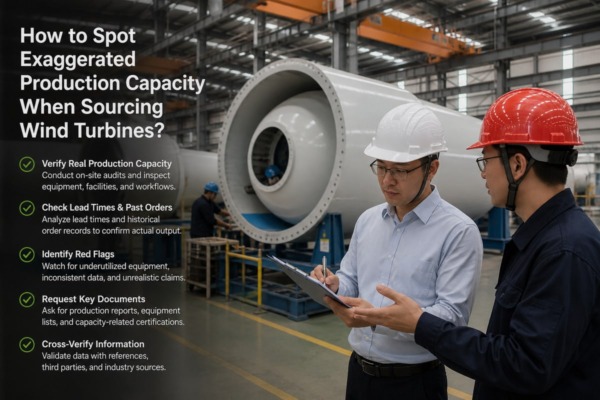
Exaggerated production capacity when sourcing wind turbines can quietly destroy a project budget. Running an export factory in Zhejiang, I have watched inflated numbers cost buyers real money.
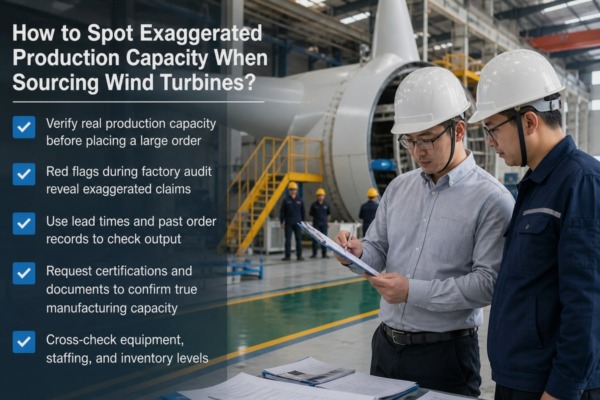
To spot exaggerated production capacity when sourcing wind turbines, verify capacity data against past bulk order records, demand real workshop footage, audit component supply chains, cross-check lead times against claimed throughput, and require power curves, P50/P90 yield models, and independent certifications instead of verbal promises.
The problem is rarely the turbine itself. The problem is how sellers present the numbers. Below, I break down four practical checks. Each one comes from real experience on the supplier side of the table.
How can I verify a wind turbine supplier's real production capacity before placing a large order?
A US procurement manager once told me she trusts factories the way she trusts weather forecasts. After hosting her audit team at our Zhejiang workshop, I understood exactly why.
Verify real production capacity by cross-checking past bulk order records, requesting live workshop video, comparing claimed MW output against realistic capacity factors, reviewing independent reference projects, and interviewing third-party O&M teams. Never rely on verbal promises or brochure-level nameplate figures alone.
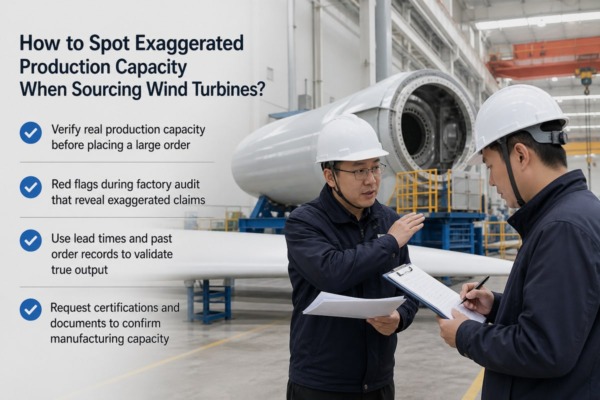
My own products are pinwheels — tiny cousins of wind turbines — and buyers audit us constantly. That seat on the supplier side taught me one rule: capacity data must be verified, never assumed. Check past bulk order records. Ask for real workshop footage. Do not accept verbal capacity promises, ever. This is the foundation of procurement due diligence, whether you are buying decorative pinwheels or multi-megawatt machines.
Nameplate Capacity Is Not Real Output
Here is the trap. A turbine's nameplate rating describes maximum output under specific wind conditions. It says nothing about average production. The relevant business metric is annual energy production 1, measured in MWh, not installed MW. Capacity factor is your fastest plausibility check.
| Metric | What It Actually Means | Realistic Benchmark |
|---|---|---|
| Nameplate capacity | Peak output at rated wind speed | Avg. new US turbine: 3.4 MW in 2023 |
| Capacity factor 2 | Actual output ÷ theoretical maximum | US onshore range: 5%–50%, averaging 38% |
| Annual energy production | Real MWh delivered per year | Must match the site's power curve model |
If a supplier's numbers imply a capacity factor near 70%, the claim fails the smell test. One UK analysis found 40 of 121 wind farms 3 overstated expected output by 10% or more, and 27 overestimated by 20% or more. This is not rare.
Now, a fair objection: big modern turbines really are productive, so is a large MW number really deceptive? No — turbine size growth is legitimate. The deception lives in the presentation: which wind speed the rating assumes, and which losses get ignored. That is why I push buyers toward independent reference projects and interviews with third-party site managers outside the supplier's preferred list. Even Tier 1 manufacturers should welcome that scrutiny.
What red flags during a factory audit reveal exaggerated production capacity claims?
Auditors have walked our pinwheel line dozens of times. Every visit taught me what a sharp auditor notices — and what an inflated capacity claim tries to hide.
Key audit red flags include idle or staged production lines, missing sub-component inventory for gearboxes and blades, single-source dependencies, no raw material buffers for rare earth magnets or carbon fiber, restricted workshop access, and logistics that cannot physically move the claimed output.
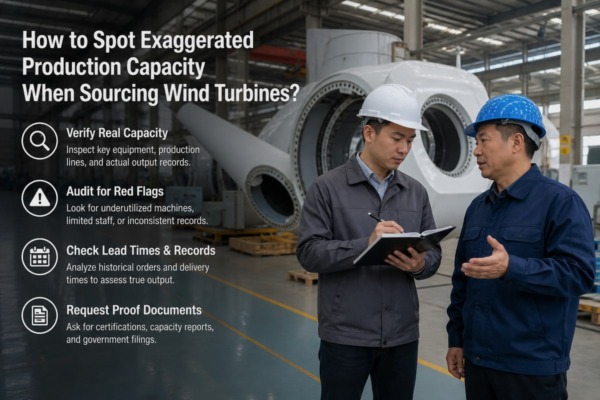
When buyers audit our workshop, I show them everything: raw material stock, active stations, packed goods awaiting export. Suppliers hiding exaggerated production capacity do the opposite. They steer you toward a polished showroom and away from the actual floor. In my experience hosting OEM factory audits, refusal to allow unscripted workshop photos is the single loudest warning. If a wind turbine supplier will not let you film active production, assume the claimed capacity is theoretical.
Follow the Components Upstream
A turbine factory is only as fast as its slowest input. Supply chain transparency matters more than assembly hall size. Dig into critical sub-components — gearboxes and blades 4 especially — because component sourcing bottlenecks are where paper capacity collapses.
| Audit Red Flag | What It Likely Signals |
|---|---|
| Spotless, quiet assembly hall during "peak season" | Line staged for visits; real orders are elsewhere or nonexistent |
| No visible gearbox or blade inventory | Sub-component bottleneck; capacity depends on a third party |
| Single supplier for a critical part | One disruption freezes the entire claimed output |
| No long-term contracts for rare earth magnets or carbon fiber | Capacity is theoretical assembly speed, not backed by material access |
| Vague answers about port crane and vessel bookings | Factory cannot physically ship what it claims to build |
That last row deserves emphasis. Logistical throughput verification is often skipped. Turbine blades and nacelles need specialized transport vessels and heavy port crane slots. If claimed monthly output exceeds what regional ports can handle, the capacity number is fiction regardless of what happens inside the factory. Ask to see freight bookings, not just floor space.
How do I use lead times and past order records to check if a supplier is overstating output?
I learned this the hard way: order records never lie, but sales teams sometimes do. Our own export files became my best proof when buyers questioned our output.
Compare quoted lead times against claimed monthly output — if a factory claims high capacity but quotes long lead times for a modest order, the numbers conflict. Request past bulk order records, shipping documents, and customs data to confirm actual historical throughput.
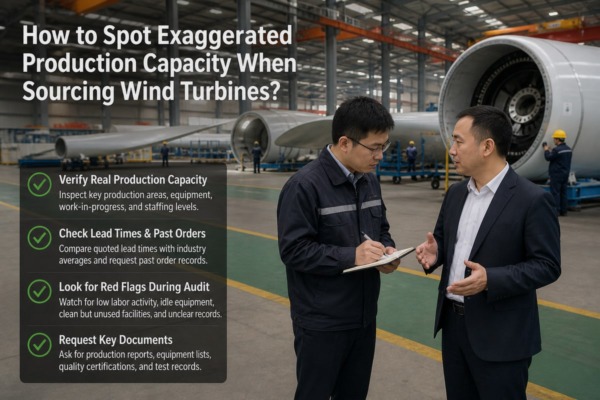
Years ago, a distributor asked me to prove we could handle a seasonal surge. I did not argue. I opened our shipment history and showed dated bills of lading, month by month. That moment shaped how I advise every buyer today: past bulk order records are the strongest evidence of real capacity, and any supplier unwilling to share them is telling you something. The same logic scales directly to wind turbines, where the stakes are enormously higher.
A Five-Step Throughput Cross-Check
Production throughput verification is mostly arithmetic. Here is the process I recommend:
- Get the capacity claim in writing. Pin down units per month, by model, in the current quarter — not a "design capacity" from a brochure.
- Request a formal lead time quote for your intended order volume. Manufacturing lead times are hard commitments; capacity claims are often soft marketing.
- Do the math. A supplier claiming 20 nacelles per month who quotes nine months for a 30-unit order is contradicting itself. Real backlog or fake capacity — either way, you need the truth.
- Pull historical evidence. Ask for anonymized past order records, delivery schedules, and shipping documents covering at least the last two years. Cross-reference with customs data where available.
- Call past customers directly. Independent reference checks with previous buyers and their O&M teams expose gaps between promised and delivered schedules.
Watch for one more trick: suppliers who explain every delay as "exceptional." One exception is believable. A two-year pattern of exceptions is the actual capacity. In my experience, factories with genuine throughput share records eagerly, because the paperwork does their selling for them.
What certifications or documents should I request to confirm a factory's true manufacturing capacity?
Every document request costs negotiation time — a trade-off I weigh weekly at our factory. Yet skipping paperwork on a turbine deal is far more expensive than asking.
Request the model-specific power curve, a full P50/P90 energy-yield report with itemized losses, ISO 9001 quality certificates, type certification, factory acceptance testing records, grid code compliance documents, availability guarantee terms, and independently verified technical bankability reports.
Our factory holds far simpler documentation than a turbine maker, but the principle I apply is identical: if a claim matters, it must exist on paper with a third party behind it. Verbal capacity promises are worth nothing. When we develop custom products for overseas brands, we document tolerances and test results before any deposit changes hands. Demand the same discipline — multiplied — from a wind turbine supplier.
The Document Stack That Exposes Inflated Claims
| Documento | Qué demuestra | Señal de alerta si falta |
|---|---|---|
| Model-specific power curve | Output at each wind speed for the exact model offered | Supplier substitutes a "typical" or brochure curve |
| P50/P90 energy-yield report | Probabilistic production with itemized losses | Losses lumped together or unrealistically small |
| ISO 9001 / quality management systems certificate | Documented, audited production processes | Quality claims rest on reputation alone |
| Type certification (e.g., IEC 61400 series) | Independent design and safety validation | Turbine only "designed to" standards, never certified |
| Factory acceptance testing records | Units actually tested before shipment | No FAT protocol means no output verification |
| Grid code compliance certificates | Legal connection at your specific site | Risk of forced curtailment or commissioning delays |
| Technical bankability reports | Independent engineers vouch for the numbers | Lenders will not finance; neither should you trust |
Read the availability guarantee fine print carefully. "Time-based" availability counts hours the machine is mechanically ready — even in dead calm. Energy-based availability is what pays your bills. Also ask directly whether quoted output depends on firmware "boost modes" tied to rare atmospheric conditions or recurring license fees, and whether local reactive power requirements will force active output reductions. Finally, remember the forecasting math: research has found an average 3.5% to 4.5% overprediction bias in P50 production estimates. Even honest models lean optimistic — which is exactly why independent verification is non-negotiable.
Conclusión
Exaggerated capacity claims survive on trust, not evidence. Verify order records, demand workshop footage, audit the supply chain, and put every promise in documents. Insist your supplier's door stays open.
Notas al pie
1. US EIA explanation of how wind turbines generate electricity and the meaning of annual production. ↩︎
2. Authoritative IEA report providing global benchmarks for wind energy capacity factors and electricity generation. ↩︎
3. Scientific study published in Nature discussing the performance and energy production of wind farms. ↩︎
4. Official Department of Energy resource describing the critical internal components of wind turbines like gearboxes and blades. ↩︎
Más artículos
También podrían resultarle útiles.

¿Cómo verificar remotamente las capacidades de producción de una fábrica para componentes enchufables de hierro forjado?
Verify wind turbine production capacity by checking bulk order records, workshop footage, and capacity factor data before you…
Leer más →
¿Cómo evaluar la capacidad de producción de una fábrica al obtener insertos de hierro forjado?
Verify wind turbine production capacity by checking bulk order records, workshop footage, and capacity factor data before you…
Leer más →
¿Qué preguntas debe hacer a los proveedores de insertos de hierro forjado para detectar a los poco fiables a tiempo?
Verify wind turbine production capacity by checking bulk order records, workshop footage, and capacity factor data before you…
Leer más → English
  Spanish
  German
  Arabic