
What Should You Know About Wind Turbine Customization Before Buying?
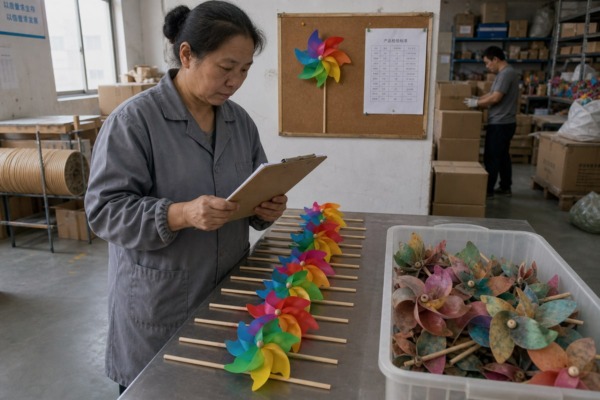
Wind turbine customization sounds simple until a container of faded, mismatched pinwheels lands in your warehouse die-cut molds 1. At our Zhejiang factory, we see that costly mistake happen far too often.
Before buying custom wind turbines, confirm eight details in writing: the artwork pattern, printing process, rotor size, stick or pole material, packaging method, sampling fee, number of free revision rounds, and the allowed deviation range for bulk production. Clear specs prevent quality disputes and shipping delays.
Those eight points come straight from our daily order sheets. In this guide, I will walk through each one. You will learn what to ask for, what it costs, and how to protect your order from factory floor to your dock. Let’s start with the options themselves.
What customization options can I choose for my wind turbine order?
Last spring, our print shop ran a rainbow-gradient pinwheel order three times because the buyer never locked the Pantone codes. That week taught us to document every option upfront.
You can customize the blade pattern and artwork, printing process, rotor diameter, blade count and shape, hub color, stick material and length, and packaging. Reputable suppliers also offer OEM branding, custom color gradients, and mixed-design assortments within one order.
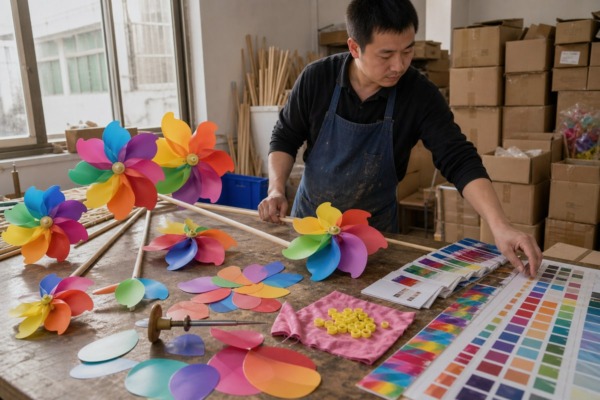
Customization is not one decision. It is a stack of small decisions, and each one affects cost, lead time, and how the finished pinwheel spins. When we develop a new design with a client, we go through the list below line by line. I recommend you do the same with any supplier.
The Core Options You Should Lock In Writing
| Customization option | What to specify | Why it matters |
|---|---|---|
| Artwork pattern | Vector files, Pantone codes, gradient direction | Prevents color drift between sample and bulk |
| Printing process | Offset CMYK, silk screen, foil, or double-sided | Changes cost, vibrancy, and outdoor fade resistance |
| Rotor diameter | Exact spinning-head size in centimeters | Affects spin speed, display impact, and carton size |
| Blade count and shape | Petal, butterfly-wing, or classic curl; 4–8 blades | New shapes need a fresh die-cut mold |
| Stick material | Wooden dowel, plastic tube, or fiberglass rod | Drives durability, weight, and freight cost |
| Packaging | Poly bag, header card, display box, bulk carton | Impacts damage rates and retail presentation |
Blade count deserves extra thought. Fewer, larger petals catch light wind and start spinning easily. More petals look fuller on the shelf but need a stiffer breeze. We often send buyers two samples so they can test both in real wind before committing.
Decorative Wind Turbines vs Power-Generating Turbines
One clarification saves confusion. If you search this topic, most results discuss megawatt machines rated by IEC wind class 2, with blade pitch control, grid-tie system inverters, and off-grid battery storage. Those buyers compare tower height options and chase higher annual energy production; Nordex, for example, reports blade serrations cut sound by roughly 1.5 to 2.0 dB while lifting output up to 6 percent. Decorative wind turbines like ours skip all that engineering weight. Your decisions are about visual impact, spin quality, and durability — but the same discipline applies: match the product to where it will actually be displayed.
How will customization affect my minimum order quantity and pricing?
A US distributor once asked me why her 5,000-piece custom quote beat a competitor's 20,000-piece stock price. The answer sits in how tooling and printing costs spread across volume.
Customization typically raises minimum order quantities to 3,000–10,000 pieces per design because printing plates, die-cut molds, and sampling fees must spread across the run. Unit prices drop as volume rises, so consolidating designs and confirming revision limits early keeps total costs competitive.
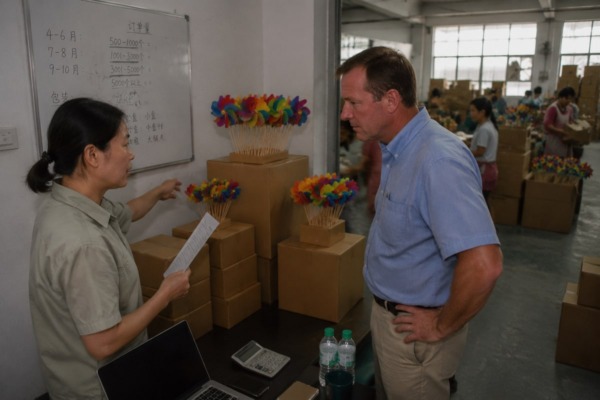
Pricing a custom pinwheel order is really about separating one-time costs from per-unit costs. Once you see the split, negotiation becomes much easier. Here is how the cost structure looks on our side of the table.
One-Time Costs vs Per-Unit Costs
| Cost type | Examples | How to manage it |
|---|---|---|
| One-time | Sampling fee, printing plates, die-cut mold, artwork setup | Ask if fees are refunded or credited against the bulk order |
| Per-unit | Film, ink, stick, pin, hub, labor, inner packaging | Drops meaningfully at higher volume tiers |
| Conditional | Extra revision rounds beyond the agreed limit | Fix the number of free revisions in the contract |
Two items on that list cause the most disputes, so I will be direct about them. First, the sampling fee. Always ask whether it is charged, how much it is, and whether it gets deducted from your bulk invoice. At our factory, we credit it back once the order confirms, but not every supplier does. Second, revision rounds. Agree upfront on how many artwork or sample modifications are free. Two rounds is a common standard. Unlimited "free" revisions usually get quietly priced into your unit cost.
There is good news too. Unlike a grid-tie system purchase, no interconnection agreement or utility paperwork sits between you and delivery, so lead times stay short — often three to five weeks after sample approval. And you can often mix several artwork designs within one MOQ if they share the same blade mold and size. That is the cheapest path to a varied retail assortment.
What materials should I request to keep my custom wind turbines durable outdoors?
Every material choice we weigh trades cost against lifespan. PET film survives a summer of sun; cheap PVC fades in weeks. Wooden dowels feel premium; fiberglass outlasts them outdoors.
Request UV-stabilized PET or mylar film blades, weatherproof inks, rust-resistant metal pins, and either sealed wooden dowels or fiberglass poles. These materials resist fading, cracking, and rust outdoors, keeping custom wind turbines vivid through a full retail season of sun, rain, and wind.

Durability failures are the top reason distributors face product returns, so this section deserves your closest attention. The stick material — 杆材, as we write it on our spec sheets — and the blade film do most of the work. Here is how the common choices compare.
Material Choices Compared
| Component | Budget option | Durable option | Our recommendation |
|---|---|---|---|
| Blade film | Untreated PVC | UV-stabilized PET / mylar | PET for any outdoor display over one month |
| Ink | Standard water-based | Weatherproof UV-cured | UV-cured for direct sun exposure |
| Stick | Raw wooden dowel | Sealed dowel or fiberglass rod | Sealed wood for garden retail; fiberglass for coastal markets |
| Pin and hub | Plain steel pin | Nickel-plated pin, nylon grommet | Plated pin always — rust stains blades fast |
Match Materials to the Display Environment
Think of it as a small-scale site wind assessment. A boardwalk kiosk in Florida faces salt air and steady gusts; a garden center in Ohio sees gentler conditions. We ask every buyer where the product will actually stand, then adjust film thickness and pole choice. One caution: thicker film is not automatically better. Overly heavy blades raise the wind speed needed to start spinning, and a pinwheel that does not spin does not sell. The curved, scalloped petal shapes we cut also serve a quiet purpose — smooth edges give natural aerodynamic noise reduction 3, so large displays do not rattle. And if your client plans a big public installation of pinwheel strings, remind them to check local zoning regulations for temporary outdoor displays before the event date.
How can I ensure strict quality control and safe shipping for my customized order?
One crushed carton taught us more than any audit. After a client photographed bent sticks from a US port, we redesigned our export packaging and inspection flow completely.
Ensure quality by approving a pre-production sample, defining an acceptable deviation range for bulk goods, and requiring inline plus final random inspections. For shipping, specify inner poly bags, dividers, double-wall cartons, and pallet loading, and confirm photos of packed goods before dispatch.
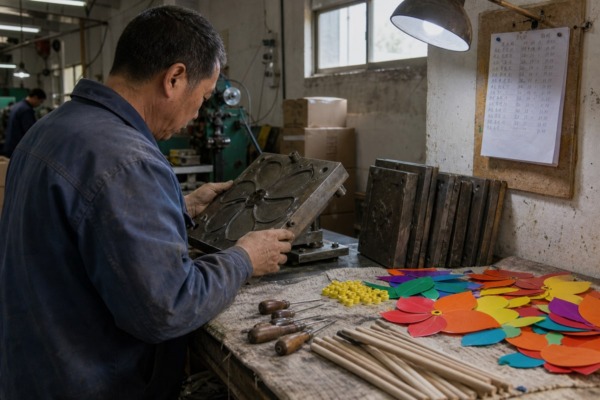
Quality control for a custom order is a sequence, not a single checkpoint. Skip one step and problems surface only after the goods cross the ocean — when fixing them is slowest and most expensive. Here is the process we run for every OEM order, and the process I suggest you demand from any supplier.
The Five-Step QC and Shipping Sequence
- Approve a signed pre-production sample. This physical sample becomes the legal reference for color, size, and assembly. Keep one set; the factory keeps a matching set.
- Define the bulk deviation range in writing. No factory run matches the sample perfectly. Agree on tolerances — for example, color within an agreed Pantone tolerance and rotor diameter within a couple of millimeters. This single clause prevents most disputes over 大货偏差, the bulk-goods deviation that surprises unprepared buyers.
- Require inline inspection during production. Catching a misaligned print at 20 percent completion costs little. Catching it after packing costs the whole run.
- Commission a final random inspection. Use AQL sampling 4 on finished, packed goods. Check spin function, pin security, stick straightness, and print registration — not just appearance.
- Verify packaging before dispatch. Each pinwheel goes in a poly bag, sticks separated by dividers, packed in double-wall export cartons with drop-test-worthy padding. Ask for photos of packed cartons and the loaded container.
Unlike utility turbine buyers who negotiate a maintenance service contract, distributors of decorative products rely on prevention plus spares. So here is one last habit worth copying: we add a small ratio of extra sticks and pins to every carton, because a replaceable part turns a potential product return into a ten-second fix at the store.
Conclusion
Wind turbine customization rewards buyers who specify everything: artwork, printing, size, stick material, packaging, sampling fees, revision rounds, and bulk tolerances. Lock those details, and your order arrives as imagined.
Footnotes
1. Die cutting is a fabrication process used to cut shapes from sheet materials like plastic film. ↩︎
2. The IEC establishes international standards for wind turbine classes and electrical systems mentioned for comparison. ↩︎
3. Aerodynamics is the study of how air interacts with solid objects, influencing noise and spin efficiency. ↩︎
4. ISO standards define the AQL sampling procedures used for quality control inspections in global manufacturing. ↩︎
More Articles
You might also find these helpful.

What Fire Retardant Certifications Should I Check When Buying Pinwheels?
Get straight, clear answers on wind turbine customization before you buy—from artwork and rotor size to packaging—so you…
Read More →
How to Verify Authenticity of Test Reports When Purchasing Wind Turbines?
Get straight, clear answers on wind turbine customization before you buy—from artwork and rotor size to packaging—so you…
Read More →
How to Check if Pinwheel/Windmill Materials Contain Harmful Chemicals?
Get straight, clear answers on wind turbine customization before you buy—from artwork and rotor size to packaging—so you…
Read More → English
  Spanish
  German
  Arabic