
How Can Bulk Purchasing Windmills Improve Cost-Effectiveness?
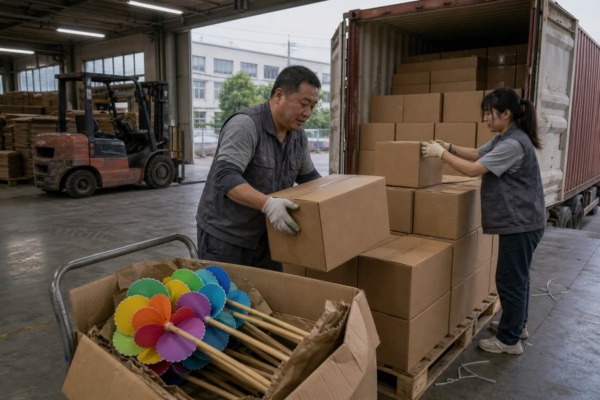
Small windmill orders quietly eat distributor margins — I hear it constantly. On our Zhejiang production line, bulk purchasing windmills is the fix we help buyers run the numbers on.
Bulk purchasing windmills improves cost-effectiveness by lowering the per-unit price through volume discounts, spreading fixed costs like molds and setup across more pieces, cutting per-unit shipping through full-container loads, and reducing transaction costs, so larger orders deliver measurably better margins than repeated small-batch purchases.
That short answer hides a lot of useful detail. Where exactly do the savings come from? How big do they get? And where do they stop growing? I will break each question down below, using the same math we walk our distributor clients through before they place a container order.
How much can I actually save by increasing my windmill order quantity?
A distributor in Ohio once messaged me on WhatsApp with a simple challenge: prove that tripling her order would actually change her landed cost. So we opened a spreadsheet together.
Larger windmill orders usually lower your per-unit price significantly because material buying, machine setup, and labor scheduling all get cheaper at scale; savings grow fastest between small trial orders and the first container-level quantity, then flatten, so marginal gains shrink at very high volumes.
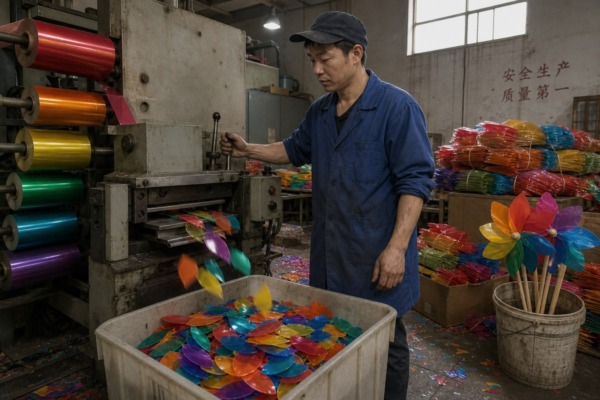
The core idea is simple. Every windmill order carries two kinds of cost. Variable costs rise with each piece you buy: plastic film, wooden dowels, grommets, labor minutes. Fixed costs stay flat no matter the quantity: die-cutting setup 1, color changeovers, order administration, sample approval, and quality documentation. When you increase quantity, the fixed portion gets divided across more pieces. That is economies of scale in its purest form.
Where the Savings Actually Come From
Here is how the main cost drivers behave as your order grows. The tiers below are illustrative of how we quote, not a fixed price list.
| Cost component | Small trial order | Full bulk order | Why it changes |
|---|---|---|---|
| Raw material (film, dowels) | Standard rate | Lower rate | We buy film in bulk rolls at better prices |
| Machine setup and die changeover | Heavy per-unit burden | Nearly invisible per unit | Fixed cost divided by more pieces |
| Labor scheduling | Stop-start, inefficient | Continuous runs | Repetition speeds up assembly |
| Order admin and documentation | Same as a big order | Same as a small order | Fixed regardless of quantity |
| Packaging printing | Minimum print fees dominate | Fees fully amortized | Print runs get cheaper per carton |
The Marginal Returns Curve
This is the part most buyers miss. The steepest per-unit drop happens between a small trial quantity and your first container-level order. Beyond that, the curve flattens. Doubling again saves less than the first jump did. So the smart move is not "buy the maximum." It is finding the point where the next tier's savings still beat your inventory and storage risk. Interestingly, utility-scale renewable energy infrastructure follows the same logic: wind farm scalability lets developers cut their Levelized Cost of Energy 2 through economies of scale and bundled maintenance service agreements. Our garden windmills are far smaller, but the math is identical.
What minimum order quantity do I need to qualify for bulk pricing discounts?
Setting MOQ tiers at our factory is always a trade-off: low enough to welcome new distributors, high enough to cover changeover time between color runs and die-cut petal shapes.
Most windmill factories, including ours, set bulk pricing tiers starting around a few thousand pieces for stock designs, while fully custom windmills usually require higher minimums to cover mold and setup costs; exact thresholds vary by design complexity, materials, and packaging requirements, so always request a tiered quote.
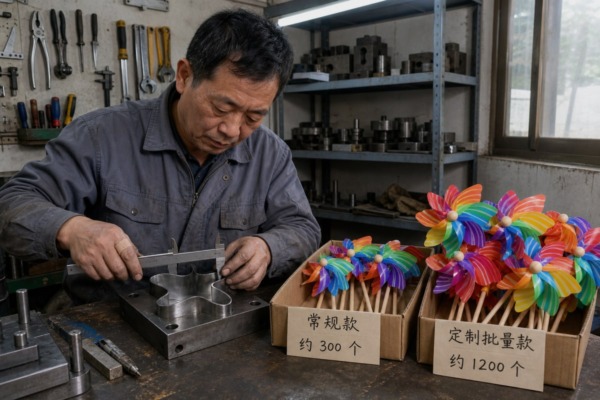
MOQs are not arbitrary gatekeeping. They exist because certain costs only make sense above a threshold. A custom petal shape needs its own cutting die. A custom color gradient needs a dedicated film run. Retail header cards have print minimums. Each of these is a small capital expenditure, and capital expenditure reduction 3 per unit only happens when enough pieces share the bill. This is also why larger, predictable orders improve everyone's cash position — the same reason project financing models reward scale in bigger industries.
Typical Tier Structure
| Order type | Threshold approach | What it unlocks |
|---|---|---|
| Trial order | Lowest entry point | Stock rainbow-petal designs, standard packaging |
| First bulk tier | A few thousand pieces | Volume procurement discounts on stock designs |
| Container tier | One full 20' or 40' load | Best per-unit price plus freight efficiency |
| Custom tier | Higher minimum per design | Custom petal shapes, prints, branded packaging |
How to Reach a Tier Faster
You do not always need one giant SKU. In our experience exporting to the US and Europe, buyers hit bulk tiers using these tactics:
- Combine SKUs. Mixed colors and sizes of the same construction often count toward one tier.
- Commit to annual volume. A yearly forecast can unlock tier pricing on smaller staggered releases.
- Customize the packaging, not the product. Stock windmills with your branded header card avoid custom-die minimums.
- Align with our production windows. Orders slotted into existing runs of the same film colors cost less to make.
Ask any supplier for the full tier table before negotiating. If they cannot show you one, they have not done the math themselves.
Will buying in bulk help me reduce my per-unit shipping and logistics costs?
Last spring we filled a 40-foot container with flat-packed DIY windmill kits — dowels, petals, and grommets nested tightly — for one US distributor. Her freight cost per piece dropped to pennies.
Yes. Buying windmills in bulk cuts per-unit shipping sharply because freight, customs clearance, documentation, and handling are largely fixed costs; a full container spreads those charges across thousands of pieces, while small courier shipments can make logistics cost more per unit than the product itself.
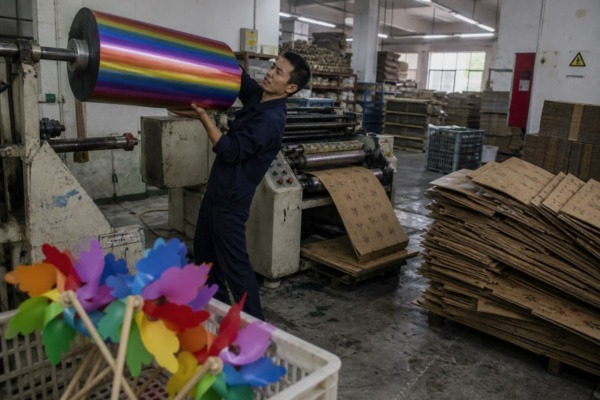
Windmills are light. That matters more than most buyers realize. Lightweight, low-value-per-piece products are exactly where courier and small-parcel shipping 4 punishes you hardest, because you pay dimensional weight on air rather than product. Bulk purchasing windmills flips that equation. One booking, one customs entry, one set of documents — supply chain optimization in its most practical form.
Courier vs LCL vs FCL
| Shipping mode | Best for | Per-unit cost behavior | Handling and damage risk |
|---|---|---|---|
| Express courier | Samples only | Very high; can exceed product cost | Many touchpoints, frequent crushed cartons |
| LCL (shared container) | Mid-size orders | Moderate; shared fixed fees | More handling at consolidation warehouses |
| FCL (full container) | Bulk orders | Lowest; fixed fees fully diluted | Sealed at our dock, opened at yours |
Packaging Density Is a Hidden Lever
Our DIY kit format — die-cut petal sets, wooden dowels, and pin assemblies packed flat — ships far denser than pre-assembled windmills on sticks. When a buyer switches to kit format for part of an order, the same container carries dramatically more sellable units. Fewer touchpoints also directly address two pain points our distributor clients raise constantly: damaged packaging and shipping delays. A sealed full container is loaded once at our Zhejiang warehouse and opened once at yours. And if warehouse space worries you, split shipments against one bulk price are a common compromise — you lock tier pricing but receive goods in staggered deliveries.
Can I still get custom designs and strict quality control on large bulk orders?
Years ago, a rushed bulk run taught us a hard lesson: petal color drifted slightly between film lots. Since then, every large order at our factory locks an approved color standard before production starts.
Yes. Large bulk orders actually make customization and quality control easier, not harder, because higher volumes justify dedicated molds, custom colors, and printed designs, while structured inspection plans — incoming material checks, in-line inspections, and pre-shipment audits — keep defect rates consistent across every carton.
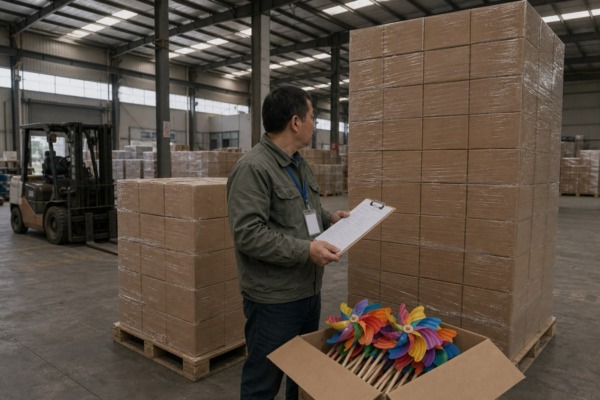
This question comes up in almost every first call with a new procurement manager. The fear is understandable: more volume, more chances for something to go wrong. But the reality runs the other way. Volume funds the very things that protect quality. A custom cutting die, a dedicated film color run, and a full inspection plan are all fixed investments. On a small order, they are unaffordable. On a bulk order, they are trivial per unit. The repetition itself helps too — the same way turbine installation efficiency improves across a large wind project, our assembly teams get faster and more consistent the longer a single design runs.
Our Bulk-Order QC Process
Here is the sequence we run on every large OEM/ODM order:
- Incoming material inspection. We check film thickness, color match against the approved swatch, and dowel smoothness before anything is cut.
- Pre-production sample approval. You sign off on a golden sample — petal shape, gradient, hub fit, stick finish — before mass production begins.
- In-line checks. During die-cutting and assembly, operators spin-test units and verify grommet hold at set intervals.
- AQL-based pre-shipment sampling. A statistical sample from finished cartons is inspected against the golden sample before booking.
- Carton and loading check. Packing integrity is verified as cartons are palletized and loaded, which directly cuts damage claims and returns.
Customization scales the same way. Custom petal silhouettes, rainbow gradients, printed patterns, branded header cards, retail-ready display packaging — all become economical once tooling and print minimums amortize across a bulk quantity. Bigger orders do not force you into generic product. They earn you the opposite.
Conclusion
Bulk purchasing windmills turns fixed costs, freight, and setup fees into shrinking line items. Run the per-unit math against small batches, find your marginal sweet spot, and order accordingly.
Footnotes
1. Official international standards body for manufacturing processes and quality management systems. ↩︎
2. Authoritative source for renewable energy cost metrics and the impact of scale on production efficiency. ↩︎
3. Institutional insight into how large-scale projects utilize specific financing structures to reward volume and stability. ↩︎
4. Government postal authority providing standards for parcel dimensions and shipping logistics. ↩︎
More Articles
You might also find these helpful.
Welche Brandschutz-Zertifizierungen sollte ich beim Kauf von Windrädern prüfen?
Bulk purchasing windmills cuts per-unit costs via volume discounts and shared fixed expenses. See where savings peak and…
Read More →
Wie überprüfe ich die Echtheit von Prüfberichten beim Kauf von Windturbinen?
Bulk purchasing windmills cuts per-unit costs via volume discounts and shared fixed expenses. See where savings peak and…
Read More →
Wie kann ich prüfen, ob Windrad-/Windmühlenmaterialien schädliche Chemikalien enthalten?
Bulk purchasing windmills cuts per-unit costs via volume discounts and shared fixed expenses. See where savings peak and…
Read More → English
  Spanish
  German
  Arabic