
How to Clearly Stipulate the Delivery Time Clause for Wind Turbines in a Contract?

A vague delivery time clause for wind turbines nearly sank one of our export orders. Delays snowball fast. At our Zhejiang factory, we now write delivery terms with surgical precision.
To clearly stipulate the delivery time clause for wind turbines, define an exact delivery date, name the delivery location and Incoterm, separate sample and bulk lead times, tie deadlines to inspection milestones, and add delay liquidated damages with a grace period, escalation formula, and total cap.
That single sentence packs in a lot. So let me unpack it piece by piece. Below, I walk through the exact terms, penalty structures, milestone links, and Incoterms that keep a delivery clause enforceable. I write from experience on both sides of the negotiation table.
What Key Terms Should I Include to Define Wind Turbine Delivery Time Clearly?
A procurement manager from the US once sent me a contract with one line: "Deliver by June." I sent it back. That single line hides at least six missing terms.
Key terms include a defined Delivery Date, a named delivery location, what event counts as delivery, separate sample and bulk lead times, a week-by-week delivery schedule, a no-early-delivery rule, and clear treatment of partial deliveries within the Turbine Supply Agreement (TSA).
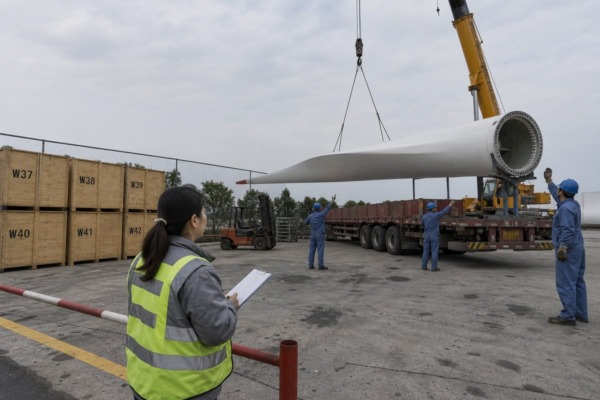
A weak delivery clause fails at the definition stage, not the deadline stage. So start by defining the event, not just the date.
Define the Delivery Event, Not Just a Date
What actually counts as "delivery"? Physical arrival at the named site? Handover at a designated point? Transfer of title and risk? Sample turbine supply agreements define the "Delivery Date" as the date for delivery of wind turbines to designated delivery locations, as set out in a formal delivery schedule. That structure works. Copy it.
Also decide how the clock starts. Some contracts set the delivery date relative to a Notice to Proceed 1 (NTP) or order confirmation rather than a fixed calendar date. That gives flexibility. But it creates ambiguity if drafted loosely. One sample clause handles this well: it requires delivery not less than four weeks and not more than fifty-six weeks after the order is delivered. A floor and a ceiling. Both parties know the boundaries.
Separate Sample Lead Time From Bulk Lead Time
In our own contracts, we always write the sample delivery date and the bulk delivery date as two separate terms. The bulk clock should only start after written sample approval. If the contract blurs the two, every sample revision becomes an excuse to slide the bulk deadline. We learned that the hard way. The lead time for wind components 2 also varies by part, so industrial contracts often specify a start date, an end date, and the number of complete units delivered per week.
| Term | What to Write | Why It Matters |
|---|---|---|
| Delivery Date | A defined date in a delivery schedule | Anchors enforcement |
| Delivery event | Arrival, handover, or risk transfer | Prevents "we shipped it" disputes |
| Sample lead time | Separate date with approval trigger | Protects the bulk schedule |
| Bulk lead time | Starts after written sample approval | Stops rolling delays |
| Delivery schedule | Units per week, start and end dates | Matches site readiness |
| No early delivery | Written consent required | Avoids storage and double-handling costs |
| Partial delivery | State whether it counts | Clarifies milestone credit |
How Can I Add Penalty Clauses to Protect Myself From Shipping Delays?
Shipping delays taught us a hard lesson early on. One late container triggered a chargeback dispute that dragged for months. Now every contract we sign carries a written delay-compensation formula.
Add delay liquidated damages (DLDs) that start after a defined grace period, typically 30 days, then accrue daily or weekly—often 1% of contract price per week—capped at around 10%, with notice obligations, a cure period, and a force majeure clause excluding excusable delay.

Liquidated damages for delay exist for one simple reason. The real cost of a late turbine is hard to prove. Delays cascade into erection, commissioning, lost energy production, and financing stress. A pre-agreed formula skips that fight. Both sides know the price of lateness before it happens.
Structure the DLD Formula in Stages
The strongest clauses stage the consequences. They do not punish day one. They escalate.
| Delay Stage | Contractual Consequence |
|---|---|
| Day 1–30 | Grace period; supplier must give written delay notice |
| Day 31 onward | DLDs accrue, e.g., 1% of contract price per week or a daily rate |
| Cumulative cap | Total exposure capped, usually around 10% of the purchase price |
| Cap exceeded | Buyer may terminate, procure replacements, withhold payment, or step in |
Also state whether the DLDs are the exclusive remedy or cumulative with other claims. Silence here invites litigation. In my experience, buyers accept a cap far more readily when the escalation before the cap is airtight.
Answer the Supplier's Objection Head-On
Suppliers will push back. They will argue that blade transport windows, customs holds, and port congestion sit outside their control, so rigid deadlines over-penalize normal industrial friction. That objection is half right. The fix is not a softer deadline. The fix is a sharper boundary between controllable delay and excusable delay. A well-drafted force majeure clause 3, plus extensions for owner-caused delay, handles the uncontrollable part. Some contracts even set shared weather risk thresholds—specific wind speeds or sea states that pause the delivery clock—so nobody argues over whether ordinary bad weather counts as force majeure. With those protections in place, the buyer's strict DLD schedule becomes fair, enforceable, and much easier to sign.
Should I Tie the Delivery Deadline to Production and Quality Inspection Milestones?
On our production line, every bulk run passes a pre-shipment inspection before it touches a pallet. That checkpoint exists because milestones catch delays weeks before the vessel sails.
Yes. Tie the delivery deadline to production and quality milestones—order confirmation, sample approval, mid-production checks, and a pre-dispatch inspection call with a fixed window, often seven days—then link each milestone to a milestone payment schedule so both parties stay accountable.

A one-line deadline tells you a delay happened. A milestone chain tells you a delay is coming. That difference is worth real money. Here is the milestone sequence I recommend writing directly into the contract:
- Order confirmation or NTP. The delivery clock starts on a written, dated trigger. Never on a verbal go-ahead.
- Sample approval. The bulk production countdown begins only after the buyer signs off in writing. This protects both sides.
- Mid-production checkpoint. The supplier submits progress reports or photos. Any expected slippage triggers a mandatory early-warning notice.
- Inspection call. The supplier notifies the buyer that goods are ready, and the buyer gets a fixed window—seven days is a common standard—to conduct a pre-dispatch inspection 4 before components leave the factory. If the buyer skips the window, the schedule proceeds.
- Dispatch verification. Modern contracts increasingly use IoT-verified dispatch, where the delivery milestone is met only when real-time GPS and tilt-sensor data are shared through a digital platform. No data, no milestone credit.
- Site readiness certificate. The buyer confirms that foundations, cranes, or warehouse access are ready. If the site is not ready, the delay is owner-caused and the schedule extends. This is how a TSA stays synchronized with the EPC or balance-of-plant contractor's readiness.
- Delivery and acceptance. Keep delivery separate from downstream completion. The Provisional Acceptance Certificate (PAC) comes after commissioning, not at the truck ramp. Mixing the two muddies responsibility.
Then attach money to the chain. Sample project agreements tie progress payments to these steps—for example, an installment due a set number of days before the scheduled delivery date. A milestone payment schedule turns the timeline from a promise into a shared commercial interest.
Which Incoterms Do I Need to Specify to Avoid Delivery Time Disputes?
Every quote we send weighs one trade-off: control versus cost. FOB keeps our price low, but DAP or DPU gives buyers a cleaner definition of on-time delivery.
Specify one Incoterms 2020 rule by name plus an exact place—for example, DPU named site, DAP buyer's warehouse, FOB Ningbo, or CIF destination port. The chosen term fixes where delivery legally happens, who unloads, and when risk transfers, which prevents most delivery time disputes.

The Incoterm decides what "on time" even means. So compare the options before you draft:
| Incoterm | Delivery Point | Who Unloads | When Supplier's Deadline Is Met | Timing Dispute Risk |
|---|---|---|---|---|
| EXW | Factory gate | Buyer | Goods made available | High for buyer |
| FOB | On board vessel, origin port | — | Goods loaded on ship | Moderate |
| CIF | Origin port (risk); freight paid to destination | Buyer | Goods loaded, freight arranged | Moderate |
| DAP | Named destination, ready for unloading | Buyer | Arrival at named place | Low |
| DPU | Named place, unloaded | Seller | Goods unloaded at named place | Lowest |
Notice the trap in FOB and CIF. Under both, the supplier legally "delivers" when the goods go on board at the origin port. Ocean delays after that point are the buyer's problem. So if you want the delivery time clause for wind turbines to cover the whole journey, choose DAP or DPU. DPU is the only Incoterms 2020 rule that puts unloading on the seller, which matters for heavy, crane-dependent components.
Name the Exact Place, Not the General Area
"Delivered to the project" is not a place. Industrial buyers now specify the individual turbine pad site rather than a general project entrance. Then attach a logistics and transportation plan as a contract annex covering routes, permits, and escort requirements. Two emerging additions are worth considering too: cradle-to-cradle obligations, where the supplier must retrieve and refurbish specialized transport frames before final delivery is accepted, and carbon-indexed logistics incentives that reward low-emission transport such as electric heavy-haulage or biofuel vessels.
Conclusion
Vague delivery language breeds delays, disputes, and lost seasons. Write the delivery time clause for wind turbines with exact dates, milestones, DLDs, and one clear Incoterm—then enforce it.
Footnotes
1. Defines the formal trigger used to start the performance clock in industrial and construction contracts. ↩︎
2. Updated authoritative Department of Energy page explaining wind turbine mechanics and primary mechanical components. ↩︎
3. Official ICC guidance on drafting clauses that excuse performance due to unforeseen, uncontrollable events. ↩︎
4. Authoritative WTO resource on the practice of inspecting goods in the exporter’s country before shipment. ↩︎
More Articles
You might also find these helpful.

How to Remotely Verify a Factory's Production Capabilities for Wrought Iron Plug-In Components?
Ensure clear wind turbine delivery time clauses in contracts with exact dates, Incoterms, milestones, and penalty caps to…
Read More →
How to Assess a Factory's Production Capacity When Sourcing Wrought Iron Inserts?
Ensure clear wind turbine delivery time clauses in contracts with exact dates, Incoterms, milestones, and penalty caps to…
Read More →
What Questions Should You Ask Wrought Iron Insert Suppliers to Spot Unreliable Ones Early?
Ensure clear wind turbine delivery time clauses in contracts with exact dates, Incoterms, milestones, and penalty caps to…
Read More → English
  Spanish
  German
  Arabic