
How to Assess a Factory’s Production Capacity When Sourcing Wrought Iron Inserts?
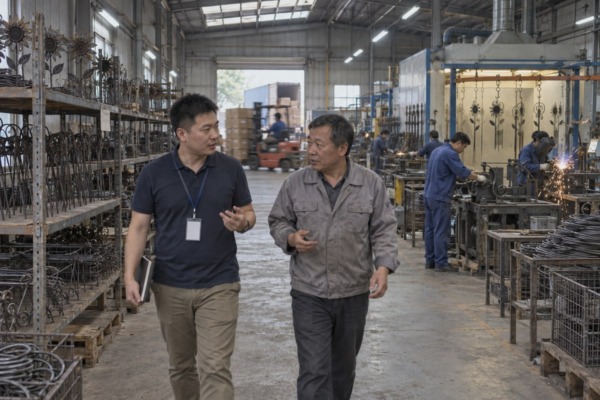
A supplier once promised our Zhufeng sourcing team unlimited capacity for metal garden stakes. Then peak season hit, orders slipped, and we learned to assess a factory’s production capacity properly.
To assess a factory’s production capacity for wrought iron inserts, ask about production lines, powder coating shifts, and monthly shipments of similar products. Check blank inventory, worker counts, and the last two months of shipping documents. Always verify peak-season capacity, not just off-season availability.
Capacity is not one number. It is a chain of constraints across cutting, forming, welding, finishing, and packing. This article walks through a practical factory audit checklist, step by step. You will learn what to ask, what to inspect, and which warning signs mean walk away.
How can I verify a wrought iron insert factory's real monthly output before signing a contract?
Last spring, I toured a partner iron-art factory near Ningbo. Their brochure claimed huge volume, but the blank racks were nearly empty. That visit changed how I verify output.
Verify real monthly output by requesting shipping documents from the last two months, counting blank inventory in the warehouse, and comparing worker numbers against claimed volume. Cross-check daily, weekly, and monthly figures for consistency, and confirm whether quoted numbers count good pieces only or include rejects.
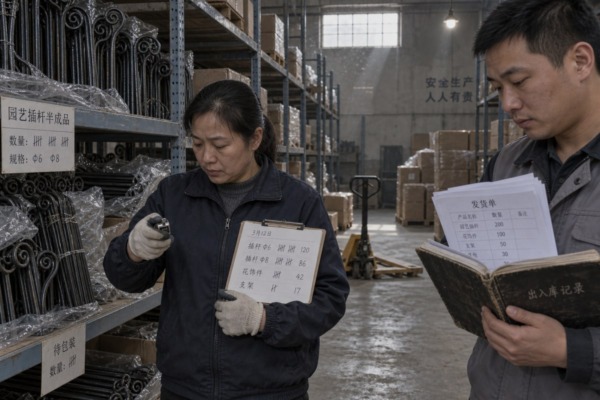
Marketing numbers and real output are two different things. In our own export work with garden decorations 1, we have seen both sides of that gap. The fix is simple: demand evidence, then test the evidence for consistency.
Translate Headline Claims Into Real Pieces
Suppliers in ornamental metalwork rarely quote finished pieces. One supplier we benchmarked lists 150 tons per month. Another claims 50 containers per year for wrought iron products. A third reports about 3,500 tons per year with around 200 machines and 150 employees. None of those figures tells you how many of your inserts they can ship. A lightweight sunflower stake and a heavy forged scroll consume very different tonnage per piece. So ask the factory to estimate capacity against your exact drawings, dimensions, material grade, and powder coating finishing spec. That single request separates serious factories from talkers.
The Documents I Always Request
| Evidence | What it proves | Watch out for |
|---|---|---|
| Shipping documents from the last 2 months | Sustained fabrication throughput, not peak claims | Documents covering unrelated product categories |
| Blank / semi-finished inventory | A real buffer for batch production capacity | Empty racks during a supposedly busy season |
| Order logs over 6–12 months | Consistency across daily, monthly, and annual figures | One peak month presented as the average |
| Electricity consumption records | Machines actually run at claimed utilization | Flat power usage during claimed peak months |
| Warehouse turnover records | Real loading and delivery pace | Stock that never moves |
Then run the math. Effective capacity equals theoretical output 2 multiplied by efficiency, utilization, and quality yield. If daily output times working days does not roughly match the monthly claim, question it. And always ask whether the quoted number counts good pieces only. Some factories include rejects and rework in their totals, which quietly inflates the figure.
What questions should I ask to evaluate a supplier's equipment and workforce capacity?
Every quote involves a trade-off we weigh at our Zhejiang facility: a single powder coating line keeps prices low, but it caps throughput hard once decoration orders stack up.
Ask how many production lines run, how many shifts the powder coating line works, total machine and worker counts, the skilled-to-general labor ratio, jig replacement schedules, and what percentage of steps are outsourced. Answers should match the claimed output and floor area.
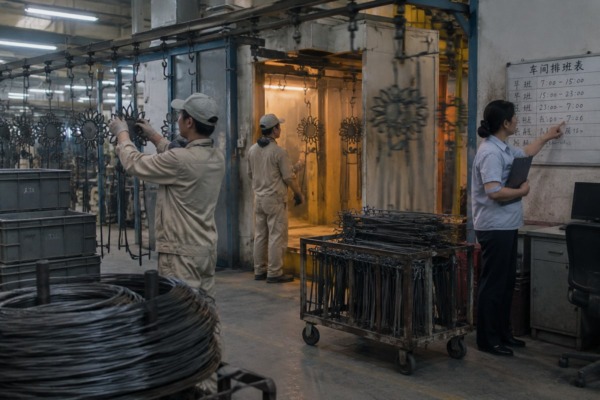
Equipment and people set the ceiling on output. But the slowest step, not the average step, determines what actually ships. So your questions should hunt for the bottleneck. Here is the question set I use before any contract, along with what a solid answer looks like.
The Question Table I Bring to Every Audit
| Question | Why it matters | A solid answer looks like |
|---|---|---|
| How many production lines do you run, and for which products? | Separates total capacity from capacity for your item | Specific line counts tied to product families |
| How many shifts does the powder coating line work? | Finishing is a classic bottleneck for coated inserts | Clear shift patterns, plus curing and drying floor space |
| How many machines do you own, and how old are they? | CNC benders and power hammers set technical throughput limits | A machine list with ages and per-machine output |
| What is your worker count and skilled-to-general ratio? | Intricate custom forging capabilities need experienced hands | A named ratio, not just a headcount |
| How often do you replace jigs and fixtures? | Worn tooling causes dimensional drift in high-volume runs | A written replacement schedule |
| What percentage of steps are outsourced? | Outside vendors create hidden capacity constraints | Named vendors with their own capacity confirmed |
| How do you handle raw material procurement in peak season? | Material shortages kill schedules quietly | Supplier contracts and on-hand steel inventory |
| What is your minimum order quantity versus maximum monthly volume? | Reveals where your order sits in their comfort zone | A range, with your order comfortably inside it |
Test the Numbers Against Each Other
Some buyers argue that a big total capacity is enough reassurance. I disagree, and I raise this objection deliberately: a factory can have high overall capacity yet low capacity for your specific insert if its tooling, finishing line 3, or inspection team is specialized elsewhere. Also cross-check proportions. If a supplier claims massive volume but reports 150 employees and 200 machines, the staffing, shifts, and floor area 4 must all support that story. When one leg of the tripod wobbles, the whole claim wobbles.
How do I confirm a factory can meet my delivery deadlines without sacrificing quality?
A US procurement manager recently asked me one blunt question over WhatsApp: could our garden stake line hit her October deadline? Her fear was delays, not price.
Confirm deadlines by checking historical lead times for similar-sized orders, auditing quality control checkpoints, verifying peak-season capacity, and requesting sample timelines for small, medium, and large orders. Build staged deliveries and inspection gates into the contract before signing anything.
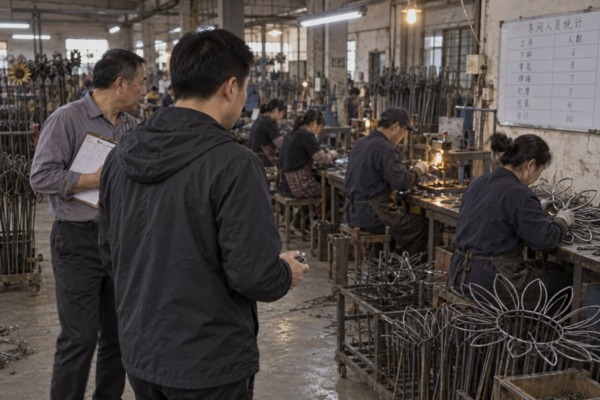
Speed and quality pull against each other on any metal line. A factory that can physically produce your volume may still fail you if inspection, sorting, or finish rework slows everything down. In our export experience with the United States and Europe, the buyers who avoid disasters are the ones who verify both sides before signing.
Why Peak Season Changes Everything
Here is the point I stress most, because I have lived it: many factories have plenty of capacity in the off-season, but their order books saturate in peak season, and then they delay. A quote given in a quiet month tells you almost nothing about a shipment due in a busy one. So ask directly about their peak-season order book. Ask how they prioritize when lines are full. Ask what happened to deadlines last peak season. Their answers reveal supply chain reliability better than any promise.
Deadline Verification Steps
| Step | What to request | Why it protects you |
|---|---|---|
| Historical lead times | Fulfillment records for similar-sized projects | Past performance beats quoted promises |
| Peak-season status | Current and projected order book for your ship window | Off-season capacity does not equal peak capacity |
| Quality control standards map | Every checkpoint from cutting to packing | High-speed runs must not compromise finish or structure |
| Finishing floor space | Area dedicated to drying and curing after coating | Cramped finishing zones throttle output late in the process |
| Live tracking | ERP or real-time milestone reporting | Manual updates hide slippage until it is too late |
| Sample timelines | Written schedules for small, medium, and large orders | Forces the factory to commit to realistic lead times |
Finally, resist the surge trap. Some factories can sprint for two weeks to impress a new client. Long-term sourcing decisions should rest on sustained throughput and on-time delivery history, not on a one-off burst.
What red flags indicate a factory is overstating its production capabilities?
We learned this lesson the hard way when an outsourced forging partner missed two shipments. Since then, our team treats every impressive capacity claim as a hypothesis to test.
Red flags include vague answers about process steps, inconsistent capacity figures across conversations, refusal to share shipment records, headline numbers about floor area or workers that do not match reality, empty blank inventory, and capacity quoted only in tons or square meters.
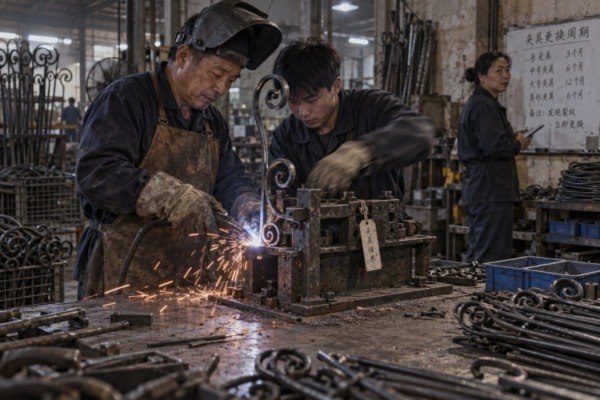
Some buyers push back on my skepticism. They argue that stated capacity is still useful because it quickly narrows the field. They are right, up to a point. A claimed number is a good filter for shortlisting. It is a terrible basis for a signature. Treat every claim as a starting point for verification, and watch for these signals.
- Capacity quoted only in vague units. Claims like 30,000 square meters of floor area, more than 200 skilled workers, or nearly 1,000 hours per week of production sound impressive. But none of them converts directly into your inserts. Demand piece-level numbers for your design.
- Figures that do not reconcile. If the daily number times working days misses the monthly claim, or the monthly number times twelve overshoots the annual figure, someone is guessing.
- Refusal to share process data. A factory hiding its shipment records, bottleneck steps, or outsourcing percentage is hiding its limits.
- Multiple sites blended into one number. Larger suppliers often combine several factories into one headline figure. Separate each site's real contribution before you trust the total.
- Empty blank racks in a claimed busy period. No semi-finished inventory means no buffer and no momentum.
- Electricity records that contradict utilization claims. Machines that supposedly run two shifts should show it in the power bill.
- Location in an environmental red zone. Government-mandated power cuts or emissions shutdowns can halt capacity overnight, no matter how many machines sit on the floor.
- Peak output sold as sustained output. Production scalability means holding volume for months, not surging for a week.
Then decide with a simple framework: approve the supplier when verified throughput, quality yield, and shipment history align with your order profile; monitor closely when evidence is partial; reject when claims and evidence diverge.
Conclusion
Capacity is a chain of constraints, not a single number. Verify shipping documents, count workers and blanks, test peak-season availability, and sign only with factories whose evidence matches their claims.
Interested in sourcing the products mentioned in this article? See details and request a quote here:
Footnotes
1. U.S. Customs and Border Protection provides authoritative guidance on trade compliance and verification for imported goods. ↩︎
2. ISO standards provide the global framework for defining and measuring production capacity and manufacturing quality. ↩︎
3. Technical overview of the powder coating process commonly used as the finishing line for wrought iron products. ↩︎
4. The International Trade Centre offers resources for businesses to manage supply chain logistics and verify supplier capabilities. ↩︎
More Articles
You might also find these helpful.
How to Remotely Verify a Factory's Production Capabilities for Wrought Iron Plug-In Components?
Learn to verify a wrought iron insert factory's true production capacity with shipping records, inventory checks, and peak-season…
Read More →
What Questions Should You Ask Wrought Iron Insert Suppliers to Spot Unreliable Ones Early?
Learn to verify a wrought iron insert factory's true production capacity with shipping records, inventory checks, and peak-season…
Read More →
How to Verify a Chinese Wrought Iron Supplier's License and Export Qualifications?
Learn to verify a wrought iron insert factory's true production capacity with shipping records, inventory checks, and peak-season…
Read More → English
  Spanish
  German
  Arabic