
How to Estimate Competitive Unit Procurement Costs for Wind Turbines?
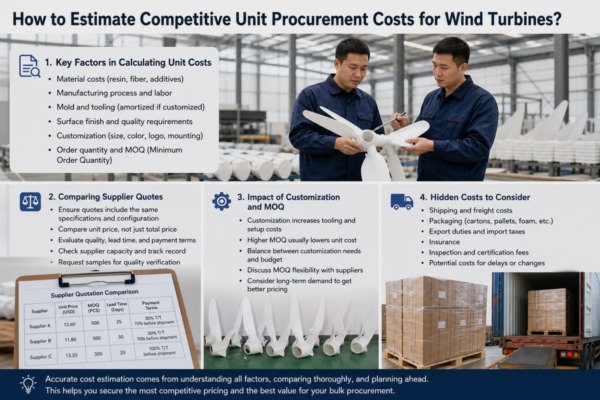
Estimating competitive unit procurement costs for wind turbine pinwheels confuses many buyers. Two quotes for one design can differ by 40%. On our Zhejiang production line, I see why daily.
To estimate competitive unit procurement costs for wind turbines or pinwheels, break each quote into materials, labor, tooling, packaging, and freight. Convert every offer to a landed cost per unit, then benchmark against overseas wholesale market rates for the same quality tier before negotiating.
The method below comes from years of quoting OEM pinwheel projects for distributors in the United States, South America, and Europe. I will walk through the cost factors, the quote comparison process, the [MOQ](https://zhufengpinwheels.com/?p=450) math, and the hidden charges. By the end, you can judge any quote with confidence instead of guessing.
What factors should I consider when calculating unit costs for wind turbine pinwheels?
Last spring, our QC team rejected an entire batch of mylar blade film because the gauge felt noticeably thinner than spec. That one check protected every unit cost calculation downstream.
Key factors include blade material grade (PET or mylar film), dowel quality, pin and grommet hardware, printing method, assembly labor, tooling amortization, defect rate, order volume, and inner packaging. Together these form the bottom-up unit cost before freight is added.
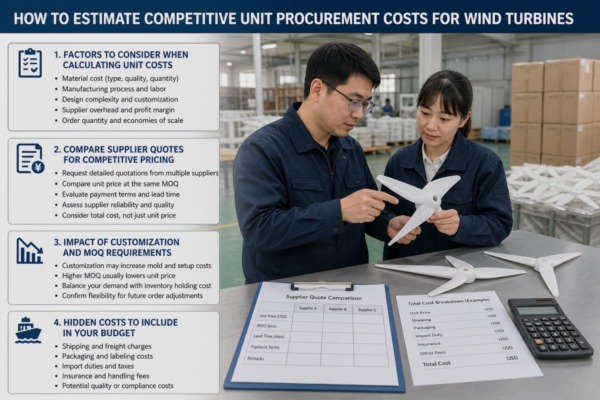
When I build a quote for a rainbow eight-petal pinwheel, I always start from the bill of materials and work upward. That bottom-up habit exists because I have watched too many buyers get burned by round-number pricing that hides what is actually inside the product.
Material and Craftsmanship Set the Floor
The blade film is the heart of the product. PET and mylar films differ in gauge, gloss, and UV resistance. A thicker film holds its butterfly-wing curve through wind and sun. A thin one warps within weeks. The wooden dowel matters too. A smooth, straight, splinter-free stick costs more than rough stock, but it cuts complaints. Hardware looks trivial — a steel pin, two yellow grommets, a small hub — yet it decides whether the wheel still spins freely after a month outdoors. This is exactly why I judge whether a unit cost is genuinely competitive by weighing the materials and workmanship behind the number, never the number alone.
Borrow the Wind Industry's Cost Discipline
Utility-scale buyers split costs cleanly. In current industry breakdowns, turbine supply eats roughly 55–65% of onshore capital 1, while Balance of Plant, grid interconnection costs, and soft costs fill the rest. Copy that logic at pinwheel scale. Treat blades, stick, and hardware as your "turbine supply." Treat assembly, tooling, and inner packaging as your Balance of Plant. Also watch raw material price volatility. PET film and steel pin prices move with resin and metal markets, so a quote that ignores current input costs is either padded or unsustainable.
| Cost component | What drives it | Share of ex-works 2 unit cost |
|---|---|---|
| Blade film (PET/mylar) | Gauge, printing, UV coating | Largest slice |
| Wooden dowel stick | Wood grade, length, finish | Moderate |
| Pin, grommets, hub | Metal and plastic quality | Small but critical |
| Assembly labor | Manual curl-and-pin steps | Moderate |
| Tooling and dies | Amortized over order volume | Falls as quantity rises |
| Defect allowance | QC standard and rework rate | Often forgotten |
How can I compare supplier quotes to find the most competitive pricing for bulk orders?
A procurement manager from Texas once sent me three competing quotes over WhatsApp and asked which was real. Two looked cheap only because their scope was quietly stripped down.
Compare supplier quotes by converting every offer to a landed cost per unit under identical Incoterms, quantities, and quality specs. Build a basket of three to five quotes, adjust for scope differences, then benchmark the results against overseas wholesale rates for the same quality tier.
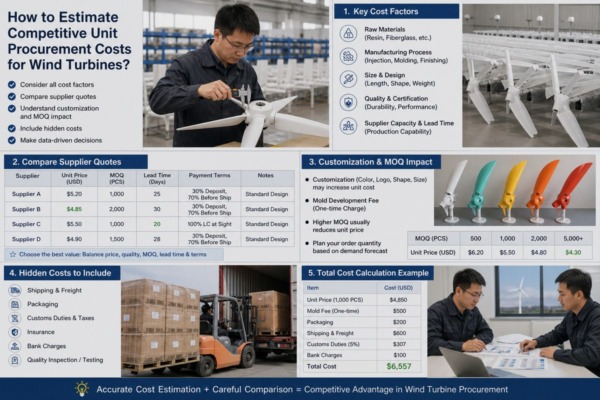
Here is the process I recommend to every distributor before signing a bulk order:
- Collect three to five quotes against one identical spec sheet.
- Force every quote onto the same Incoterms and quantity tier.
- Convert each offer to landed cost per unit, not ex-works price.
- Adjust for scope gaps like packaging, QC, and defect terms.
- Benchmark the adjusted numbers against overseas wholesale market rates.
Normalize Before You Judge
A comparison basket only works if the contents match. In utility wind, buyers never compare a bare supply deal against a full EPC contract structure, because the scopes are worlds apart. The same trap exists here. One supplier quotes ex-works with polybags only. Another quotes FOB with printed inner boxes and pre-shipment inspection included. Comparing those raw numbers is apples to oranges.
| Quote element | Question to ask | Why it changes real cost |
|---|---|---|
| Incoterms | Ex-works, FOB, or delivered? | Freight and handling shift between parties |
| Quantity tier | Is the price valid at my volume? | Tooling amortization changes per-unit math |
| Film spec | Same gauge and UV treatment? | Cheaper film hides in identical photos |
| Packaging scope | Polybag, inner box, or display-ready? | Retail packaging adds real cost |
| Defect terms | Who pays for rework or returns? | Risk transfer has a price |
Read the Market Like a Turbine Buyer
Even when vendor pricing is confidential, public anchors exist. Utility buyers use market benchmarking analysis constantly — U.S. land-based turbine OEM pricing 3 sat around $850–$950 per kW in 2022, against a broader supply range of about $700–$1,100 per kW — and they judge deals against those anchors. Do the same with wholesale pinwheel listings in your target market. Then think one level deeper, the way energy buyers think in Levelized Cost of Energy terms: the winning quote is the one with the lowest cost per sellable, undamaged unit over time, not the lowest sticker price today.
How do customization and MOQ requirements impact my total procurement cost?
Every custom die we cut in our Zhejiang workshop is a bet: the client gains a unique petal shape, but someone must absorb the tooling bill.
Customization adds tooling, printing plates, and color-matching costs that must be amortized across your order, while MOQ sets how thinly they spread. Higher volumes dilute fixed costs sharply, so unit price falls as quantity rises; small custom runs carry the highest per-piece burden.
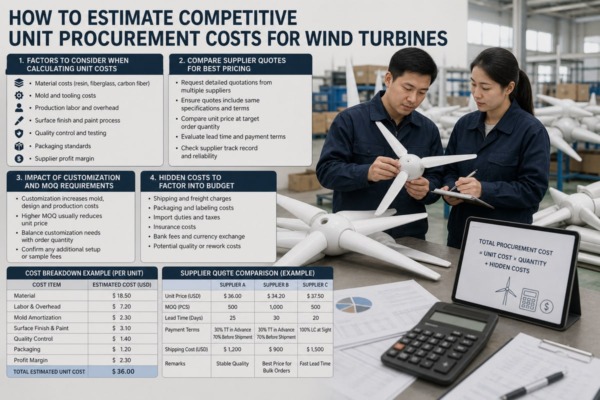
Customization is where unit procurement costs either bloat or shine, and the difference is almost always the math behind the MOQ. Here is the sequence I walk buyers through on every OEM and ODM project:
- Separate custom from standard. A new petal die, a licensed print, or a Pantone-matched gradient is custom. A stock eight-petal wheel on a natural dowel is not. Only pay customization premiums on truly custom elements.
- Demand tooling as its own line item. Treat dies and printing plates as capital expenditure, not as a mystery buried in the unit price. Visible tooling costs can be negotiated, waived on reorders, or amortized transparently.
- Run the amortization math. Divide total tooling cost by order quantity. At a small trial run, tooling can dominate the unit price. At a full container quantity, it nearly vanishes.
- Compare MOQ tiers side by side. Ask for pricing at two or three volume levels. The curve tells you where the supplier's real efficiency point sits.
- Consider a mixed strategy. Custom-printed blades on stock sticks and stock hubs often deliver a unique look at near-standard cost.
- Plan reorders before the first order. Tooling already paid for makes repeat runs cheaper — lock that into the agreement.
The logic mirrors utility wind exactly. Developers choose larger turbines because foundations, cranes, and connections spread across more capacity, and they chase capacity factor optimization to squeeze more output from fixed assets. You chase larger runs to squeeze more units from fixed tooling. But learn the wind industry's caution too: the cheapest per-unit price at a giant MOQ is not automatically the cheapest decision if it strands cash in slow-moving inventory, just as the cheapest per-kW turbine is not the cheapest project when site logistics fight back.
One crushed container taught me more than any spreadsheet. Thin cartons saved a client pennies per unit, then damaged blades erased the entire savings at the destination port.
Budget for export cartons, inner boxes, protective inserts, volumetric sea or air freight, port handling, customs duties, insurance, and a damage allowance. These hidden costs commonly add a meaningful margin on top of the ex-works price, so always calculate the full landed cost.
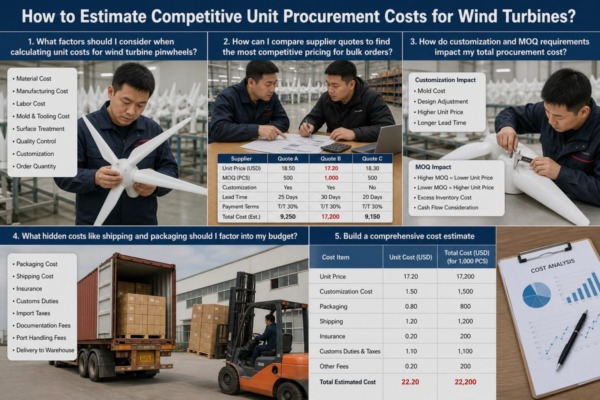
Supply chain logistics is where good quotes go to die. A pinwheel is light, but it is not small. The long wooden dowel dictates carton length, and carriers bill volumetric weight, not actual weight. In utility wind, blades over 100 meters trigger last-mile premiums, special vessels, and road modifications. Our version of that problem is a 60-centimeter stick that forces an oversized carton and inflates cubic meters per thousand units. Smart loading plans — sticks packed separately from blade sets, assembled by the retailer or end user — can cut freight volume dramatically, and it is worth asking every supplier whether their design allows it.
Map Every Cost Between Factory Gate and Warehouse
| Hidden cost | When it appears | How to control it |
|---|---|---|
| Export cartons and inserts | At packing | Specify carton grade in the contract |
| Volumetric freight | At booking | Optimize carton dimensions and knock-down packing |
| Port and handling fees | Origin and destination | Clarify Incoterms responsibility upfront |
| Customs duties and tariffs | At import | Verify HS codes and duty rates before ordering |
| Cargo insurance | Per shipment | Small cost, large protection |
| Damage and defect allowance | After arrival | Pre-shipment inspection plus honest packaging |
Duties deserve special attention. In utility wind, local content mandates can inflate procurement costs by 10–20% versus global sourcing; import tariffs play the same silent role for decorative goods, so model them before you compare countries of origin. Finally, think past arrival. Returns handling, replacement parts, and customer complaints are your version of operations and maintenance. A proper lifecycle cost assessment — landed cost plus expected post-sale losses — is the only number that reflects reality. Packaging that survives the journey is not an expense. It is insurance against the most painful pain points I hear from buyers: damaged goods, product returns, and lost shelf time.
Conclusion
A competitive unit procurement cost is proven, not guessed. Benchmark overseas wholesale rates, compare multiple supplier quotes, weigh material and craftsmanship, and negotiate with landed-cost evidence in hand.
Footnotes
1. Authoritative report providing global benchmarks for onshore wind capital costs and turbine supply price trends. ↩︎
2. Official ICC rules defining Ex Works (EXW) and other Incoterms used to calculate unit procurement costs. ↩︎
3. Updated to the live 2024 Department of Energy wind market report hub. ↩︎
More Articles
You might also find these helpful.

Welche Brandschutz-Zertifizierungen sollte ich beim Kauf von Windrädern prüfen?
Learn how to break down wind turbine pinwheel quotes into materials, labor, and freight to estimate competitive unit…
Read More →
Wie überprüfe ich die Echtheit von Prüfberichten beim Kauf von Windturbinen?
Learn how to break down wind turbine pinwheel quotes into materials, labor, and freight to estimate competitive unit…
Read More →
Wie kann ich prüfen, ob Windrad-/Windmühlenmaterialien schädliche Chemikalien enthalten?
Learn how to break down wind turbine pinwheel quotes into materials, labor, and freight to estimate competitive unit…
Read More → English
  Spanish
  German
  Arabic