
What’s the Difference Between FOB and CIF Prices in a Supplier’s Quotation?
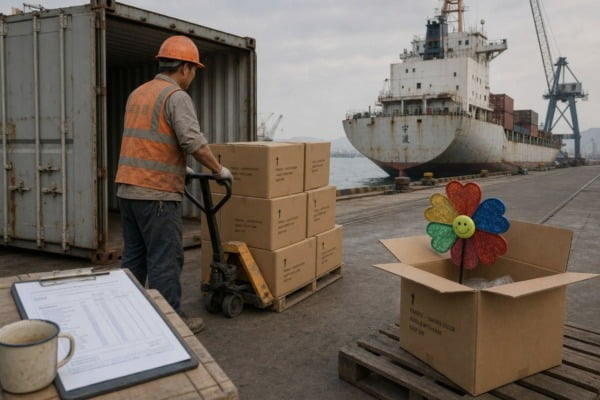
Last month, a buyer compared our FOB pinwheel quote against a competitor’s CIF price 1 and almost picked the wrong one. The difference between FOB and CIF prices confused her completely.
An FOB price covers goods delivered and loaded onto the vessel at the origin port; a CIF price adds ocean freight and minimum marine insurance to the destination port. Under both terms, risk transfers to the buyer once goods are loaded at the origin port.
That last sentence surprises most buyers. Let me walk you through how these two terms change your quote, your costs, and your risk.
How can I tell if a pinwheel supplier's quote is FOB or CIF pricing?
At our Zhejiang factory, we issue dozens of quotations every week, and I always print the trade term right next to the unit price. Not every supplier does that.
Check the quotation for the trade term and a named port. FOB quotes state an origin port, like FOB Ningbo, and exclude freight. CIF quotes state a destination port, like CIF Los Angeles, and bundle ocean freight and insurance into the price.

The named port is your fastest clue. FOB always points to a port in the supplier's country. CIF always points to a port in yours. If a quote says "FOB Shanghai," the seller's job ends when your glittery pinwheel cartons are loaded on the vessel in Shanghai. If it says "CIF New York," the seller also pays ocean freight charges and arranges marine insurance until the cargo reaches New York.
What sits inside each price
Under Incoterms 2020 2, the cost split is clear. Here is how I break it down for buyers of our pinwheel strings and garden spinners:
| Cost item | FOB quote | CIF quote |
|---|---|---|
| Product, packing, cartons | Included | Included |
| Inland trucking to origin port | Included | Included |
| Export customs clearance | Included | Included |
| Loading onto the vessel | Included | Included |
| Ocean freight to destination | Buyer pays | Included |
| Marine insurance (minimum cover) | Buyer arranges | Included |
| Destination terminal charges | Buyer pays | Buyer pays |
| Import duties and taxes 3 | Buyer pays | Buyer pays |
Red flags in vague quotations
Some quotes just say "USD 0.45/pc" with no term at all. That is dangerous. I have seen buyers assume a price was CIF, then get shocked by a separate freight invoice. Always ask three questions in writing:
- Which Incoterm applies?
- Which named port?
- What exactly is included?
A professional supplier will answer all three without hesitation. If they dodge, treat the quote as incomplete.
Which pricing term should I choose when sourcing pinwheels from China to reduce shipping delays?
One of our US distributors once lost two weeks before Easter because her previous supplier's CIF carrier took the cheapest, slowest routing. Seasonal pinwheel sales do not forgive delays like that.
Choose FOB if shipping delays hurt your business. FOB lets you appoint your own freight forwarder, pick faster vessels, and track the shipment directly. CIF hands routing control to the supplier, who often selects the cheapest carrier, not the fastest one.

Here is the honest truth from someone who ships pinwheels out of Ningbo every month: when a supplier books freight under CIF, their incentive is cost, not speed. They already quoted you a fixed price. Every dollar saved on ocean freight charges goes into their margin. So they may pick a slow service with two transshipments instead of a direct sailing.
Under FOB, you flip that incentive. Your freight forwarder works for you. You choose the carrier, the sailing schedule, and the service level. You also see the bill of lading 4 and vessel tracking directly, so you know exactly where your holiday stock sits.
A simple decision path
- You ship regularly and have a forwarder? Take FOB. You control transit time and can chase delays yourself.
- You are a first-time importer with one small order? CIF is simpler. Just confirm the estimated transit time in writing before you pay.
- Your order is seasonal (Easter, summer fairs, holiday décor)? Take FOB and book space early. Peak-season space runs out fast, and you do not want a supplier's cheap carrier deciding your delivery date.
There is another timing benefit buyers often miss. Under FOB, you usually pay freight to your forwarder around arrival, sometimes on credit terms. Under CIF, you pre-pay freight inside the supplier invoice, weeks before the vessel even sails. That difference matters for your cash flow, especially on large seasonal pinwheel orders.
Whenever I quote both terms side by side for a buyer, I explain my freight assumptions openly, because I know some competitors do not. Hidden costs are where CIF comparisons go wrong.
Watch for supplier markups on freight and insurance inside CIF prices, low-freight carriers with high destination handling fees, and higher import duties when customs values the inflated CIF amount. FOB looks cheaper upfront, but you must add real freight, insurance, and destination costs.

The core problem is that a CIF price bundles three things — product, freight, insurance — into one number. You cannot see the split. Industry research suggests some CIF quotes carry a 10–20% markup on the freight and insurance components. I present that as a sourced estimate, not a universal rule, but the transparency risk is real.
The destination fee trap
This one hurts the most. Some suppliers pick carriers offering rock-bottom origin rates. Those carriers recover their money through high terminal handling and "arrival" fees at the port of destination. You must pay those fees before the carrier releases your cargo. Your CIF quote looked cheap, but your total landed cost ballooned.
Comparing quotes the right way
Never compare an FOB number against a CIF number directly. Build both into a landed cost estimate:
| Cost element | FOB comparison | CIF comparison |
|---|---|---|
| Supplier invoice | FOB price | CIF price (freight bundled) |
| Ocean freight | Your forwarder's real quote | Hidden inside price |
| Marine insurance | Your policy, your cover level | Minimum Clause C cover only |
| Destination handling | Predictable via your forwarder | Unknown until arrival |
| Customs duty base | Often lower declared value | May include inflated freight |
Note that duty point. Many customs authorities calculate import duties and taxes on the CIF value. If the supplier padded the freight, you pay duty on the padding too. When one of our buyers switched from a competitor's CIF terms to our FOB Ningbo terms, her per-unit landed cost dropped even though our product price was nearly identical. The savings came entirely from freight transparency.
How do FOB and CIF terms affect my liability if my pinwheel shipment arrives damaged?
The insight I share most often with new buyers comes from my own hard lessons in this trade: the risk allocation is not the same as the cost allocation. People confuse the two constantly.
Under both FOB and CIF for sea freight, the transfer of risk happens when goods are loaded onto the vessel at the origin port. If your pinwheels are damaged at sea, you bear the risk under both terms — CIF only means the seller pre-paid the insurance.

This is the single most misunderstood point in international trade. Buyers see "the supplier pays freight to my port" under CIF and assume the supplier also carries the transit risk to that port. They do not. Under Incoterms 2020, risk passes to you the moment the cargo is loaded on board at the port of shipment — for FOB and for CIF alike. Older texts said "ship's rail"; modern practice says "loaded on the vessel." Either way, once our pinwheel cartons cross onto that ship in Ningbo, the transit risk is yours.
Why CIF claims get messy
Here is the awkward part of CIF. You bear the risk, but the seller holds the insurance contract. If a container of holographic pinwheel spinners arrives with water damage, you must file the claim through a policy you did not choose, with an insurer you have never dealt with, often in the supplier's country. That creates real friction and delay.
Worse, CIF only requires minimum cover — Institute Cargo Clauses (C). That is thin protection. It typically excludes many common causes of damage. Fragile decorative goods like foil pinwheels deserve broader cover.
Protecting yourself in practice
- Under FOB, buy your own marine insurance with All Risks (Clause A) cover. You control the policy, the insurer, and the claim.
- Under CIF, ask the supplier to upgrade cover beyond Clause C and to name you as the insured party on the certificate.
- Either way, photograph cartons at loading, keep the bill of lading clean, and inspect immediately at destination so damage claims have evidence.
At our factory, we photograph every container loading for exactly this reason. Good documentation protects both sides when something goes wrong at sea.
Conclusion
FOB and CIF split costs differently, but risk transfers at loading under both. Compare quotes by total landed cost, confirm the named port, and choose the term matching your logistics capability.
Footnotes
1. US government resource explaining how insurance and freight costs are allocated under different trade terms. ↩︎
2. Official source for the international commercial terms used in global trade and shipping. ↩︎
3. Official US Customs and Border Protection guide on the responsibilities of importers regarding duties and taxes. ↩︎
4. Comprehensive overview of the legal document used in shipping to acknowledge receipt of cargo. ↩︎
More Articles
You might also find these helpful.

¿Qué certificaciones de resistencia al fuego debo verificar al comprar molinetes?
FOB and CIF prices differ in what a supplier's quotation includes; learn to spot the named port and…
Read More →
¿Cómo verificar la autenticidad de los informes de prueba al comprar turbinas eólicas?
FOB and CIF prices differ in what a supplier's quotation includes; learn to spot the named port and…
Read More →
¿Cómo comprobar si los materiales de los molinetes contienen químicos dañinos?
FOB and CIF prices differ in what a supplier's quotation includes; learn to spot the named port and…
Read More → English
  Spanish
  German
  Arabic