
How to Negotiate Lower MOQ or Mixed Styles for Wrought Iron Plug-In Components?
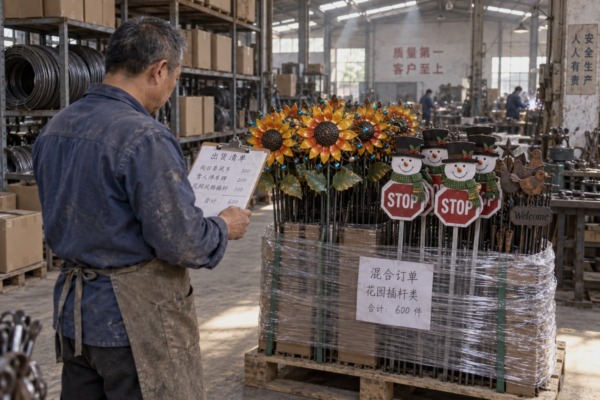
Buyers ask our Zhejiang production line weekly for a lower MOQ 1 on wrought iron plug-in components. Most get refused — not because factories are rigid, but because the ask is structured wrong.
To negotiate a lower MOQ or mixed styles for wrought iron plug-in components, combine several styles into one consolidated order that meets the factory’s minimum material input, offer a 10–25% higher trial-order unit price, share one raw material across styles, and commit to stable reorders.
That single paragraph is the whole playbook in miniature. Below, I break down each piece. I will show you what drives an [MOQ](https://zhufengpinwheels.com/?p=1484), how mixed-style consolidation works, how to protect quality on small runs, and how long-term tactics keep unlocking flexibility. Everything here comes from real orders we have quoted, run, and shipped.
How can I convince suppliers to lower the MOQ for wrought iron plug-in components?
A procurement manager messaged me on WhatsApp last spring: "Your 1,000-piece MOQ kills my test launch." We closed that deal anyway — because she let me explain what drives the number.
Convince suppliers by targeting what the MOQ protects: setup labor, material purchasing, finishing, and packaging economics. Offer a unit price 10–25% above bulk rates, accept standard packaging and fewer finishes, request overstock components, or propose a trial order at 50–70% of the quoted MOQ.
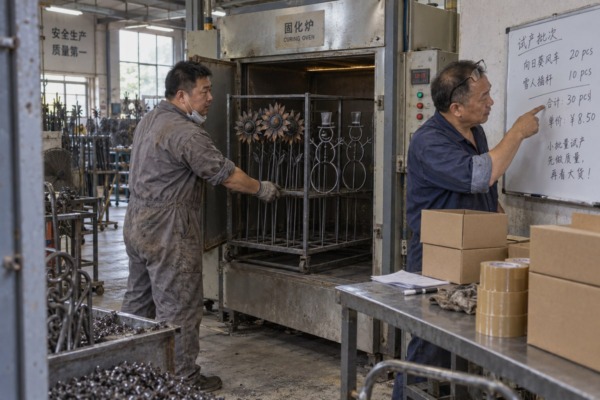
The first thing to understand is that MOQ is not one number in this category. Marketplace listings for wrought iron items 2 range from single-piece minimums up to 50, 100, 500, 1,000 pieces, or even full container commitments. That spread tells you something important. There is no universal rule. The number depends on factory size, product complexity, and sales channel. Ornamental ironwork suppliers selling through retail marketplaces can afford tiny minimums. Factories quoting wholesale metal components cannot, because their whole cost model assumes an efficient run.
What the MOQ Actually Protects
When I quote a plug-in garden stake, my MOQ covers five real cost floors. Attack the right one and the number moves.
| Cost driver | Why it sets the MOQ | Your negotiation lever |
|---|---|---|
| Material purchasing | Iron and steel are bought in mill-lot quantities | Use stock gauges the factory already holds |
| Setup labor | Tooling and jig changeovers take paid hours | Offer 10–25% above the bulk unit rate |
| Finishing | Powder-coat batches need a minimum load | Limit yourself to one or two finishes |
| Packaging | Cartons and pallets have print minimums | Accept standard export cartons |
| Margin per run | The factory needs a profit floor per setup | Commit to a documented second order |
Trade-Offs That Move the Number
Sample order negotiation works best when it is specific. Tell the supplier your exact styles, quantities per style, and target landed cost. Then offer trades. Ask if they hold overstock or off-the-shelf components from previous runs — those bypass manufacturing minimums entirely. Strip out nonessential requirements first: custom packaging, extra color variety, special labeling. Each removal lowers the factory's risk, and lowered risk is what actually lowers an MOQ.
What strategies help me negotiate mixed styles within a single production order?
Changeovers on our stake line take real hours. Every time we swap tooling from sunflower spinners to holiday sign stakes, that setup cost lands on someone's invoice.
Negotiate mixed styles by asking whether the MOQ applies per style or per total order, then building a mixed-SKU basket that reaches the factory's minimum material input. Share one raw material and finish across styles, accept a small unit-price increase, and allow a slightly longer lead time.
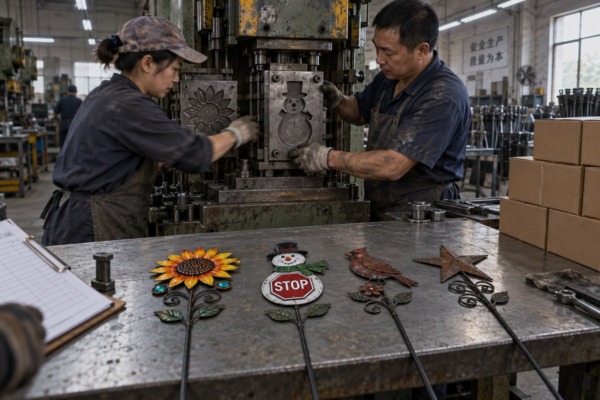
Consolidated mixed orders are the strategy I push hardest, because it is the one I say yes to most often on our own line. The logic is simple. A factory does not truly need 1,000 pieces of one style. It needs enough total volume to justify buying material and running the line. If your combined order across four styles reaches our minimum material input quantity, the changeover cost gets split across all four styles instead of crushing one small batch. Here is my exact process:
- Ask directly: does the MOQ apply to each style separately, or to the total order? Many buyers never ask, and many suppliers apply it to the total.
- Build a mixed-SKU basket that hits the factory's minimum material input. Four styles at 300 pieces each can be more attractive than one style at 1,000.
- Propose one shared raw material and one shared finish across all styles. Shared material cuts the factory's changeover and procurement cost, and I will trade that saving for a lower per-style minimum.
- Accept the honest costs: mixed runs push the unit price up slightly, and the lead time runs a bit longer because of multiple setups.
Choose Styles That Share Production DNA
Standardized components help enormously. Items built on universal molds or common iron gauges — think wrought iron balusters 3 or staircase railing parts in a shared profile — mix cheaply. Another workaround I recommend: order semi-finished components with a universal plug-in base, then vary only the decorative tops. That bypasses style-specific minimums at the source while keeping our custom fabrication services affordable.
| What you accept | Why the factory cares | Typical impact |
|---|---|---|
| Slight unit-price increase | Covers extra changeovers | Small, single-digit uplift per piece |
| Slightly longer lead time | Multiple setups queue on one line | Days added, not weeks |
| One shared material spec | Cuts material-change and procurement cost | Unlocks lower per-style MOQ |
| One or two shared finishes | Fills powder-coat batches efficiently | Keeps finishing minimums intact |
How do I balance requesting a lower MOQ with maintaining strict quality control standards?
Small runs scare me more on quality than big ones. With 300 pieces, one bad powder-coat batch is 100% of your shipment, and there is no averaging out.
Balance both by keeping quality requirements fixed while flexing quantity, packaging, and finish variety. Write QC standards into the trial production run contract, request pre-production samples, inspect the first mixed batch at 100%, and never trade inspection rights for a lower minimum.
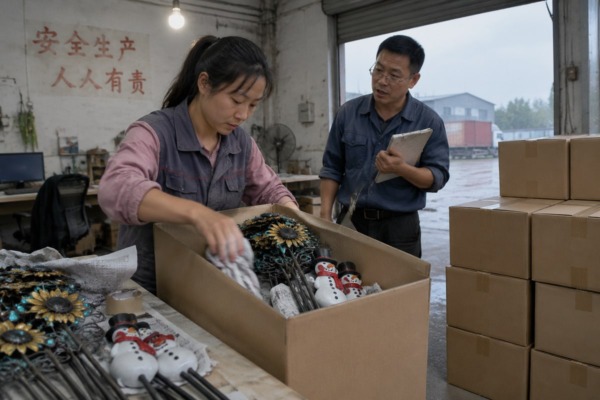
The buyers I trust most negotiate hard on quantity and never on quality. That distinction matters, because some suppliers quietly assume a lower MOQ means looser standards. It should mean the opposite. A trial production run exists to prove capability, so it should be inspected more strictly than a routine bulk order, not less. When a US distributor negotiates a small mixed order with us, I encourage her to keep every QC clause intact and cut costs elsewhere.
Here is how I separate what you can concede from what you must protect. You can concede custom retail packaging, wide color assortments, and premium finishes on a first order. You must never concede coating thickness 4, weld integrity, stake-fit tolerance on the plug-in base, or your right to a pre-shipment inspection. Damaged packaging and product returns are the two pain points that destroy distributor margins, and both trace back to skipped checkpoints on small runs.
QC Checkpoints for Small Mixed Orders
| Stage | What to check | Why it matters on small runs |
|---|---|---|
| Pre-production sample | Material gauge, finish color, plug-in fit | Locks the standard before any metal is cut |
| First-article inspection | One approved piece per style | Mixed orders multiply setup errors per style |
| In-process finish check | Coating coverage and adhesion | One bad coat batch ruins the entire small lot |
| Pre-shipment inspection | Function, dimensions, carton drop test | Prevents returns and transit-damaged packaging |
Frame the small order as a sample phase in writing. State that the trial validates quality before a larger commitment. Factories offering serious custom fabrication services respect that framing, because it signals you are a professional buyer testing a long-term partner, not a hobbyist chasing a discount.
What long-term supplier relationship tactics help me secure more flexible MOQ and style options?
One lesson took me years to accept: the second order buys more flexibility than the first negotiation ever will. Factories remember who reordered on schedule.
Secure flexibility by committing to annual volume shipped in smaller mixed installments, paying for raw materials upfront under a virtual warehousing model, aligning orders with the factory's existing production schedule, and building a documented reorder history that justifies lower minimums and wider style mixes over time.

My core negotiation logic with new buyers is always the same trade: a small trial MOQ now, in exchange for a credible commitment to stable repeat orders later. The first order is where I take the risk. The reorder is where I earn it back. Buyers who understand this structure their opening message around total annual potential, not just the first purchase order. That single change reframes the entire conversation.
Several structures make the commitment concrete rather than verbal. An annual volume agreement broken into smaller mixed-style installments gives the factory planning certainty while giving you inventory flexibility. A virtual warehousing model — where you pay the raw material cost upfront and we forge styles on demand — removes our financial risk and can collapse per-style minimums dramatically. Aligning your order with our existing production schedule for similar items minimizes machine downtime, so ask what is already running. Remnant runs from leftover material are another quiet opportunity; factories are eager to move quality remnants in small, non-standard quantities to clear floor space.
Structures That Trade Commitment for Flexibility
| Tactic | What you give | What you get |
|---|---|---|
| Annual volume, mixed installments | A firm yearly commitment | Small, flexible shipments per release |
| Virtual warehousing | Raw material cost upfront | On-demand styles, minimal per-style MOQ |
| Schedule alignment | Timing flexibility | Lower setup cost, better pricing |
| Consolidator co-loading | Shared container space | Small orders via consolidated container shipping |
| Cumulative volume tiers | Loyalty across the year | Bulk discount tiers on total annual volume, not single POs |
These structures also sharpen your own inventory management strategies. Smaller mixed installments mean less dead stock, faster demand testing, and cleaner cash flow — which is exactly why the relationship, not the discount, is the real prize.
Conclusion
A rigid MOQ can stall your whole launch. Do not beg for discounts — restructure the order. Consolidate styles, commit to reorders, and factories will meet you halfway.
Interested in sourcing the products mentioned in this article? See details and request a quote here:
Footnotes
1. Wikipedia entry explaining the economic principles behind minimum order quantities in manufacturing and supply chains. ↩︎
2. The ITC provides market analysis and trade support for small businesses sourcing metal goods internationally. ↩︎
3. The International Trade Administration provides data and resources regarding the global trade of iron and steel products. ↩︎
4. ISO provides international standards for coating thickness and finishing quality in metal manufacturing. ↩︎
More Articles
You might also find these helpful.

How to Remotely Verify a Factory's Production Capabilities for Wrought Iron Plug-In Components?
Negotiate lower MOQ on wrought iron plug-in components by consolidating mixed styles, offering a higher trial price, and…
Read More →
How to Assess a Factory's Production Capacity When Sourcing Wrought Iron Inserts?
Negotiate lower MOQ on wrought iron plug-in components by consolidating mixed styles, offering a higher trial price, and…
Read More →
What Questions Should You Ask Wrought Iron Insert Suppliers to Spot Unreliable Ones Early?
Negotiate lower MOQ on wrought iron plug-in components by consolidating mixed styles, offering a higher trial price, and…
Read More → English
  Spanish
  German
  Arabic