
How Do I Request a Formal Proforma Invoice From Wind Turbine Suppliers?
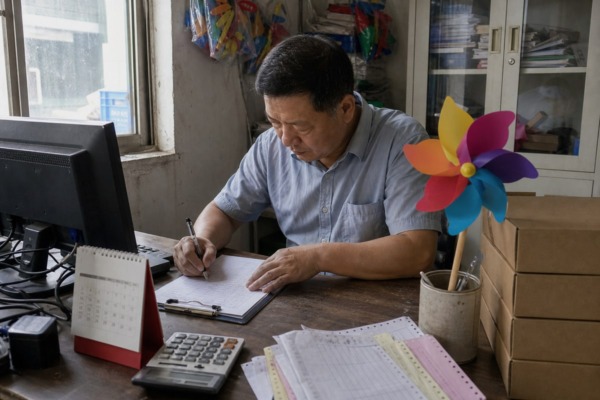
One missing Incoterm on a formal proforma invoice once cost a buyer her entire Easter season. At our Zhejiang pinwheel factory, we watch this mistake derail wind turbine orders constantly.
To request a formal proforma invoice from wind turbine suppliers, send a written request stating the product, quantity, unit price, total amount, Incoterms, payment terms, and delivery timeline. Ask the supplier to label the document Proforma Invoice, add a validity date, and use it as your ordering basis.
That is the short answer. The longer answer is where orders succeed or fail. Below, I walk through exactly what to send, how to verify the document, and how to protect your shipping schedule.
What Key Details Should I Include When Asking a Supplier for a Proforma Invoice?
Olivia, a US procurement manager we supply, opens every order cycle with the same WhatsApp message: PI first, please. Complete requests get fast, accurate documents.
Include your legal company name, billing and shipping addresses, product descriptions with technical specifications, exact quantities, unit prices, total amount, preferred Incoterms, payment terms, currency, target ship date, and a requested validity period. Complete details let the supplier issue an accurate proforma invoice on the first attempt.

A proforma invoice, or PI, is a pre-sale commercial document. It is not a tax invoice. It locks in the itemized scope, pricing, trade terms, and lead time before your purchase order moves forward. In my experience, the buyers who get clean PIs are the ones who send complete inputs. The rule I share with every new distributor is simple: the PI must state the product, quantity, unit price, total amount, and trade terms, because that document becomes the basis for the whole order.
The Core Data Block Every Supplier Needs
The U.S. International Trade Administration 1 lists eleven core items that belong on a proforma invoice, including buyer and seller details, unit and extended prices, weights and dimensions, Incoterms, and a validity date. Give your supplier the raw material for all of them.
| Detail to send | Why the supplier needs it |
|---|---|
| Legal buyer name and billing address | Matches the PI to your import records |
| Shipping address, if different | Sets the freight quote and delivery point |
| Buyer reference or RFQ number | Links the PI to your procurement file |
| Item description and quantities | Drives unit pricing and carton counts |
| Preferred Incoterms and delivery location | Defines who pays freight and carries risk |
| Payment terms and currency | Prevents disputes at deposit time |
| Target ship date | Confirms the lead time is realistic |
Move From Request for Quotation to PI in One Message
Start with a Request for Quotation email, then say clearly that you need the reply issued as a formal proforma invoice. Ask the supplier to label the document Proforma Invoice, give it a unique reference number, and attach it as a PDF. That labeling detail sounds small. It is not. An unlabeled document can confuse your accounting team and your bank.
How Do I Verify That a Proforma Invoice Matches My Custom Pinwheel Order Specifications?
Last October our QC team caught a PI listing seven petals instead of eight for a custom rainbow pinwheel run. The buyer had already approved it without reading line two.
Compare the proforma invoice line by line against your approved sample, drawings, and Bill of Quantities. Check petal count, blade material, colors, dowel length, packaging type, and quantities per carton. Any mismatch between the PI and your custom pinwheel specifications must be corrected in writing before payment.
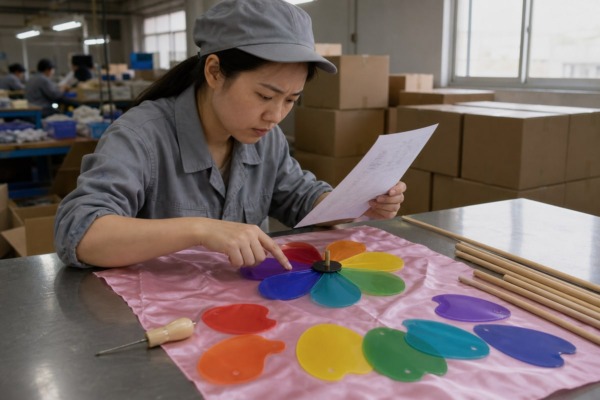
Verification is where most custom orders go wrong, and I say that after years of building OEM pinwheels for brands in the United States, South America, and Europe. A PI that says colorful garden pinwheel tells you almost nothing. Our own eight-petal rainbow design has very specific technical specifications: flower-shaped mylar blades in a green-to-teal gradient, white striped print, a yellow center hub, and a natural wooden dowel. If your custom version changes any of those elements, the PI must say so.
Match the PI to Your Approved Sample
The approved pre-production sample is your anchor. Every descriptive line on the PI should trace back to it. When we develop a custom design with a client, we photograph the signed-off sample and reference its code directly on the proforma invoice. Ask your supplier to do the same. It removes all argument later.
Run a Bill of Quantities Cross-Check
For DIY kit versions, the check gets deeper. A kit order is really a Bill of Quantities: petal pieces per color, wooden dowels, pins, and yellow grommets per set. Count the components on paper before you count them in a carton.
| PI field | Verify against | Common error |
|---|---|---|
| Product description | Approved sample code and drawings | Wrong petal count or color sequence |
| Material specification | Sample material sheet | Mylar quoted, cheaper film supplied |
| Unit of measure | Your purchase plan | Priced per piece, ordered per set |
| Kit component list | Bill of Quantities | Missing grommets or pins per kit |
| Quantity per carton | Packaging agreement | Carton counts that break your retail packs |
If anything conflicts, request a revised PI. Never fix errors verbally.
Can I Negotiate Pricing or Payment Terms Before Confirming the Proforma Invoice?
Every quarter we weigh the same trade-off at our factory: hold pricing for loyal distributors, or adjust for mylar film and wooden dowel costs. That tension explains PI validity dates.
Yes. A proforma invoice is a preliminary document, not a binding contract, so pricing, payment terms, and milestones remain negotiable until you confirm it. Negotiate volume discounts, deposit percentages, and Letter of Credit terms first, then request a revised PI reflecting the final agreement.

Some buyers treat a PI as a near-formal commitment. Others treat it as a flexible pre-contract quote. Here is how I resolve that tension for our clients: the PI is negotiable right up until you confirm it, and then it becomes the ordering basis both sides honor. Negotiating after confirmation damages trust. Negotiating before confirmation is expected, and honestly, we respect buyers who do it well.
Follow this sequence:
- Review the first PI and flag pricing or payment terms you want changed.
- Negotiate in writing, referencing the PI number, not vague earlier chats.
- Ask about volume tiers. Our budget-friendly positioning means larger pinwheel runs almost always unlock a better unit price.
- Agree on payment milestones. For big seasonal programs, we often split payments between production start and shipment.
- Discuss warranty and maintenance expectations, such as replacement terms for units damaged in transit.
- Request a revised PI with a fresh validity date, then confirm.
Payment Structures We Commonly See
| Structure | How it works | Best for |
|---|---|---|
| T/T deposit plus balance | Deposit before production, balance before shipment | Standard wholesale orders |
| Milestone payments | Split across production start, shipment, and delivery | Large seasonal programs |
| Letter of Credit 2 | Bank pays against compliant export documentation | High-value or first-time deals |
One more point on timing. Ask for a clear validity period, because raw material costs can swing quickly in this sector; we usually cap our PI validity at around thirty days for exactly that reason. An expired PI is not a price you can enforce.
What Should I Check in the Proforma Invoice to Avoid Shipping and Customs Delays?
A shipment to South America taught us a hard lesson: one vague product description on a PI triggered a customs inspection and three lost weeks.
Check that the proforma invoice shows accurate HS codes, precise product descriptions, net and gross weights, carton dimensions, country of origin, Incoterms 2020 with a named delivery point, and the estimated shipping date. These fields drive customs clearance, freight quotes, and your import documentation.

Shipping and logistics problems rarely start at the port. They start on paper, weeks earlier, inside a sloppy PI. Since shipping delays and damaged packaging are the two complaints I hear most from distributors, I treat this section of the formal proforma invoice as non-negotiable at our factory.
Start with the Harmonized System code. An accurate HS code 3 lets your broker calculate import duties correctly and prevents reclassification arguments at the border. Then look at the Incoterms 2020 4 line. It must name an actual point, such as FOB Ningbo or CIF Los Angeles, so risk and cost transfer are never ambiguous. A bare FOB with no port named is a delay waiting to happen.
Weights and dimensions deserve equal attention. Pinwheel cartons are light but bulky, and wooden dowel sticks set your carton length. Wrong dimensions distort freight quotes and container planning. Finally, confirm the estimated ship date matches the quoted lead time, and remember your customs clearance will ultimately run on the final export documentation set, so the PI should mirror it exactly.
| PI field | Delay risk if wrong |
|---|---|
| HS code | Reclassification, duty disputes, border holds |
| Product description | Physical inspection and testing requests |
| Incoterms 2020 and named point | Freight cost disputes, uncollected cargo |
| Weights and dimensions | Rebooked freight, container shortfalls |
| Country of origin | Rejected certificates, tariff errors |
| Estimated ship date | Missed retail seasons and vessel cutoffs |
Conclusion
A precise proforma invoice protects your budget, schedule, and customs clearance. Request it early, verify every line, negotiate before confirming, and let the PI anchor your entire order.
Footnotes
1. Official government resource for international trade standards and proforma invoice requirements. ↩︎
2. Provides a comprehensive overview of this standard international payment and security instrument. ↩︎
3. The World Customs Organization manages the Harmonized System codes used for global product classification. ↩︎
4. The International Chamber of Commerce is the official body defining these global trade terms. ↩︎
More Articles
You might also find these helpful.

How to Remotely Verify a Factory's Production Capabilities for Wrought Iron Plug-In Components?
Learn how to request a formal proforma invoice from wind turbine suppliers, avoid costly errors, and secure accurate…
Read More →
How to Assess a Factory's Production Capacity When Sourcing Wrought Iron Inserts?
Learn how to request a formal proforma invoice from wind turbine suppliers, avoid costly errors, and secure accurate…
Read More →
What Questions Should You Ask Wrought Iron Insert Suppliers to Spot Unreliable Ones Early?
Learn how to request a formal proforma invoice from wind turbine suppliers, avoid costly errors, and secure accurate…
Read More → English
  Spanish
  German
  Arabic