
How to Confirm Pole Material Strength When Sourcing Pinwheel Samples?
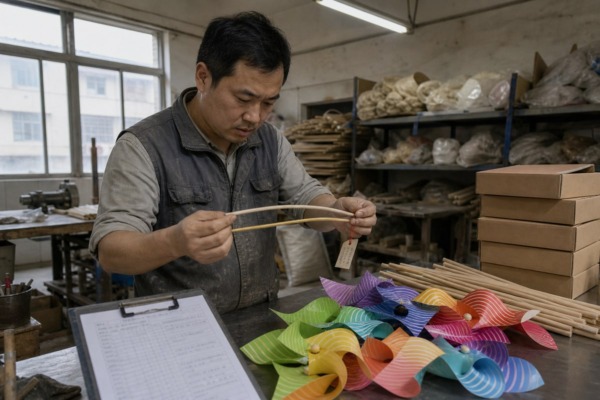
A pinwheel that snaps at its stick ruins a whole retail display. Confirming pole material strength before sourcing pinwheel samples is a lesson our Zhejiang production line learned early.
To confirm pole material strength, request a material data sheet, verify virgin resin or wood grade, then physically bend, flex, and shake each sample pole. Compare results against a signed golden sample, and lock wall thickness, material certification, and test criteria into your purchase order.
That is the short answer. The full process has four stages. First, ask the right questions before samples ship. Second, run hands-on tests when samples arrive. Third, match the material to your climate. Fourth, protect that quality through bulk production. Let me walk you through each stage.
What Questions Should I Ask My Supplier About Pole Material Before Ordering Samples?
Last spring, a US procurement manager messaged me on WhatsApp with one line: "Prove the stick won't snap." Our sales team now sends a question list before quoting pinwheel orders.
Ask your supplier for a material data sheet, confirmation of virgin versus recycled resin, the exact wood species or polymer grade, wall thickness tolerances, ASTM F963 compliance evidence, and batch traceability. Written answers become your acceptance criteria when samples arrive.

Most disputes I have seen in this trade are not about whether a sample "looks strong." They are about whether the supplier can prove the pole matches a claimed grade. So your questions should force documentation, not opinions.
The Six Questions That Matter Most
| # | Question to Ask | What a Good Answer Looks Like |
|---|---|---|
| 1 | What is the exact material and grade? | A named polymer grade or wood species, backed by a material data sheet with tensile strength values |
| 2 | Is the resin virgin or recycled? | Clear declaration; recycled resins often show inconsistent density and weaker structure |
| 3 | What is the wall thickness or diameter tolerance? | A number with a plus/minus range, not "standard" |
| 4 | Which ASTM standards apply? | ASTM F963 for toy mechanical strength; flexural test data for plastic poles |
| 5 | How is the colorant added? | A masterbatch ratio, since over-pigmentation can degrade the polymer's load-bearing capacity |
| 6 | Can you trace the sample to a production lot? | Lot numbers linking the sample to the same material batch |
Why Traceability Beats a Pretty Sample
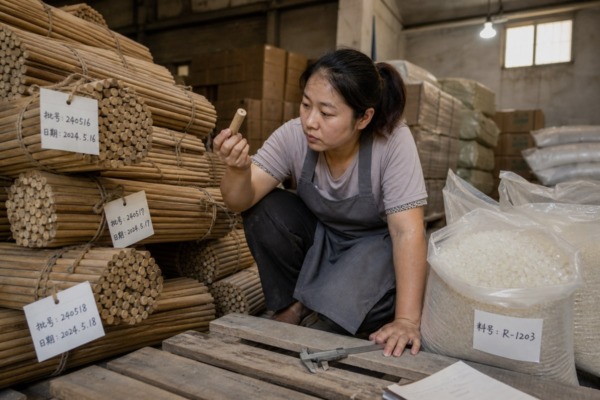
A sample only proves something if it is representative. In the utility pole world, wood pole strength claims are verified with full-size destructive bending tests under ASTM D1036, and ANSI O5.1 class values 1 rest on that same procedure. Your pinwheel dowel is far smaller, but the logic scales down perfectly. The sample must come from the same species, treatment, and lot as your bulk order. When we prepare samples at our factory, we tag each one with the material batch reference. If a supplier cannot do that, their material certification tells you very little. Ask for it in writing before you pay a sample fee.
How Can I Test Pole Strength Myself Once I Receive My Pinwheel Samples?
On our QC bench in Zhejiang, we bend and shake every pole batch before it reaches assembly. That habit started after one brittle dowel lot slipped past visual checks.
Test pole strength yourself by bending each pole into a gentle arc, shaking it hard to check bending resistance, and comparing every stick against your approved sample. Fiberglass, plastic, and wooden poles should all flex and recover without snapping or permanently deforming.
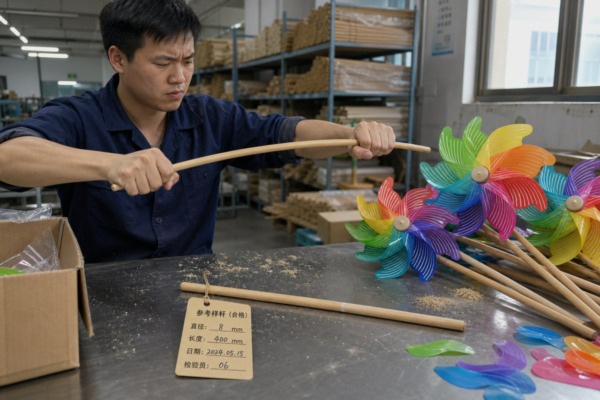
You do not need a lab for the first pass. Your hands are surprisingly good instruments for basic stress testing. Here is the exact sequence we use on our own line, and the one I recommend to every buyer who receives samples from us.
The Five-Step Hands-On Test
- The bend test. Hold the pole at both ends. Bend it into a gentle arc, then a deeper one. A healthy pole resists with even spring and returns straight. A pole with low flexural modulus 2 feels dead or floppy. A brittle one cracks or creases.
- The shake test. Grip the pole at one end and whip it side to side, hard. This simulates gusting wind at the pole's weakest point. Listen for cracking sounds and watch for whitening at stress points.
- The scratch test. Score the surface lightly with a fingernail or blade edge, then repeat the bend test. This checks notch sensitivity. A notch-sensitive material can fail catastrophically from one shallow scratch or molding burr.
- The crimp check. Press hard where the hub attaches. Soft surfaces crimp and loosen over time. Suppliers can verify this zone with Shore Durometer hardness readings if you want numbers.
- The comparison. Test your new samples and your previously approved sample side by side, in the same session. Differences in stiffness or recovery jump out immediately when you feel them back to back.
When Hands Are Not Enough
For high-volume or outdoor programs, escalate to a lab. Standardized flexural testing measures the bending modulus objectively, and small-specimen tests can characterize the underlying material, the same way ASTM D143 small clear specimens support full-size wood pole results. Hand tests screen; lab tests prove pole material strength on paper.
Which Pole Materials Hold Up Best Against Wind and Outdoor Weather Conditions?
Every quote we prepare balances cost against wind survival. A wooden dowel saves cents per unit, while fiberglass adds durability that outdoor retailers in Florida keep asking us for.
Fiberglass reinforced plastic poles offer the best wind load resistance and UV resistance for outdoor pinwheels. Hardwood dowels rank second with good stiffness but moisture sensitivity. Standard plastic poles work indoors, yet they turn brittle fastest under prolonged sun exposure.
Here is how the three common pole materials compare, based on what we see returning from different export markets.
| Property | Fiberglass Reinforced Plastic | Wooden Dowel | Standard Plastic (PP/ABS) |
|---|---|---|---|
| Flexural behavior | Excellent spring-back, high fatigue life | Stiff but can snap at grain defects | Adequate new, degrades with age |
| UV resistance | Very good | Good (surface grays over time) | Poor without UV stabilizers |
| Moisture response | Minimal | Swells, warps, weakens when saturated | Minimal |
| Wind load resistance | Best in class | Good in moderate wind | Suitable for calm or indoor use |
| Relative cost | Highest | Middle | Lowest |
| Best application | Beach, garden, year-round outdoor | Seasonal garden displays | Indoor décor, party favors, short events |
Aging Tests Predict Real Outdoor Life
New samples always feel fine. The question is month six. Environmental aging tests, meaning UV exposure cycles 3 and moisture saturation, reveal whether a pole will grow brittle or warp. For wooden poles, moisture conditioning genuinely changes test results; that is why ASTM D1036 requires air-seasoning and butt-section soaking before full-size wood poles are tested. Water content matters that much. For our garden pinwheels with natural wooden dowels, like the rainbow petal design we run for spring programs, we specify sealed or coated dowels for humid destinations.
Do Not Forget the Hub Joint
Materials expand at different rates in heat. If the pole and the plastic hub have mismatched thermal expansion coefficients 4, the assembly loosens in temperature swings. Ask your supplier how the pin, grommets, and hub grip the pole across a realistic temperature range, not just at room temperature.
How Do I Make Sure My Bulk Order Matches the Pole Quality I Approved in Samples?
Years ago we shipped a container where bulk poles measured thinner than the approved sample. The rework taught us to seal golden samples and measure every production lot.
Seal a signed golden sample, write pole material, wall thickness, and dimensions into the purchase order, then verify bulk production through in-line checks and a pre-shipment quality control inspection that repeats the same bend, shake, and measurement tests you approved.

Sample approval is the start of quality control, not the end of it. "Spec creep" is the quiet enemy: a slightly cheaper resin here, a slightly thinner wall there, and six months later your poles snap on retail shelves. The defense is a written spec plus physical checkpoints.
Build a Golden Sample System
Keep two identical approved samples. You hold one; the supplier seals one with both signatures. Every quality decision refers back to that physical object, covering rigidity, wall thickness, color, and hub fit. At our facility, sealed golden samples sit in a reference cabinet, and our line supervisors check daily output against them by feel and by caliper.
Checkpoints From Production to Shipment
| Stage | What to Check | Tool or Method | Pass Criterion |
|---|---|---|---|
| Material intake | Resin grade or wood lot | Data sheet vs. lot label | Matches approved spec exactly |
| First article | Diameter and wall thickness measurement | Digital calipers | Within written tolerance |
| In-line | Bend and shake behavior | Hand test vs. golden sample | Indistinguishable from reference |
| In-line | Color consistency | Visual vs. golden sample | No drift suggesting masterbatch ratio change |
| Pre-shipment | Random poles from multiple cartons | Full five-step hand test | Zero breaks or permanent deformation |
Color drift deserves special attention. If bulk poles arrive noticeably darker, the pigment loading may have changed, and over-pigmentation can degrade the polymer's long-term load-bearing capacity. Also remember that strength is statistical, not singular. Utility pole standards work from distribution-based values like 5th percentile strength, not averages. Translated to pinwheels: test many poles from many cartons. One strong pole proves nothing about pole material strength across a hundred thousand units.
Conclusion
Weak poles create returns, refunds, and lost shelf space. Ask hard questions, bend every sample, choose materials for real weather, and lock bulk quality to your golden sample.
Footnotes
1. ANSI is the primary authority for wood utility pole classification and strength standards. ↩︎
2. ASTM provides the standardized testing methods for measuring the flexural properties of plastics. ↩︎
3. Authoritative Wikipedia entry explaining standardized UV weathering and exposure cycles for materials. ↩︎
4. NIST provides authoritative data on material properties, including thermal expansion for various polymers. ↩︎
More Articles
You might also find these helpful.

How to Remotely Verify a Factory's Production Capabilities for Wrought Iron Plug-In Components?
Confirm pole material strength before sourcing pinwheel samples by requesting data sheets, verifying resin grade, and bend-testing against…
Read More →
How to Assess a Factory's Production Capacity When Sourcing Wrought Iron Inserts?
Confirm pole material strength before sourcing pinwheel samples by requesting data sheets, verifying resin grade, and bend-testing against…
Read More →
What Questions Should You Ask Wrought Iron Insert Suppliers to Spot Unreliable Ones Early?
Confirm pole material strength before sourcing pinwheel samples by requesting data sheets, verifying resin grade, and bend-testing against…
Read More → English
  Spanish
  German
  Arabic