
How Do Specification Requirements Drive Up Procurement Costs for Wrought Iron Inserts?
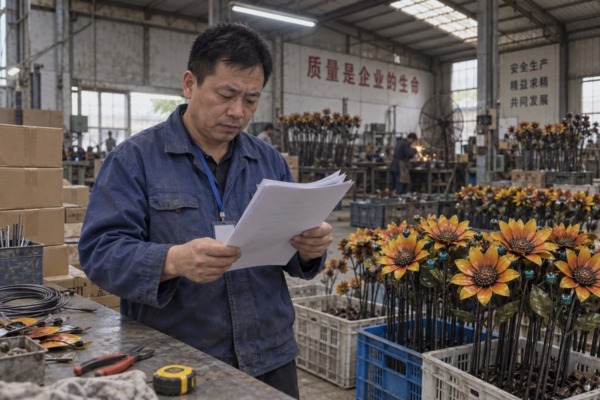
Last spring, a distributor sent our Zhejiang workshop a twelve-page spec for garden inserts. The quote tripled overnight. Specification requirements quietly inflate procurement costs for [wrought iron inserts](https://zhufengpinwheels.com/?p=1466).
Specification requirements drive up procurement costs for wrought iron inserts because every added tolerance, finish, or inspection rule pushes the part away from commodity pricing toward custom fabrication. Non-standard materials, niche coatings, and strict quality control inspections each add setup, labor, and rejection risk to the quote.
Let me walk you through where these costs hide. I will use real patterns from our own quoting process. By the end, you will know which spec lines to keep and which to cut.
How do strict tolerance and finish requirements increase my wrought iron insert costs?
Our QC team once rejected a full rack of powder-coated garden stakes 1 because the client's spec allowed only half a millimeter of variance. Rework consumed an entire week.
Strict tolerance and finish requirements increase wrought iron insert costs by forcing slower production methods, more skilled labor, extra quality control inspections, and higher scrap rates. Tight dimensional tolerances demand precise tooling, while finishes like hot-dip galvanizing plus powder coating add separate processing steps and handling fees.
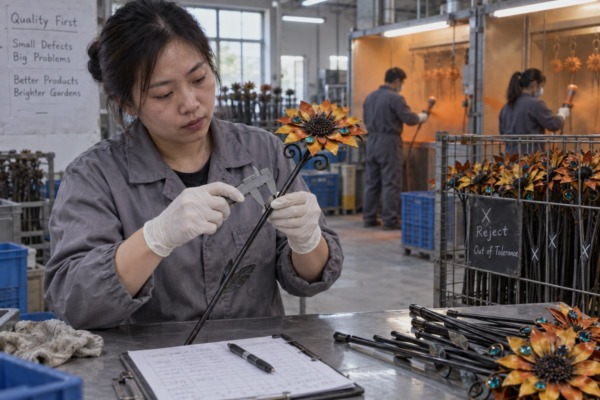
The core problem is simple. A quote is not one number. It is a stack of cost buckets: material rate, labor rate, consumables, machine time, manufacturing overhead, and margin. A single tight tolerance touches several of those buckets at once. That is why a small line on your spec sheet can move the price by a lot.
Where the money goes when tolerances tighten
When dimensional tolerances 2 shrink, our operators must slow the bending line. We build extra jigs. We measure more often. We scrap more parts. In our experience quoting decorative metal inserts for US and European buyers, the three biggest cost points are always the same: non-standard tube thickness and special bend angles, niche surface treatments like extra-thick galvanizing or custom colors, and severe tolerances paired with full-inspection requirements. Anything that departs from our existing molds and raw material inventory adds a surcharge. Full inspection is especially expensive. Sampling checks a few units per carton. A 100% inspection requirement means every single insert gets handled, measured, and logged. That labor lands directly on your invoice.
The finish stack
Finishes stack in the same way. Hot-dip galvanizing is one plant process. Architectural-grade powder coating finishes are another. Combine them, and you pay for two rounds of prep, curing, transport between plants, and handling fees. Custom colors add more. The coater must buy new powder and clean the spray line just for your batch.
| Spec requirement | What changes in production | Cost impact |
|---|---|---|
| ±0.5 mm dimensional tolerances | Slower cycles, new jigs, more measuring | Higher labor and scrap cost |
| Hot-dip galvanizing + powder coat | Two plant processes, double handling | Extra processing and freight fees |
| Extra-thick zinc or custom color | Small-batch coating line changeover | Surcharge per batch |
| 100% inspection instead of sampling | Every unit checked and logged | Higher QC labor and overhead |
Should I choose custom specifications or standard sizes to keep my procurement budget down?
Every time we tool up a new bend angle at our Zhejiang plant, I weigh mold cost against reuse. That single trade-off decides whether customization ever pays.
Choose standard sizes whenever the insert only needs to look good and survive outdoors; they cost less, ship faster, and meet minimum order quantities easily. Choose custom specifications only when exact fitment, code compliance, or brand-specific design justifies the tooling, setup, and longer lead time.
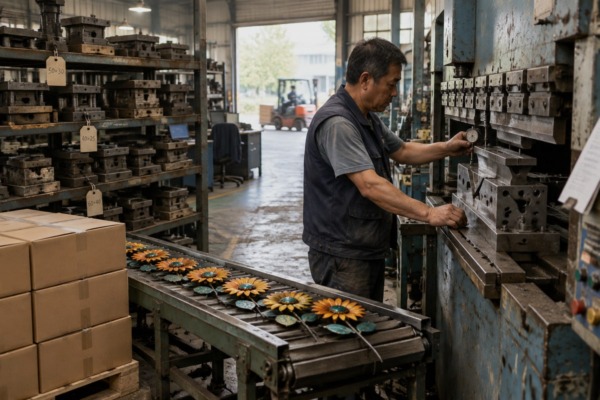
Here is how the two paths compare side by side:
| Factor | Standard sizes | Custom specifications |
|---|---|---|
| Tooling | Existing molds, no setup fee | New molds, one-off setup charges |
| Minimum order quantities | Easy to meet, shared production runs | Often below factory minimums, high per-unit cost |
| Lead time | Days to a few weeks | Roughly 6–12 weeks or more |
| Pricing basis | Commodity pricing | Project-specific fabrication pricing |
| Packaging | Standard cartons | Custom crating, specialized transport |
The market itself is splitting along this line. Cheap standardized metal inserts 3 sit on one side. Premium custom ornamental metalwork 4 sits on the other, priced far higher because of specialization and low volume. One retail example makes the point well: a current entry-door wrought iron insert listing runs about $884.68 to $1,347.28 per unit. Generic metal components covering the same opening cost a fraction of that. The difference is not the metal. It is the specification detail behind it.
From our side of the production line, the biggest custom cost drivers are non-standard tube wall thickness and special bend angles. Both force us off our existing raw material stock. Orders that fall below our normal manufacturing minimums are worse still, because machine setup and tooling get spread across very few units. And do not forget supply chain logistics. Oversized or odd-shaped inserts need custom-designed crating and special freight, which can nearly double the total landed cost.
My honest advice? Take the middle path. Keep the body standard and customize only the visible layer, such as color or a decorative motif. That preserves your brand look while your budget stays close to commodity pricing.
A US procurement manager once messaged me on WhatsApp asking why our quote and a competitor's differed by forty percent on identical drawings. Hidden specification costs explained everything.
Ask your supplier to split every quote into a base price plus a line-item surcharge for each customization. Then ask which requirements match their existing tooling and material stock, what inspections are included, how packaging is priced, and how each spec item affects lead time.
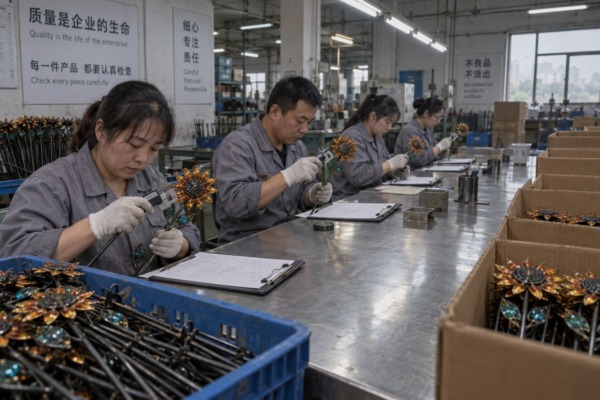
The single most useful habit I teach buyers is the split quote. When a factory quotes one lump sum, every customization hides inside it. When the quote reads as a base-model price plus a separate surcharge for each custom item, you see the cost increment of every requirement at a glance. We offer this format to our own distributors, and it changes negotiations completely. Suddenly the conversation is not "too expensive" but "which three lines do we cut?"
Here are the questions I would ask any supplier of wrought iron inserts, in order:
- Can you break the quote into a base price plus per-customization surcharges? This exposes exactly which spec lines drive the cost.
- Which of my requirements fit your existing tooling and raw material inventory? Anything outside current molds and stock will carry a premium. Ask them to flag those items.
- What inspection level is included in the price? Sampling is standard. Full quality control inspections, material mill certificates, or non-destructive testing add real administrative and technical overhead, so get those priced separately.
- Who pays for third-party lab work? Metallurgical tests such as Charpy V-notch verification require outside laboratories and are never free.
- Is this a fully loaded price? More buyers now demand quotes that include shop drawings, coatings, and packaging, because hidden specification items often dominate the final number.
- How does each requirement change lead time? A custom finish that adds four weeks carries scheduling cost, storage risk, and delay premiums that never appear on the invoice.
Ask these six questions before you sign, and overly detailed specifications lose their power to surprise you.
How do I know which specification requirements are truly necessary versus unnecessary overengineering?
I once quoted an over-specified order that taught me a spec sheet can cost more than the steel itself. Now our team questions every requirement before pricing.
A specification is truly necessary when it protects safety, structural fit, corrosion life, or legal compliance. It is overengineering when it exceeds the product's real service conditions—such as machining-grade tolerances on decorative parts, exotic material grades, or full metallurgical testing for ornamental garden inserts.
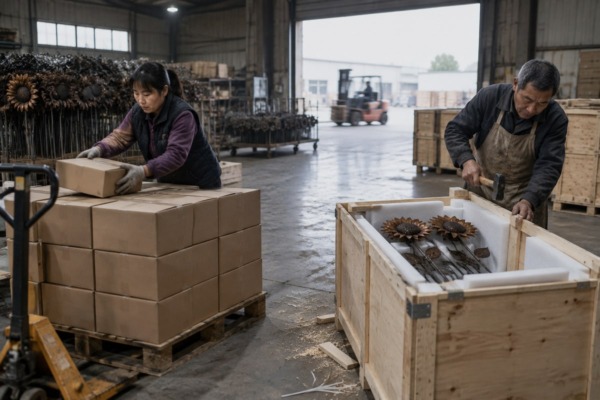
Buyers often push back on me here, and the objection deserves a fair answer. They say strict specs protect safety, structural integrity, and long service life, so higher upfront cost reduces lifecycle cost and failure risk. That is true—for the right parts. An insert embedded in concrete and carrying load absolutely deserves a referenced ASTM standard, a defined material grade, and documented inspection. I will never argue against that.
But most of the inserts we ship to the US, South America, and Europe are decorative. They hold up ornamental metalwork in a yard, not a balcony railing. For those parts, the supplier viewpoint holds: over-specification creates unnecessary customization, slows production, and inflates price without proportional value. The honest middle ground is that cost rarely comes from the iron itself. It comes from the combination of custom dimensions, finish requirements, and compliance paperwork stacked on one part.
Use this table as a sanity check:
| Requirement | Usually necessary when… | Usually overengineering when… |
|---|---|---|
| Genuine wrought iron callout | Heritage restoration demands it | Mild steel performs identically for decorative duty |
| Charpy V-notch or NDT testing | The insert bears structural load in cold climates | The part is a garden ornament |
| Marine-grade duplex coating | Coastal, high-corrosion installation | A standard powder coat already outlasts the product's retail life |
| Internal channels for lighting or sensors | The feature earns a clear retail premium | It complicates forging with no sales upside |
| Audited low-carbon "green" iron | Your brand publicly commits to it | No customer will ever ask for proof |
My decision test is one question: if I delete this line, does safety, fit, lifespan, or legal compliance change? If the answer is no, it is a nice-to-have. Price it as one, or cut it.
Conclusion
The spec sheet sets the price, not the steel. Cut requirements to real service needs, demand split quotes, and your wrought iron insert procurement budget stays firmly under control.
Interested in sourcing the products mentioned in this article? See details and request a quote here:
Footnotes
1. The Powder Coating Institute is the primary technical resource for powder coating quality and application standards. ↩︎
2. ISO provides international standards for geometrical product specifications and dimensional tolerances in manufacturing. ↩︎
3. The International Trade Administration provides resources on international trade standards and compliance for manufactured goods. ↩︎
4. NOMMA is the leading trade association providing technical standards and resources for the ornamental metal industry. ↩︎
More Articles
You might also find these helpful.

How to Remotely Verify a Factory's Production Capabilities for Wrought Iron Plug-In Components?
Specification requirements like tight tolerances, custom finishes, and full inspections quietly triple wrought iron insert costs—learn which spec…
Read More →
How to Assess a Factory's Production Capacity When Sourcing Wrought Iron Inserts?
Specification requirements like tight tolerances, custom finishes, and full inspections quietly triple wrought iron insert costs—learn which spec…
Read More →
What Questions Should You Ask Wrought Iron Insert Suppliers to Spot Unreliable Ones Early?
Specification requirements like tight tolerances, custom finishes, and full inspections quietly triple wrought iron insert costs—learn which spec…
Read More → English
  Spanish
  German
  Arabic