
How to Describe Wrought Iron Accessories to Suppliers Without a Design Drawing?
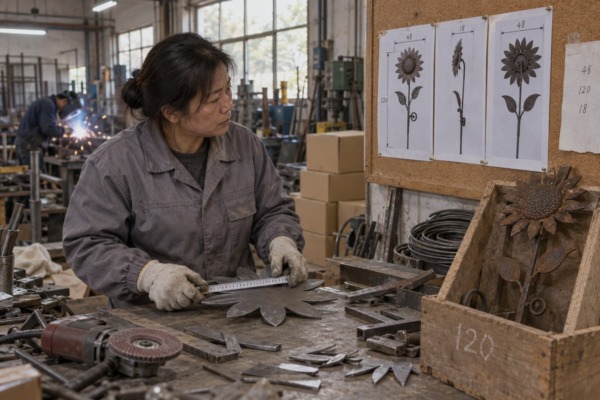
Buyers send our production line one blurry photo of wrought iron accessories 1 and expect an accurate quote. No dimensions means guessing. Guessing means wrong prices, wrong samples, wasted weeks.
To describe wrought iron accessories without a design drawing, send high-resolution photos from multiple angles with key dimensions marked on the image, state the material, finish, quantity, and use case, flag non-negotiable features, and ship a reference sample so the supplier can quote and produce accurately.
You do not need CAD software to order custom ornamental iron components hot-dip galvanized 2. You need structure. This guide shows you exactly what to send, how to say it, and how to verify the result. Let me walk you through each step the way we coach our own buyers.
How can I clearly describe my wrought iron accessory idea without providing a technical drawing?
Last spring, our QC team rebuilt a sunflower garden stake three times because the buyer's only reference was one front-facing photo. Multi-angle photos would have prevented every rework.
Describe your wrought iron accessory like a text drawing: name the part and its use, give overall dimensions, describe shapes in plain geometry terms, specify material and finish, state quantity, and clearly separate features that must stay identical from features the supplier may adjust.
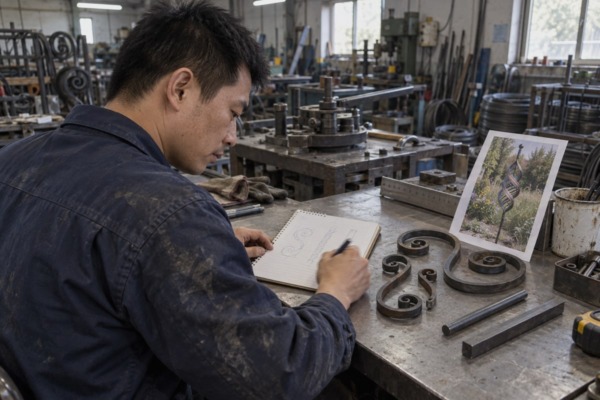
Think of your description as a "text drawing." A real drawing tells a factory five things: what the part is, how big it is, what it is made of, how it should look, and how precise it must be. Your words must do the same job. When our team quotes decorative garden stakes or wind spinners, those five answers decide the price. Nothing else does.
Use plain geometry language
Skip vague words like "elegant" or "classic." Use shape words a workshop can act on. This is basic metal fabrication terminology, and it travels well across languages.
| Term | What it tells the supplier | Example use |
|---|---|---|
| Round bar / square bar / flat bar | The stock profile to buy | 10 mm round, 25 x 3 mm flat |
| Scroll, S-curve, loop | The bend pattern | Double scroll under a bracket arm |
| Twisted bar | Decorative twist along the length | One full twist per 100 mm |
| Tapered bar, fishtail scroll, upset end | Forging details | Fishtail tips on decorative scrollwork designs |
| Mirrored pair, left/right hand | Symmetry requirements | Two brackets, mirrored |
Separate "must match" from "may vary"
Tell the supplier which features are fixed and which are flexible. A model brief looks like this: "Set of four curtain rod finials, scroll style, matte black finish, matching pair symmetry required, approximate size 90–100 mm long, outdoor-safe coating preferred." That single sentence covers use, shape, finish, size range, and priority. Add a rough hand-drawn sketch with a few notes, and most factories can quote it the same day.
What key details should I include when explaining my design requirements to a supplier?
Every quote we prepare balances two forces: tighter tolerances raise cost, while loose specs invite rework. Knowing which details matter lets buyers control both sides of that equation.
Include the product name and use case, overall dimensions with tolerances, material grade, finish and coating type, quantity and repeat-order plans, mounting method, mating hardware specifications, delivery destination, and deadline. Also flag which dimensions are non-negotiable and ask whether existing tooling can be adapted.

A drawing-free brief works only if it covers everything a technical specifications sheet would cover. Here is the checklist we ask our own OEM buyers to complete before we quote garden decorations.
| Detail | Why it matters | Example |
|---|---|---|
| Product name and use | Sets safety and finish expectations | Garden railing accent vs. indoor decor |
| Dimensional measurements | Drives material cost | 250 mm tall x 180 mm wide, flat bar style |
| Material grade standards | Prevents substitution surprises | Mild steel acceptable; ask supplier to recommend |
| Finish | The top source of disputes | Black powder coat, matte, outdoor-rated |
| Quantity and repeats | Affects tooling decisions | 500 now, 2,000 yearly |
| Mounting and mating parts | Ensures the part fits | Slides onto 12 mm tube fitting |
| Destination and deadline | Shapes packaging and freight | US East Coast, 60 days |
State tolerances in one line
You do not need engineering software. Write it plainly: "overall size ±2 mm; hole spacing ±0.5 mm; finish color match to sample." General fabrication work commonly holds around ±0.5 mm and about ±1° on bends, and tighter values raise cost. If the part is purely decorative, say so and allow looser limits. If it must fit existing hardware, tighten only those few dimensions.
Name the finish precisely
In my experience, most quote disputes are finish disputes, not shape disputes. "Black iron" is not a spec. Say powder coating finishes 3 in matte black, hot-dip galvanized, antique rubbed, or distressed patina. State whether hammer marks, weld grinding, or slight color variation are acceptable. Mention outdoor UV and corrosion exposure.
Ask about existing tooling first
Before anything else, I always tell buyers to ask one money-saving question: can the factory make small adjustments to an existing mold instead of opening a new one from zero? On our lines, a petal-shape tweak to current tooling costs a fraction of new tooling and cuts weeks from the lead time.
Can I use photos or reference samples instead of a CAD file to communicate my concept?
A US procurement manager once WhatsApped us six photos of a wind spinner and asked for a quote within the hour. We managed—because she had annotated every image.
Yes. Annotated reference photos and physical samples can fully replace a CAD file for decorative ironwork. Send high-resolution images from the front, side, and detail angles, mark key dimensions directly on each photo, and mail a sample so the factory can measure it firsthand.
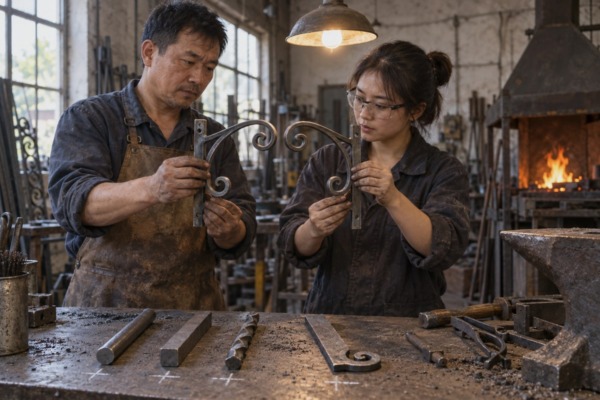
Not all photo briefs are equal. I rank them on a maturity ladder, and each rung changes how fast and how accurately a factory can respond.
| RFQ type | What it contains | Best for | Risk level |
|---|---|---|---|
| Photo-only | Images, no measurements | Early style exploration | High—supplier guesses scale |
| Measured-photo | Multi-angle photos with dimensions marked on the image | Most decorative wrought iron accessories | Low for ornament, medium for fit |
| Full drawing | Dimensioned CAD or PDF | Load-bearing, fit-critical parts | Lowest, but slowest to prepare |
Here is the method I insist on, and it comes straight from our own factory floor. Send high-definition photos from the front, the side, and detail close-ups. Mark the key dimensions right on each image. State the mating tube fitting specs and the use case—garden railing or pure decoration. Circle the parts that cannot change. Then courier a physical reference sample to the factory. A sample answers a hundred questions no email can.
Build a style pack
Combine reference photos and samples with color chips, annotated screenshots, and hand-drawn sketches. If you want aesthetic similarity rather than a clone, write "match this shape, not this exact dimension." You can also reference part numbers from ornamental iron catalogs for standard forged steel finials 4, rosettes, or iron baluster patterns. Some buyers now use phone-based 3D scanning apps to capture the installation area, or cut a 1:1 cardboard template to lock proportions. A "joinery map"—photos of decorative collars, rivets, or wraps—tells the workshop to avoid plain modern welds.
Some buyers still object that a drawing is essential. For complex, load-bearing gates, I agree. For a decorative bracket or garden stake, a measured-photo brief gets you the same result faster.
How do I confirm the supplier's sample matches my vision before approving mass production?
We learned years ago that approving a sample over video calls alone is risky. Screens hide texture, weight, and color depth. Now we insist buyers hold the sample first.
Request a pre-production sample, measure every critical dimension against your annotated photos, test the fit with your mating hardware, compare the finish to your reference sample in daylight, then sign and seal the approved piece as a golden sample that governs mass production quality.
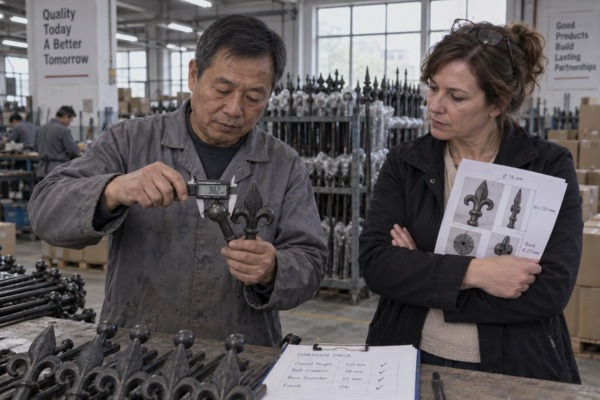
Custom metalwork prototypes exist to catch errors while they are still cheap. Skipping this stage to save two weeks is the most expensive shortcut in this business. Follow a fixed sequence instead.
- Order a physical pre-production sample. Photos of the sample come first, but never approve on photos alone.
- Measure against your brief. Check every dimension you marked on your annotated images, especially the non-negotiable ones.
- Run a fit test. If the part mates with a tube fitting, rail, or bracket, physically assemble it. This is where our garden stake buyers catch prong and rod mismatches.
- Judge the finish in daylight. Compare color, gloss, and texture against your reference sample outdoors, not under warehouse lighting.
- Stress the part briefly. Flex it, mount it, and if it is outdoor decor, leave it in weather for a few days.
- Sign the golden sample. Both sides keep or photograph a sealed approved unit. It becomes the inspection standard for mass production.
| Check | How to verify | Pass criteria |
|---|---|---|
| Critical dimensions | Caliper or tape against brief | Within stated tolerance, e.g., ±0.5 mm on holes |
| Finish match | Side-by-side with sample in daylight | No visible color or gloss gap |
| Fit | Assemble with real mating hardware | Slides and locks without force |
One caution on the "let the supplier design it" route. It is convenient when you only have a concept, and an experienced fabrication partner can save you real time. But agree in writing on design ownership, the number of free revision rounds, and who pays for tooling changes. Otherwise the sample stage becomes an open-ended negotiation.
Conclusion
A supplier-ready description needs no drawing—just annotated multi-angle photos, exact dimensions, finish specs, non-negotiable features, and a reference sample. Give suppliers that, and quotes, samples, and production align.
Interested in sourcing the products mentioned in this article? See details and request a quote here:
Footnotes
1. Authoritative overview of wrought iron material properties and historical use in manufacturing. ↩︎
2. Technical resource from the American Galvanizers Association regarding corrosion protection for steel. ↩︎
3. Official industry association providing standards and technical resources for powder coating applications. ↩︎
4. Encyclopedia entry defining the architectural and decorative role of finials in metalwork. ↩︎
More Articles
You might also find these helpful.

How to Remotely Verify a Factory's Production Capabilities for Wrought Iron Plug-In Components?
Skip design drawings: learn how to describe wrought iron accessories to suppliers using photos, plain geometry terms, and…
Read More →
How to Assess a Factory's Production Capacity When Sourcing Wrought Iron Inserts?
Skip design drawings: learn how to describe wrought iron accessories to suppliers using photos, plain geometry terms, and…
Read More →
What Questions Should You Ask Wrought Iron Insert Suppliers to Spot Unreliable Ones Early?
Skip design drawings: learn how to describe wrought iron accessories to suppliers using photos, plain geometry terms, and…
Read More → English
  Spanish
  German
  Arabic