
How Can I Tell If a Supplier’s Wrought Iron Fittings Price Is Fair?
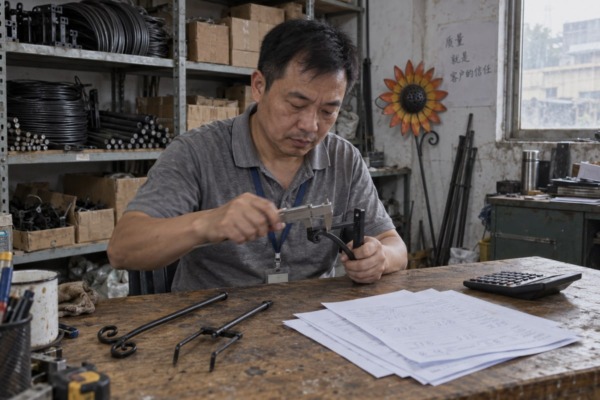
Last month I compared three wrought iron fittings price quotes for our garden stake line — the spread was alarming steel market rates 1. Overpay, and margins vanish. Underpay, and quality collapses.
A supplier’s wrought iron fittings price is fair when it sits within the market range for the same size, material grade, finish, and quantity, and when the quote separates raw material, fabrication, coating, packing, and freight. Compare at least three identical-spec quotes and check current steel market rates.
That answer sounds simple, but each step has traps. I have sat on both sides of this table — quoting buyers from our Zhejiang factory and sourcing metal components from our own sub-suppliers. Below, I will walk you through exactly how I judge whether a quote is honest, padded, or dangerously cheap.
What Factors Should I Compare When Evaluating Wrought Iron Fittings Quotes?
A US procurement manager once sent me two "identical" quotes that were nothing alike — one priced per piece, one per kilogram. Our export team sees this confusion weekly.
Compare product category, fitting size, connection type, material grade, wall thickness, surface finish, weight, and order quantity. Confirm whether the price is per piece, per kilogram, or per lot, and whether fabrication, coating, testing, packing, and freight are included in each quote.
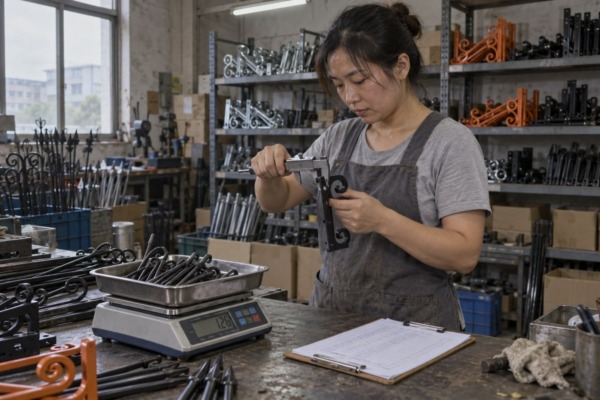
Before you compare any numbers, line up the specifications. Here is the checklist I use when reviewing quotes for the metal rods, prongs, and brackets that go into our decorative products:
| Factor | Why It Matters | What to Ask the Supplier |
|---|---|---|
| Product category | Decorative and industrial fittings price differently | "Is this ornamental, malleable, cast, or true wrought iron?" |
| Material grade | Determines strength and price basis | "Which ASTM standards does it meet?" |
| Wall thickness / weight | The biggest hidden cost lever | "State the weight per piece in the quote" |
| Surface finish | Coating adds 20–30% to base cost | "Is galvanizing or powder coating included?" |
| Unit basis | Per piece vs per kg changes everything | "Quote both units so I can cross-check" |
| Quantity | Volume triggers bulk order discounts | "What are your price break thresholds?" |
Pin Down the Product Category First
The phrase "wrought iron fittings" is used loosely. In plumbing supply, similar parts are usually malleable, cast, or ductile iron with their own catalog price sheets. In decorative metalwork, it means gates, brackets, and rails, where design complexity drives cost. The ranges prove the point: raw wrought iron stock runs roughly $2 to $5 per pound, simple ornamental items run $20 to $100, railings run $70 to $200 per linear foot, and gates run $200 to $600 per linear foot. Meanwhile, a threaded malleable iron 2 1/2" elbow can cost just $3.08, and a 1" 90° elbow about $3.29.
Normalize Units Before Comparing
I convert every quote into cost per piece and cost per kilogram. One quote may include heavier pieces or better coating than another. Without normalized units, you are comparing apples to anchors.
How Do I Know If a Low Price Means Lower Quality Materials or Workmanship?
On our powder coating line in Zhejiang, shaving coating thickness would save real money per piece — and cost us every repeat order. Cheap quotes usually hide exactly that choice.
A low price often signals reduced wall thickness, thinner powder coating, weaker welds, or a material swap from wrought or forged iron to cheap castings. Verify quality by requesting mill test reports, coating thickness specifications, weld samples, and confirmation of the exact material standard before ordering.
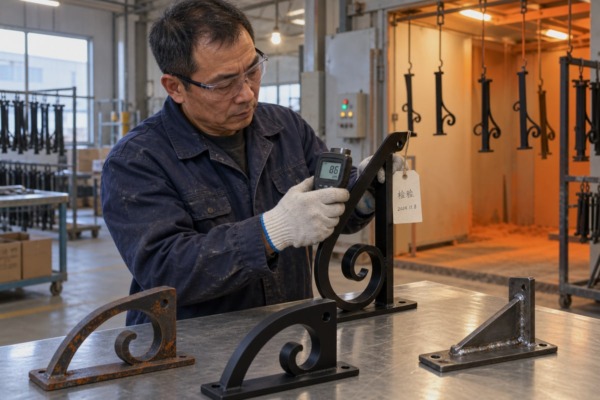
Steel prices are transparent. Anyone can check the live market rate. So when one factory quotes far below its peers, that gap cannot come from cheaper steel. In my experience, it comes from three places: wall thickness, coating thickness, or welding shortcuts. I have taught my own buyers to treat a dramatically low quote as a red flag, not a bargain.
| What Gets Cut | How It Shows Up | Long-Term Risk |
|---|---|---|
| Wall thickness | Lighter piece, same appearance | Bending, cracking under load |
| Powder coating microns | Glossy at delivery, thin under a gauge | Rust within one or two outdoor seasons |
| Welding process | Spot welds instead of full seams | Joint failure, product returns |
| Material swap | Cast iron sold as wrought iron | Brittleness, poor corrosion resistance |
The Forged Steel Comparison Test
True wrought iron has lower carbon content and higher ductility than cast iron, which justifies a real price premium. The same logic applies in any forged steel comparison: labor-intensive hand-forging or repeated hammering costs more than mass-produced casting. If a supplier claims hand-forged quality at casting prices, one of those claims is false.
Demand Mill Test Reports
I ask for mill test reports on the raw material and a written spec for coating thickness. Surface finish quality is measurable, not a matter of opinion. Remember that hot-dip galvanizing or powder coating typically adds 20% to 30% to the base price — a quote that includes coating at bare-metal prices deserves scrutiny.
What Hidden Costs Should I Watch For Beyond the Unit Price?
Packaging is the trade-off we debate every season at our factory: thicker cartons cost more upfront but prevent the damage claims that destroy a distributor's margin.
Watch for tooling and mold fees, cutting and threading charges, galvanizing or powder coating surcharges that add 20 to 30 percent, testing and certification fees, packing costs, minimum order quantity penalties, freight and logistics costs, and import duties. Always compare total landed cost, not unit price.

The unit price is only the opening line of the story. When we quote OEM projects for US and European wholesalers, I insist the full cost picture goes on paper, because surprises at invoice time kill trust. Here is where the hidden money sits:
| Hidden Cost | When It Appears | Typical Impact |
|---|---|---|
| Tooling / mold fees | Custom shapes and intricate patterns | One-time charge, sometimes significant |
| Cutting and threading | Non-standard lengths or connections | Per-piece surcharge |
| Galvanizing / powder coating | Added after the base quote | +20–30% on base price |
| Testing and certification | Regulated or branded orders | Fixed fee per batch |
| Minimum order quantity | Small trial orders | Higher per-unit price below MOQ |
| Freight and logistics costs | Always — often quoted separately | Varies by volume, route, and season |
| Import duties | At customs in your market | Depends on HS code and origin |
Two more traps deserve attention. First, weight-based bulk pricing: suppliers often unlock meaningful bulk order discounts only at specific tonnage thresholds, so ask exactly where those breaks sit before you fix your order size. Second, reclaimed or specialty pieces: guides on salvaged ironwork show total costs far above the sticker price once restoration, adaptation, transport, and fitting are added. A cheap purchase price can become an expensive project.
My rule is simple. I build a landed-cost sheet for every serious quote: unit price, plus every line above, divided by usable pieces received. Damaged packaging that causes returns belongs in that math too — a lesson our export team learned early and never forgot.
How Can I Verify a Supplier's Pricing Matches Industry Standards?
I learned to track steel prices the hard way, after a supplier blamed a sudden increase on "the market" — the market had actually dropped that quarter.
Verify pricing by tracking real-time steel market rates, requesting a cost breakdown of raw material, bending, welding, surface treatment, packaging, and profit, and benchmarking against published distributor price sheets. A fair wrought iron fittings price sits within the documented market range for identical specifications.
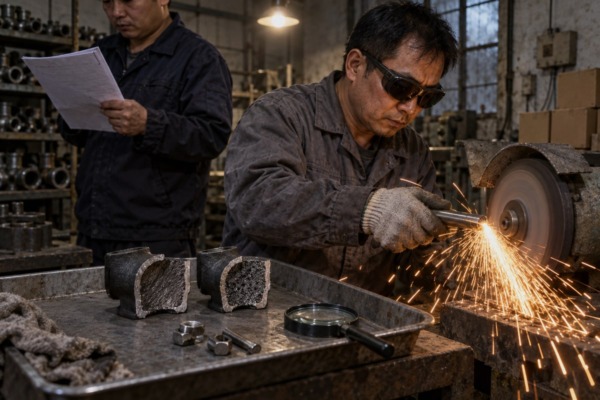
Track Raw Material Market Trends
Global iron ore 3 and scrap metal indices are the primary drivers of shifting market rates, and they are public. Before I negotiate anything, I check current steel pricing. Raw material market trends tell you instantly whether a supplier's "price increase" is real or invented. This is the single most powerful verification tool available, and it costs nothing.
Use the Six-Part Cost Breakdown
I require every quote to be split into six parts: raw material, bending and forming, welding, surface treatment, packaging, and profit. Honest factories provide this willingly. Evasive ones refuse — and that refusal is itself an answer. With the breakdown in hand, I can challenge any single line instead of arguing about a lump sum.
Benchmark Against Published Price Sheets
Compare against distributor price sheets, not just retail web listings, because contractor and retail pricing differ sharply. Regional context matters too:
| Benchmark | Typical Range |
|---|---|
| Raw wrought iron stock | $2–$5 per pound |
| Simple ornamental items | $20–$100 per piece |
| Threaded malleable elbows | ~$3 per piece |
| Indian dealer listings (cast/ductile) | INR 120–300/kg |
| Indian directory listing | INR 82/kg |
| US marketplace items | ~$14–$650 per item |
A quote that looks expensive in one market may be normal in another.
When a Premium Is Justified
Higher prices are fair when backed by real value: ISO certification, documented ASTM standards compliance 4, short lead times, or custom fabrication. Specialty work commands more too — authentic puddled iron with verified slag inclusion for historical restoration, metallurgical compatibility checks that prevent galvanic corrosion against antique iron, precision machining for legacy pipe diameters, and carbon-neutral production using electric arc furnaces all carry legitimate premiums. The question is whether the premium is explained, not whether it exists.
Conclusion
A fair wrought iron fittings price is never just the lowest number. Match specifications, demand cost breakdowns, benchmark steel rates, and compare landed costs — then buy with confidence.
Interested in sourcing the products mentioned in this article? See details and request a quote here:
Footnotes
1. The global hub for metal trading, offering real-time pricing data for steel and other industrial metals. ↩︎
2. Professional engineering society providing standards for malleable iron and other materials used in piping and fittings. ↩︎
3. Provides global data and statistics on iron ore and steel production trends for industry benchmarking. ↩︎
4. The leading authority for technical standards for materials, products, systems, and services including iron fittings. ↩︎
More Articles
You might also find these helpful.

How to Remotely Verify a Factory's Production Capabilities for Wrought Iron Plug-In Components?
Compare wrought iron fittings price quotes by matching spec, unit basis, and coating to spot fair pricing and…
Read More →
How to Assess a Factory's Production Capacity When Sourcing Wrought Iron Inserts?
Compare wrought iron fittings price quotes by matching spec, unit basis, and coating to spot fair pricing and…
Read More →
What Questions Should You Ask Wrought Iron Insert Suppliers to Spot Unreliable Ones Early?
Compare wrought iron fittings price quotes by matching spec, unit basis, and coating to spot fair pricing and…
Read More → English
  Spanish
  German
  Arabic