
How to Evaluate a Supplier’s Experience Exporting to the U.S. Market?
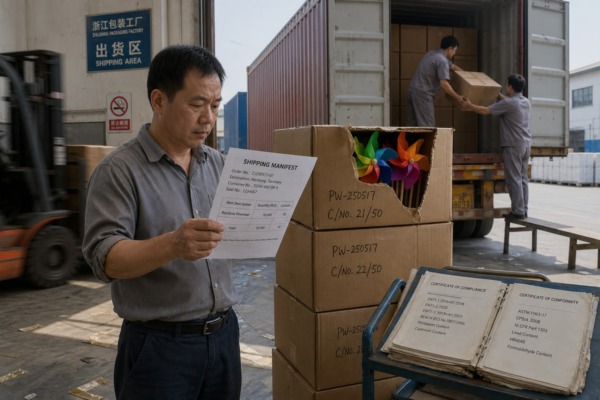
Skipping a check of a supplier’s experience exporting to the U.S. market can strand your pinwheel order at customs. Our Zhejiang factory has met many buyers after that expensive lesson.
To evaluate a supplier’s experience exporting to the U.S. market, verify real U.S. shipment history through Bill of Lading data, confirm compliance certifications like ASTM F963 and CPSIA, review sample customs documents, check trade references, and test their knowledge of U.S. inspection and labeling standards.
U.S. export experience is not one credential. It is a bundle of capabilities. A supplier may have shipped to many countries. That does not mean they can handle U.S. rules, documents, or inspections. This article breaks the evaluation into four practical checks. Each check gives you specific questions to ask and specific proof to demand.
What Certifications Should I Ask a Pinwheel Supplier to Prove U.S. Export Compliance?
Last spring, a Texas distributor asked us for our شهادة منتج الأطفال 1 before discussing price. That single request told me she had been burned by an uncertified pinwheel supplier before.
Ask a pinwheel supplier for a Children's Product Certificate backed by CPSC-accepted third-party lab testing to ASTM F963 and CPSIA, plus proof of lead and phthalate compliance, small parts testing, CPSIA tracking labels, and permanent country-of-origin markings.

Pinwheels look simple. Under U.S. law, they usually are not. The CPSC treats any toy marketed to children under 12 as a children's product. That triggers mandatory third-party testing at a CPSC-accepted lab. The supplier must then support a Children's Product Certificate for every import. If a supplier cannot explain this chain, they have not truly served the U.S. market.
The Documents That Actually Matter
Here is the compliance file I would expect any serious pinwheel supplier to produce on request.
| Document or Standard | ما يغطيه | ما يجب طلبه |
|---|---|---|
| تقرير اختبار ASTM F963 | Sharp points, sharp edges, small parts, mechanical hazards | A full report from a CPSC-accepted lab |
| CPSIA chemical compliance | Lead limits of 90 ppm in paint and 100 ppm in substrate; 0.1% phthalate cap | Test results tied to your actual materials |
| شهادة منتج الأطفال | Certifies the testing behind the shipment | A sample CPC from a past U.S. order |
| CPSIA tracking label | Permanent batch traceability on product or packaging | Photos of label placement on real goods |
| Country of origin marking | Permanent, visible origin marking | Artwork showing the marking position |
In our own files, we keep test reports covering the plastic petals, the coating on the wooden dowel, and the assembly pin. A knowledgeable supplier also knows which rules do not apply. Pinwheels need no FDA facility registration 2, because they are not food or medical items. When a supplier explains that distinction without prompting, their grasp of U.S. product safety standards is real. Be careful with suppliers who only offer a CE mark or an EN71 file. Those are European product safety standards. They do not satisfy U.S. requirements, and CBP compliance reviews will not accept them as substitutes.
How Can I Verify a Supplier's Track Record with U.S. Distributors Before Placing My Order?
One procurement manager once pulled our Bill of Lading records before our first call. I respected that. Paper claims are cheap; shipping manifests do not lie.
Verify a supplier's U.S. track record by checking Bill of Lading data on trade intelligence platforms, requesting redacted export documents, conducting trade reference checks with past U.S. distributors, running restricted party screening, and confirming repeat orders rather than one-off shipments.

Anyone can say they export to America. Your job is to separate claims from evidence. In my experience, the buyers who avoid trouble ask four direct questions. Have you completed U.S. export orders? Do you know U.S. regulations and customer inspection standards? Can you show U.S. client cases, even anonymized? Are those orders repeated, or one-time events? A supplier's answers reveal more than any brochure.
Start With Public Shipping Data
Trade intelligence tools let you analyze public manifest records. Bill of Lading data shows shipment frequency, volume, and product descriptions. Look for consistency across multiple years. A single container shipped long ago is not a track record. It is a data point. When evaluating a supplier's experience exporting to the U.S. market, patterns matter more than single events.
Trade Reference Checks and Screening
Next, go beyond data. Ask for two references and make a short call. Also run restricted party screening against U.S. Department of Commerce and Treasury lists. It is free and takes minutes. Finally, protect the payment itself. Confirm bank details through a second channel before wiring money. Business Email Compromise fraud often strikes exactly at this stage.
| Verification Method | ما الذي تثبته | إشارة تحذيرية |
|---|---|---|
| Bill of Lading data review | Real, repeated U.S. shipments | One shipment, years ago |
| Redacted export documents | Invoice precision and HTS familiarity | Vague, template-only samples |
| Trade reference checks | Buyer satisfaction and repeat orders | Refusal to share any contact |
| Restricted party screening | No sanctions exposure | Name matches on watchlists |
| Bank detail verification call | Protection from wire fraud | Pressure to pay a "new" account |
Some buyers argue that prior U.S. shipping history alone is enough. I disagree. History without compliance depth is a Level 1 supplier wearing a Level 3 badge. Check both.
What Questions Should I Ask About Packaging and Logistics for U.S.-Bound Pinwheel Shipments?
Every quarter, we weigh a trade-off: stronger export cartons cost more, but crushed pinwheel blades cost far more. U.S.-bound logistics decisions always come down to details like this.
Ask about carton drop-test standards, inner packing that protects pinwheel blades, HTS code accuracy, Importer Security Filing timing, Incoterms responsibilities, customs brokerage coordination, lead times, and contingency plans for port delays before booking any U.S.-bound pinwheel shipment.
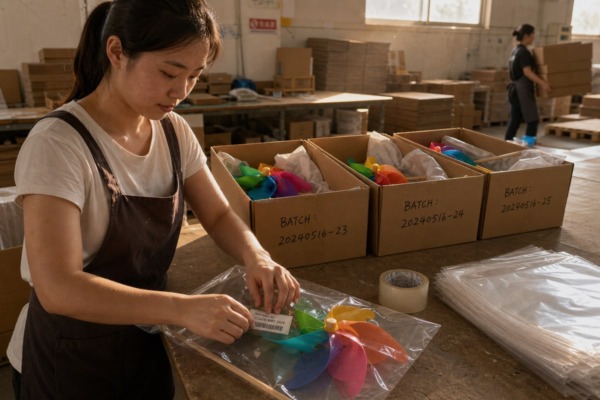
Damaged packaging is one of the top complaints I hear from American distributors. Pinwheel blades are thin plastic or mylar film. Wooden dowels can pierce cartons if packed loose. So logistics questions deserve the same rigor as price questions. I suggest asking these seven, in order.
- How do you protect blades and dowels inside the carton? Listen for poly sleeves, dividers, and secured bundles.
- What drop tests do your export cartons pass? A confident supplier describes the test, not just "strong boxes."
- What HTS code do you use for pinwheels? Toys fall under heading 9503. HTS code accuracy determines your duty rate and your CBP compliance exposure.
- How do you support the Importer Security Filing? The importer files the ISF, but the supplier must provide the data early. The filing is due at least 24 hours before vessel loading, and CBP penalties can reach $5,000 per violation.
- Which Incoterms do you quote, and who is the importer of record? This allocates duties, taxes, and risk.
- How do you coordinate with customs brokerage services and freight forwarders? Ask who manages communication when a shipment hits a problem.
- Can you provide milestone tracking? Mature suppliers share real-time updates, and some connect to visibility platforms via API.
Also probe duty knowledge. Section 301 tariffs affect many Chinese goods, and landed cost matters more than factory price. Anti-dumping duty risk is low for pinwheels today, but a supplier should know how to check scope rulings. Finally, ask whether they have completed C-TPAT certification 3 security questionnaires for U.S. importers. That signals supply chain security awareness.
| Question Area | Strong Answer Sounds Like | Weak Answer Sounds Like |
|---|---|---|
| Inner packaging | "Sleeved blades, divided layers, drop-tested cartons" | "We pack very carefully" |
| HTS and duties | "9503 classification, plus current Section 301 impact" | "وكيل الشحن يتولى ذلك" |
| ISF data | "Sent within 48 hours of booking" | "What is an ISF?" |
| Delay contingency | "Backup port and buffer stock plan" | "Delays are not our problem" |
How Do I Confirm a Supplier Understands U.S. Quality Control Standards for Pinwheels?
Years ago, an American inspector rejected a batch over blade rotation stiffness we considered acceptable. That failed inspection taught our team what U.S. quality control standards really demand.
Confirm understanding by asking the supplier to explain AQL inspection levels, defect classifications, pre-shipment inspection procedures, and past third-party audit results. A supplier who has passed U.S. distributor inspections can describe checkpoints, tolerances, and corrective actions in detail.

U.S. distributors do not inspect casually. They inspect systematically. So the fastest test of a supplier's experience exporting to the U.S. market is to ask them to talk through an inspection. Vague answers mean no real experience. Specific answers mean they have lived through it.
Speak the Language of AQL
Most U.S. buyers use ANSI/ASQ Z1.4 sampling plans. A common setup for toys is AQL 2.5 for major defects 4 and 4.0 for minor defects, with zero tolerance for critical defects. Ask the supplier what those numbers mean for pinwheels. A fluent supplier answers instantly. A critical defect is a sharp point or a loose small part. A major defect is a blade that will not spin or a badly misprinted petal. A minor defect is slight color variance between batches. Then ask when they schedule pre-shipment inspection. The correct answer is when at least 80% of the order is packed. Any supplier who resists third-party inspectors like SGS or QIMA is telling you something important.
Traceability and Distributor-Specific Checklists
U.S. quality expectations now extend into sourcing. Under UFLPA, importers must prove supply chains are free of forced labor. Ask for a sample chain-of-custody pack tracing the plastic film and wooden dowels back to their sources. Also remember that customer inspection standards vary by distributor. Ask how the supplier absorbs a buyer-specific checklist and how they run corrective actions after a failed check.
| المستوى | Supplier Profile | Recommended Buyer Action |
|---|---|---|
| Level 1: Limited | No direct U.S. shipments; weak on documents and testing | Proceed only with heavy onboarding and oversight |
| Level 2: Moderate | Some U.S. orders; basic paperwork fine; adaptation gaps remain | Order with third-party inspection and tight specs |
| Level 3: Strong | Repeat U.S. customers; fluent in CPC, AQL, ISF data, traceability | Scale volume with normal supervision |
الخاتمة
Choosing blindly risks delays, rejections, and returns. Evaluate a supplier's U.S. export experience as a system—certifications, shipment records, logistics knowledge, and QC fluency—and you remove most of that risk.
الحواشي
1. Official CPSC guidance on the mandatory certification required for importing children’s products into the United States. ↩︎
2. Official FDA resource explaining the requirements and process for food facility registration under U.S. law. ↩︎
3. Official U.S. Customs and Border Protection page explaining the voluntary supply chain security program for international trade. ↩︎
4. Technical resource explaining the industry-standard sampling procedures and defect classifications used in U.S. quality inspections. ↩︎
المزيد من المقالات
قد تجد هذه مفيدة أيضًا.

كيفية التحقق عن بُعد من قدرات إنتاج المصنع لمكونات التوصيل المصنوعة من الحديد المطاوع؟
Verify a supplier's U.S. export experience with real shipment records, ASTM F963/CPSIA certifications, and customs documents to avoid…
اقرأ المزيد →
كيفية تقييم قدرة إنتاج المصنع عند توريد إدخالات الحديد المطاوع؟
Verify a supplier's U.S. export experience with real shipment records, ASTM F963/CPSIA certifications, and customs documents to avoid…
اقرأ المزيد →
ما الأسئلة التي يجب أن تطرحها على موردي إدخالات الحديد المطاوع لاكتشاف غير الموثوقين مبكرًا؟
Verify a supplier's U.S. export experience with real shipment records, ASTM F963/CPSIA certifications, and customs documents to avoid…
اقرأ المزيد → English
  Spanish
  German
  Arabic