
How to Arrange a Pre-Shipment Inspection for Windmills?

One defective container can wipe out a season’s profit. I have watched buyers skip a pre-shipment inspection 1 for windmills and regret it. Our Zhejiang pinwheel factory taught me better.
To arrange a pre-shipment inspection for windmills, confirm production completion with the supplier, book a third-party inspection agency two to three days in advance, share the purchase order and packing details, have inspectors verify products and packaging at the factory, and release shipment only after a passing report.
That is the short version. The details decide whether the process actually protects you. Below, I walk through scheduling, checklists, inspector choices, and what to do when defects appear. Each step comes from real orders we have shipped to the United States, South America, and Europe.
How do I schedule a pre-shipment inspection with my pinwheel supplier in China?
Last spring, a US procurement manager messaged me on WhatsApp asking when her inspector could visit. We locked the date together, and that simple step saved her whole delivery window.
Schedule the inspection after confirming actual production readiness, not the planned ship date. Book a third-party inspection agency at least two to three days in advance, provide factory contact details and purchase documentation, and reserve the loading date only after the report clears.
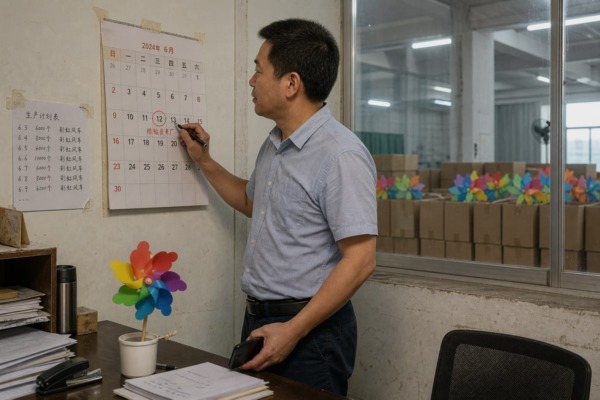
The biggest scheduling mistake I see is anchoring the inspection to the contract ship date. Production slips. Holidays hit. If the inspector arrives and half the cartons are still open, you pay for a wasted visit. So always anchor the booking to real factory status.
A Step-by-Step Booking Process
Here is the sequence we follow with our own buyers:
- Define the shipment scope. List every SKU, spare part, and document in the order. Pinwheel strings and assembly kits count too.
- Ask for a production status update. Get photos of finished and packed goods before you book anyone.
- Book the inspector early. Most agencies in China accept bookings made at least two to three days in advance. Complex or peak-season orders need more lead time.
- Send the paperwork. The agency needs the purchase order, approved sample references, packing list, and factory contact details.
- Appoint attendees. Typically the supplier's QC lead hosts, the inspector checks, and the buyer joins remotely if needed.
- Confirm the visit window. We stage goods in one area so the inspector loses no time.
- Review the report before booking the truck. Many agencies issue reports within 24 hours, which keeps your shipping slot safe.
Timing Milestones That Matter
| Milestone | Typical Timing | Who Confirms |
|---|---|---|
| Production status update | About a week before the target ship date | Supplier |
| Inspection booking | At least 2–3 days before the visit | Buyer or sourcing agent |
| On-site inspection | After goods are finished and mostly packed | Third-party inspector |
| Inspection report | Often within 24 hours of the visit | Inspection agency |
| Loading and release | Only after a passing report | Buyer |
One clarification helps here. A Factory Acceptance Test verifies performance during or right after production. A pre-shipment inspection is different. It confirms final conformity, packaging readiness, and document completeness right before transport. For decorative windmills, the pre-shipment check is usually the one that matters most.
What should I include in my inspection checklist for windmill quality control?
During a recent run of rainbow petal pinwheels, our QC team caught a mis-drilled hub hole before packing. That one checklist line stopped a thousand wobbly windmills from shipping.
A windmill inspection checklist should cover petal surface condition, spinning smoothness, dowel stick integrity, assembly completeness, dimensional verification against approved samples, color and print accuracy, packaging strength, carton labels, and document completeness, including the packing list and any required safety test reports.

A good checklist mirrors the product. Our eight-petal garden windmills combine mylar-film blades, a plastic hub, yellow grommets, a pin, and a wooden dowel. Each part fails in its own way, so each part needs its own line on the checklist.
A Component-by-Component Checklist
| Item | What to Check | Common Defects |
|---|---|---|
| Petal blades | Surface condition, rainbow gradient accuracy, print alignment | Scratches, faded print, cracked film |
| Hub and grommets | Secure pin fit, free rotation on the axis | Loose pin, tight or seized spin |
| Wooden dowel | Straightness, smoothness, surface treatment inspection of the coating | Splinters, warping, rough finish |
| Assembly kits | All die-cut pieces present, drilled holes aligned | Missing grommets, mis-drilled holes |
| Function | Spin test under airflow, noise level | Wobble, squeaking, stalling |
| Packaging | Carton strength, inner protection, correct labels and barcodes | Crushed cartons, wrong shipping marks |
| Documents | Packing list, test reports, assembly instructions | Missing safety documentation |
Dimensional verification deserves special emphasis. Petal length, hole position, and dowel diameter must match the approved sample. A one-millimeter drift in the hub hole makes an entire batch spin badly.
Don't Confuse Turbine Rules with Toy Rules
Some buyers read about wind turbine components 2 and ask whether I apply IEC 61400 standards or non-destructive testing like ultrasonic scanning. That concern is understandable but misplaced. IEC 61400 governs utility-scale turbines, where breakbulk cargo handling of massive blades justifies structural stress checks. Decorative windmills are cartonized consumer goods. Visual checks, function tests, drop tests, and label verification catch what matters. Skipping turbine-grade testing does not mean skipping rigor. It means matching the method to the product, which keeps your inspection affordable and fast.
How can I choose between third-party inspectors and in-house QC for my pinwheel orders?
Every order forces a quiet cost question in my office: pay an outside inspector, or trust our own line checks? The honest answer depends on order value and risk.
Choose a third-party inspection agency for high-value, customized, or first-time orders because it delivers unbiased verification and a formal inspection certificate. Rely on supplier in-house QC for repeat, low-risk reorders, and combine both when packaging damage or returns have occurred before.
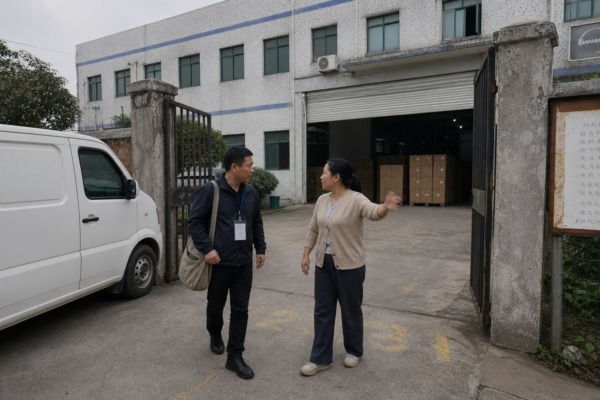
Start with a side-by-side view, because this is fundamentally a comparison decision:
| Factor | Third-Party Inspection Agency | Supplier In-House QC |
|---|---|---|
| Objectivity | Independent, unbiased verification | Possible conflict of interest |
| Cost | Per-visit inspection fee | Included in the product price |
| Documentation | Formal inspection certificate plus photo audit trail | Internal records only |
| Best for | New suppliers, custom designs, large orders | Repeat orders with trusted partners |
| Availability | Needs 2–3 days booking notice | Continuous throughout production |
When Each Option Wins
I will be blunt about my own side of the table. Our in-house QC team checks every production run, and we stand behind that work. But I still tell buyers like Olivia, our typical US procurement contact, to commission a third-party agency to visit the factory before cartons are sealed. The agency verifies the products and packaging against the order, issues an independent inspection report 3, and only after it passes do we arrange shipment. That is the exact process I recommend, because independent eyes remove doubt on both sides.
The report also builds a digital audit trail. High-resolution photos of goods and cartons taken at the factory become your baseline evidence if a carrier damages the shipment or a warranty dispute arises later.
A Hybrid Model That Works
Most of our long-term distributors settle into a hybrid rhythm. Third-party inspections cover the first three orders and every new custom design. After trust is established, reorders run on our in-house QC with photo reports, and a third-party visit returns once or twice a year as a spot audit. This keeps inspection costs proportional to real risk without ever going blind.
What steps can I take if my pre-shipment inspection reveals defective windmills?
Years ago, a failed report on faded petals taught me to build rework time into every schedule. Now a defect finding triggers a plan, not a panic.
If the pre-shipment inspection reveals defective windmills, hold the shipment, classify defects by severity, require the supplier to sort or rework the goods, schedule a re-inspection, and release cargo only after a passing report. Use photographic evidence to support claims and negotiate corrective actions.
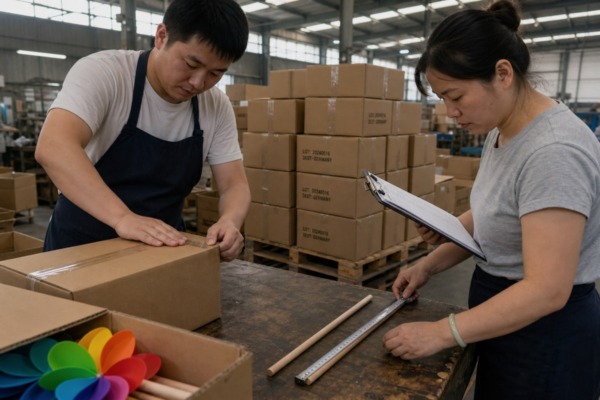
A failed report feels like a crisis, but it is actually the system working. The defect was caught at the factory, where fixing it is cheap, instead of at your warehouse, where fixing it is nearly impossible. Here is how I guide buyers through it.
Classify Before You React
Not every defect deserves the same response. Sort the findings first:
| Severity | Example on Windmills | Typical Action |
|---|---|---|
| Critical | Exposed sharp pin, safety label missing | Full hold, 100% sorting before any release |
| Major | Petals detach, hub will not spin | Rework the affected units, then re-inspect |
| Minor | Slight print offset within the agreed AQL tolerance | Accept and note for the next production run |
Follow a Clear Recovery Sequence
First, hold the shipment formally in writing. Never let cargo move on a verbal promise. Second, review the inspector's photos with the supplier and agree on root cause. On our line, most major findings trace back to one station, so targeted rework is usually enough. Third, set a rework deadline and book the re-inspection immediately, since agencies still need their two-to-three-day notice. Fourth, once the re-inspection passes, consider adding loading supervision. The inspector watches container condition 4, carton counts, and sealing, which protects you against the packaging damage and transit losses that plague this trade. Finally, document everything. The failed report, the corrective action record, and the passing certificate together strengthen your position in any future claim and make the next order smoother.
Conclusion
Defects found at your customer's door cost the most. A pre-shipment inspection for windmills costs little by comparison. Book the inspector, verify products and packaging, then ship confidently.
Footnotes
1. The WTO Agreement on Pre-shipment Inspection provides the international regulatory framework for these trade services. ↩︎
2. The IEC develops international standards for wind turbine components to ensure safety and performance across the industry. ↩︎
3. ISO standards govern the requirements for bodies performing inspection and the issuance of formal inspection reports. ↩︎
4. U.S. Customs and Border Protection provides authoritative guidelines on maintaining container condition and security for international trade. ↩︎
More Articles
You might also find these helpful.

How to Remotely Verify a Factory's Production Capabilities for Wrought Iron Plug-In Components?
Learn how to schedule a pre-shipment inspection for windmills, from booking timelines to checklists, so defects get caught…
Read More →
How to Assess a Factory's Production Capacity When Sourcing Wrought Iron Inserts?
Learn how to schedule a pre-shipment inspection for windmills, from booking timelines to checklists, so defects get caught…
Read More →
What Questions Should You Ask Wrought Iron Insert Suppliers to Spot Unreliable Ones Early?
Learn how to schedule a pre-shipment inspection for windmills, from booking timelines to checklists, so defects get caught…
Read More → English
  Spanish
  German
  Arabic