How to Compare Windmill String Supplier Quotes for a Fair Price?
Comparing windmill string supplier quotes drives me a little crazy sometimes—and I write them toy-safety compliance 1. On our production line in Zhejiang, I see buyers pick the lowest number and regret it. One quote hides freight. Another quietly swaps foil petals for thinner film. By the time the container lands, the “cheap” deal costs more than the honest one. The fix is a simple, repeatable comparison method, and I will walk you through it.
To compare windmill string supplier quotes fairly, normalize every offer to the same string length, pinwheel count, pinwheel material, and rope material, then calculate total landed cost including freight, packaging, and duties. Score suppliers on quality control, lead time, and warranty—not just the headline unit price.
Let me break that down step by step. We will look at how to dissect a quote, spot hidden costs, judge quality behind a low price, and ask the right questions before a bulk order.
How Do I Break Down a Windmill String Quote to Compare Suppliers Accurately?
A buyer once sent me three "identical" quotes to review. None were identical. One string was 3 meters with 8 pinwheels; another was 2 meters with 6. Same product name, different products.
Break down a windmill string quote into five parts: string length, number of pinwheels per string, pinwheel material, rope or wire material, and unit basis. Convert every supplier's offer to price per meter or per pinwheel before comparing, and request a line-item breakdown for lump-sum quotes.
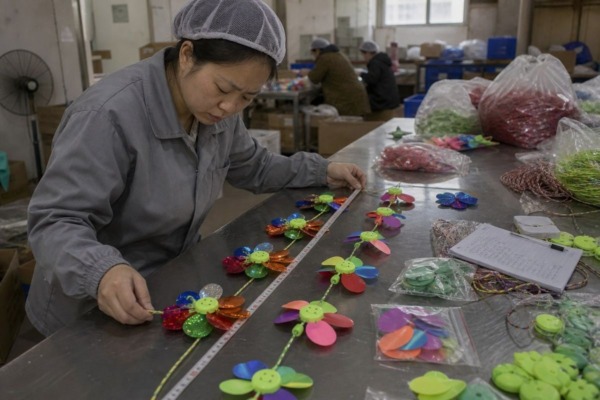
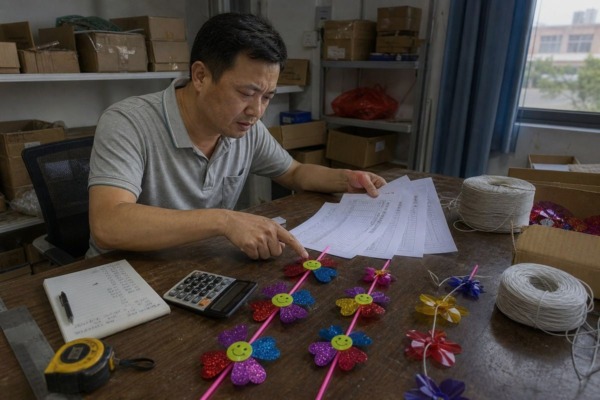
Here is the core truth I have learned from years of quoting pinwheel strings: the price is driven by four variables, and suppliers rarely disclose all four in the same way. The length of the string matters. The number of pinwheels on that string matters even more, because each spinner adds material, assembly labor 2, and packing volume. Then the pinwheel material—glittery holographic foil, plain glossy film, or thicker molded plastic petals—can swing cost significantly. Finally, the rope material itself, whether nylon cord, braided polyester, or galvanized wire, changes both price and outdoor lifespan.
Start With a Standardized RFQ
Before you collect quotes, define the exact spec in your RFQ evaluation process. State the string length, pinwheel count, petal material, rope material, quantity, and packaging. When all suppliers answer the same scope, comparison becomes possible. When they don't, you are comparing guesses.
Normalize to a Common Unit
Restate every quote as price per pinwheel or price per meter of finished string. A $2.10 string with 6 spinners is actually more expensive per spinner than a $2.60 string with 8.
| Quote Element | Supplier A | Supplier B | What to Check |
|---|---|---|---|
| String length | 2 m | 3 m | Price per meter |
| Pinwheels per string | 6 | 8 | Price per pinwheel |
| Petal material | Holographic foil | Plain PET film | Thickness, UV resistance |
| Rope material | Nylon cord | Braided polyester | Tensile strength ratings |
| Unit price | $2.10 | $2.60 | Normalized, not raw |
If a supplier gives only a lump sum, ask for material, labor, packaging, and freight as separate lines. Any serious factory can provide this within a day. Ours does.
What Hidden Costs Should I Watch for When Reviewing Pinwheel String Supplier Quotes?
The costliest lesson I ever watched a distributor learn involved an FOB quote she read as door-to-door. The freight and logistics costs added 22% she never budgeted.
Watch for excluded freight, mismatched Incoterms, import duties, packaging upgrades, sample and tooling fees, MOQ-driven inventory costs, and payment-term financing effects. Always calculate total landed cost per unit—product price plus shipping, insurance, tax, and duty—before declaring any pinwheel string quote the cheapest.
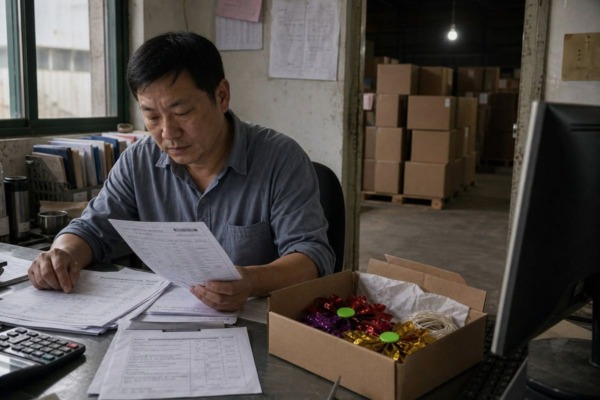
Hidden costs rarely hide on purpose. Usually, they hide because two quotes are written under different terms. One supplier quotes FOB Ningbo. Another quotes EXW from an inland factory. A third quotes DDP to your warehouse. All three headline prices are real, yet none are comparable until you standardize the Incoterms.
Build a Landed Cost View
Total cost of ownership is the only fair basis. For decorative pinwheel strings, that means adding several layers on top of the unit price:
| Hidden Cost | Why It Distorts Comparison | How to Neutralize It |
|---|---|---|
| Freight and insurance | Included in some quotes, excluded in others | Ask for FOB and CIF/DDP versions |
| Import duties and tax | Vary by HS code and destination | Confirm the HS code in writing |
| Packaging | Bulk poly bags vs. retail-ready header cards | Specify packaging in the RFQ |
| Sample and tooling fees | Charged upfront by some, waived by others | Request them as separate line items |
| MOQ effects | Low unit price at 20,000 pcs raises inventory carrying cost | Model your real sell-through rate |
| Payment terms | 30% deposit vs. 100% upfront changes cash cost | Compare effective financing impact |
Ask What Is Not Included
The single most powerful question in quote review is: "What is excluded from this price?" Omissions—carton markings, drop-test packaging, replacement parts for damaged pinwheels—are where surprise costs live. In our experience exporting to the US and Europe, packaging alone can move a quote 5–10%, because a string of six foil flowers survives ocean freight only if the carton and inner dividers are engineered for it. A quote that skips protective packaging looks cheaper until the returns start. For long-term programs, some buyers also negotiate index-linked pricing in their procurement contract terms, so raw material swings in plastic film or wire adjust the price fairly for both sides.
How Can I Tell If a Low Quote Means Lower Quality Control Standards?
Whenever a competitor undercuts our pinwheel string price by 20%, I get curious rather than worried. There are only so many places that money can come from.
A suspiciously low quote usually signals thinner petal film, weaker rope, skipped QC inspections, or unstabilized plastic that fades outdoors. Verify by requesting material test reports, samples, spin and pull tests, ISO quality standards documentation, and photos of the supplier's inline inspection process before ordering.
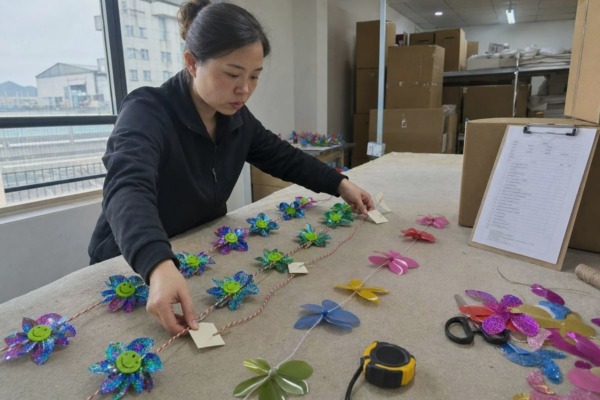
Price cuts have to come from somewhere. In pinwheel strings, they typically come from five places, and each one shows up later as a customer complaint. Thinner foil petals tear in the first strong wind. Non-UV-stabilized film fades from vibrant rainbow to washed-out pastel within a season. Cheaper rope with low tensile strength ratings snaps under tension when strings are hung across a storefront. Undersized grommets and pins let spinners wobble or fall off. And skipped inspections let all of the above ship undetected.
What Evidence to Demand
At our factory, every batch of pinwheel strings passes a spin test, a pull test on the cord, and a color-fastness check before packing. Any supplier with real quality control can show you the same. Ask for:
- Material test reports for the petal film and rope, including breaking load limits on the cord.
- Confirmation of UV-stabilized polymers if the product is for outdoor garden display.
- Galvanized wire specifications or a corrosion resistance coating spec if the string uses metal wire instead of textile cord.
- Certifications such as ISO 9001 3, plus toy-safety compliance like EN standards for products sold as children's items in Europe.
- A small trial order or pre-shipment sample before scaling to full volume.
Compare Cost Drivers Honestly
Sometimes a low quote is legitimate. Efficient tooling, better film sourcing, and high-volume production 4 genuinely lower cost—that is how we keep our own pricing budget-friendly without cutting material grade. The test is transparency. A factory that lowers price through efficiency will happily explain how. A factory that lowers price through material substitution will dodge the question. If the supplier resists sending samples, refuses a line-item breakdown, or cannot name the film thickness, treat the low number as a warning, not a win.
What Questions Should I Ask Suppliers to Ensure I'm Getting a Fair Price on Bulk Orders?
One of my favorite American buyers negotiates over WhatsApp with a single spreadsheet. Her questions are short, specific, and impossible to dodge. Her orders almost never go wrong.
Ask suppliers to confirm exact spec, quote validity period, bulk order discounts by volume tier, lead time estimates, QC and inspection procedures, warranty for damaged goods, payment terms, and what the quote excludes. Then use a weighted scorecard to compare answers, not just prices.
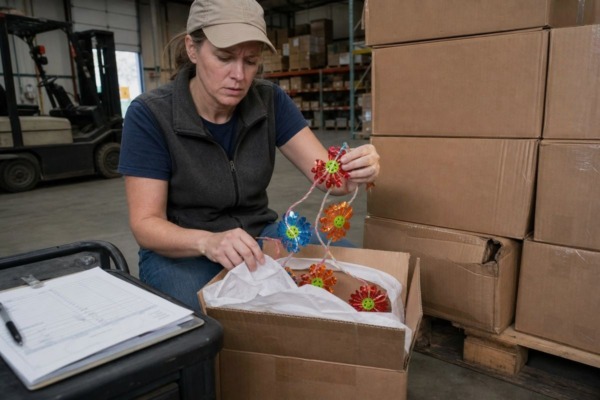
Good questions do two jobs. They fill in the blanks a quote leaves open, and they reveal how a supplier behaves under pressure. A vendor who answers quickly and precisely before the order will usually communicate the same way when a shipment issue appears. A vendor who goes vague at the quoting stage will vanish when you need them most.
The Question Checklist
Work through these systematically:
- Can you confirm the string length, pinwheel count, petal material, and rope material in writing?
- What are your bulk order discounts at each volume break point—5,000, 10,000, 20,000 strings?
- What are your lead time estimates in peak season versus off-season, and what happens if you miss them?
- What inline and pre-shipment QC steps do you perform, and can I appoint a third-party inspection?
- What is your policy on damaged packaging or broken pinwheels on arrival?
- What exactly is excluded from this quote?
- How long is the quote valid, and is pricing fixed or index-linked to raw materials?
- Can you customize petal colors, string length, or packaging for my regional market—for example, stronger UV specs for high-sun regions?
Score the Answers, Not Just the Price
Build a weighted scorecard so your decision stands up internally:
| Criterion | Suggested Weight | What a Strong Answer Looks Like |
|---|---|---|
| Total landed cost | 35% | Full line-item transparency, clear tiers |
| Quality assurance | 25% | Documented QC steps, samples, test reports |
| Lead time reliability | 15% | Realistic dates with penalty or remedy terms |
| Customization ability | 10% | OEM/ODM development support |
| Payment and warranty terms | 10% | Balanced deposits, clear damage policy |
| Responsiveness | 5% | Same-day, specific replies |
Once the matrix is complete, negotiate with evidence. Show suppliers exactly where they lag a competitor and ask if they can close the gap. In my experience, honest factories sharpen their terms when they see a fair, structured comparison—because they know they will win on value.
Conclusion
A fair price matches the same spec, same terms, and lowest real risk. Normalize the quotes, total the landed cost, verify quality, and score suppliers—then decide with confidence.
Footnotes
1. Updated CPSC business guidance page for toy safety standards and compliance requirements. ↩︎
2. US government source for labor cost data and manufacturing assembly statistics. ↩︎
3. Official international standard for quality management systems. ↩︎
4. Federal program supporting manufacturing efficiency and production standards. ↩︎
More Articles
You might also find these helpful.

What Fire Retardant Certifications Should I Check When Buying Pinwheels?
Compare windmill string supplier quotes by normalizing length, pinwheel count, and materials, then weigh total landed cost against…
Read More →
How to Verify Authenticity of Test Reports When Purchasing Wind Turbines?
Compare windmill string supplier quotes by normalizing length, pinwheel count, and materials, then weigh total landed cost against…
Read More →
How to Check if Pinwheel/Windmill Materials Contain Harmful Chemicals?
Compare windmill string supplier quotes by normalizing length, pinwheel count, and materials, then weigh total landed cost against…
Read More → English
  Spanish
  German
  Arabic