How to Define the Right Style and Design for Pinwheel Strings for Your Shop?
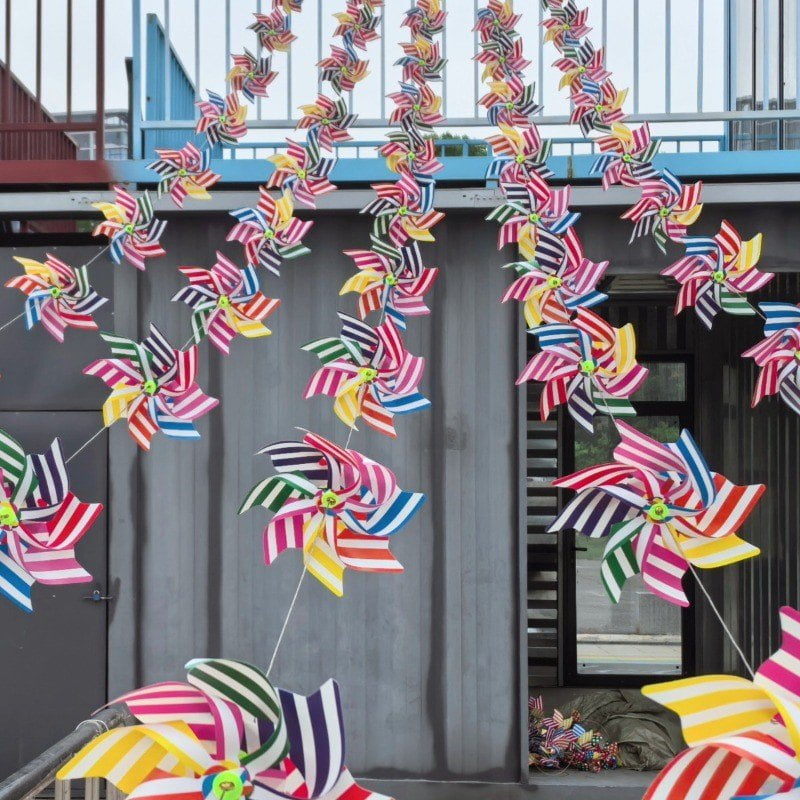
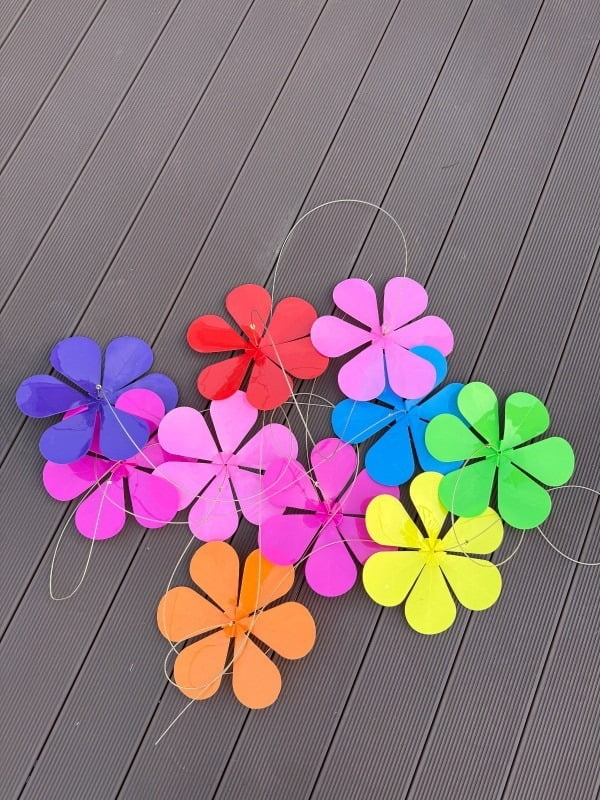
Choosing pinwheel strings sounds easy until a shipment arrives and clashes with your storefront. On our production line, I have seen buyers lose whole seasons to one wrong style choice.
To define the right style and design for pinwheel strings, start with your shop’s purpose and audience. Then choose bold shapes, high-contrast colors, weather-resistant materials, and a string length that fits your display space. Match the design to your brand before ordering.
That is the short answer. Now let me walk you through each decision, step by step, the same way I guide our wholesale clients.
How Do I Choose the Right Pinwheel String Style to Match My Shop’s Brand Image?
A buyer from Texas once sent me photos of her boutique and asked which of our samples fit. That one conversation taught me more than any catalog ever could.
Match the pinwheel string style to your shop’s identity. Playful, bright designs suit toy stores and family shops. Clean geometry and muted palettes suit boutiques and gift shops. Garden centers need larger, weatherproof styles. Define the shop’s role first, then design around it.

At our factory in Zhejiang, we always ask one question before quoting: what job will the pinwheel string do? A window piece that grabs attention needs a different design than a shelf accent that supports your visual merchandising 1 quietly. Garden decoration and supermarket decoration follow different style rules. We learned this the hard way years ago when a garden-style string looked cheap under bright supermarket lighting.
Start With Readability
A pinwheel string is seen in a glance, often from across a street. So simple shapes win. Bold silhouettes, clear outlines, and clean radial symmetry 2 read better than intricate details. Symmetry also makes the pinwheels spin evenly, which keeps the whole string looking balanced and professional.
Match Style to Shop Type
Here is the framework I share with our distributors:
| Shop Type | Recommended Style | Why It Works |
|---|---|---|
| Children’s / toy store | Bright rainbow, playful shapes | High energy, kid appeal |
| Boutique / gift shop | Limited palette, crisp geometry | Feels refined and coordinated |
| Garden center | Large blades, natural tones | Blends with kinetic garden decor |
| Seasonal pop-up | High contrast, fast-produce designs | Bold motion, quick turnaround |
| Farmhouse / home goods | Warm colors, classic silhouettes | Signals handcrafted quality |
The key lesson is this: the right style is the one that reads clearly, fits your brand, and can be produced consistently at scale. A one-off concept that looks great on paper often fails on a busy sidewalk.
What Design Factors Should I Consider When Customizing Pinwheel Strings for My Storefront?
Every custom order forces a trade-off I weigh daily: richer detail versus faster, more consistent production. Our engineers balance both on every OEM project we develop.
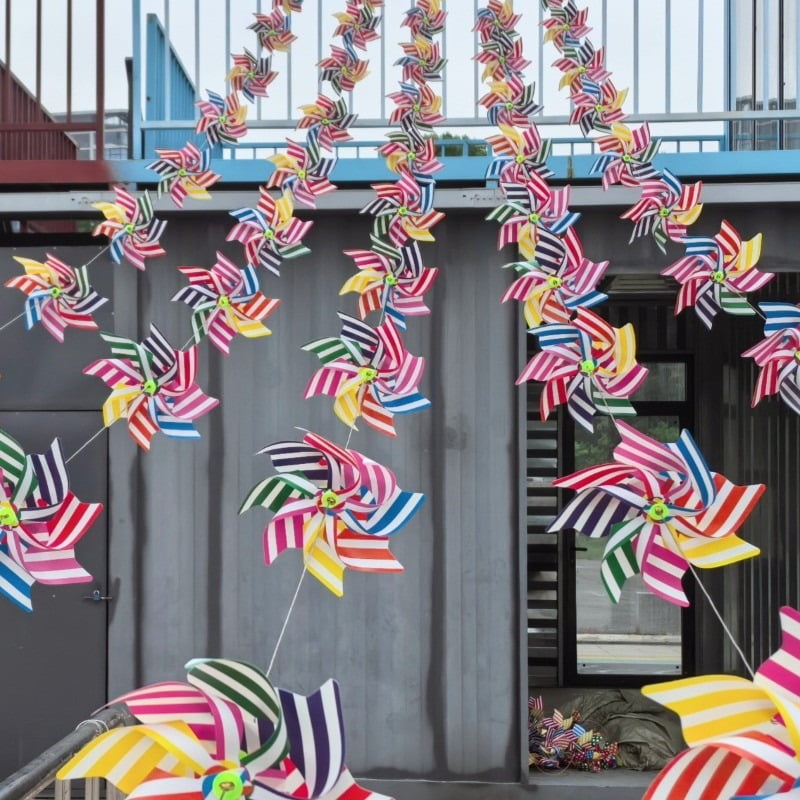
Consider six factors when customizing pinwheel strings: string length, pinwheel count and spacing, blade size, material durability, mounting method, and 360-degree visibility. Our standard string is ten meters, but length and pinwheel quantity can be fully customized to your storefront.
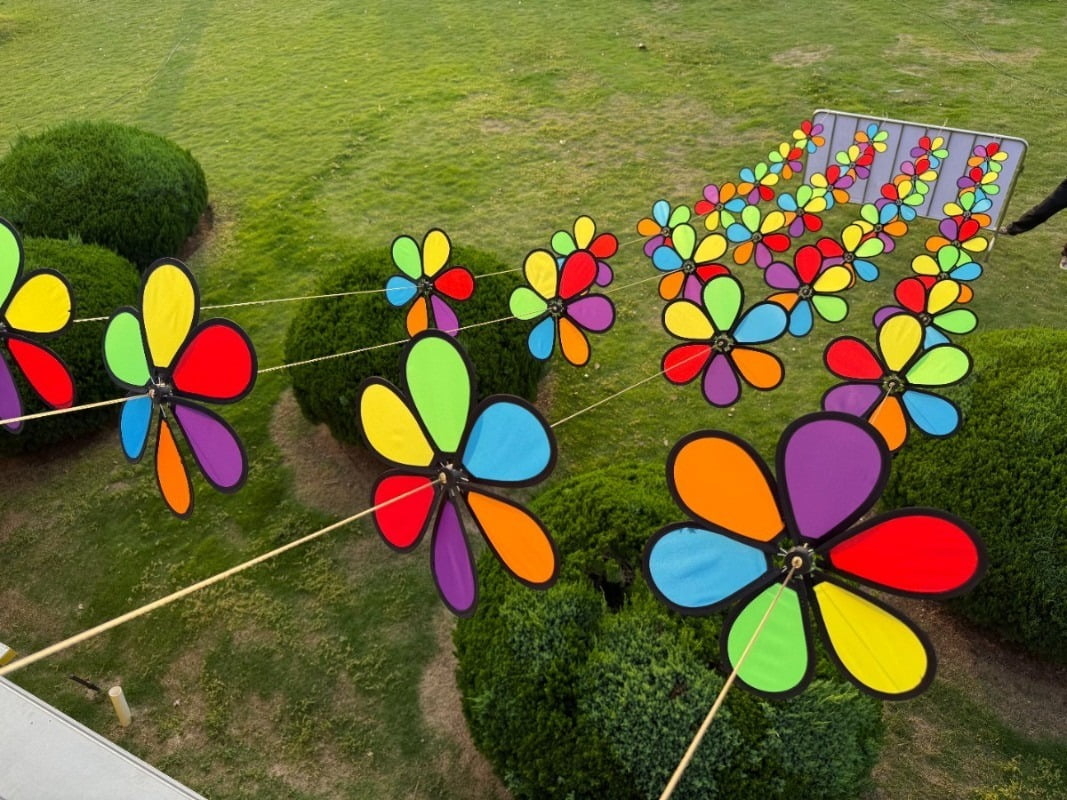
When we develop a custom string with a client, we work through a fixed sequence. This keeps the project on schedule and avoids costly revisions. Here is that process in plain terms.
- Set the length. Our standard pinwheel string runs ten meters, which suits most awnings, fence lines, and deck railings. But we can adjust the length to any storefront.
- Set the pinwheel count and spacing. More pinwheels create denser motion. Wider spacing looks cleaner and more upscale. Even spacing is non-negotiable; uneven gaps look unfinished.
- Choose blade size. Larger blades catch the eye from farther away. Smaller blades suit tighter entryways and indoor seasonal retail displays.
- Pick the mounting method. Clips, loops, or fixed ties each behave differently in wind. We test all three on our sample rail before recommending one.
- Confirm visibility from both sides. Double-sided prints or alternating blade patterns keep the design impactful from every angle, not just from the street.
- Plan for rotation in light wind. Lightweight blade designs spin in minimal airflow. That wind-driven motion is what pulls foot traffic toward your door.
One more factor matters for storefront aesthetics 3: modularity. Strings that let you swap individual pinwheels make it easy to refresh the display for holidays without buying a whole new set. Our clients who rotate seasonal themes reorder far more often, because the base hardware keeps working year after year.
How Can I Ensure the Colors and Materials of My Pinwheel Strings Attract More Customers?
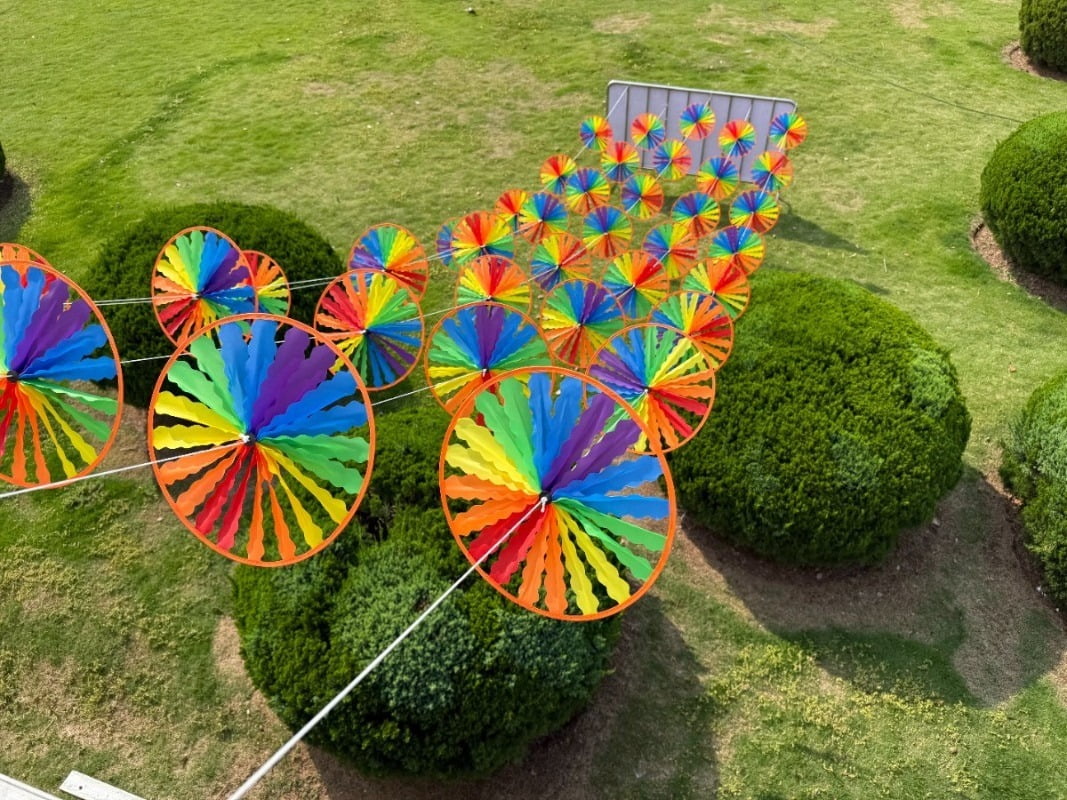
Our best-selling colorway remains the classic seven-color rainbow. It matches universal taste. But our film workshop also produces creative color-film finishes that surprise even long-time buyers.
Use high-contrast, blue-anchored, or rainbow palettes with one dominant color, and choose weather-resistant materials like treated polyester or heavy-duty vinyl with UV-resistant coatings. Strong contrast keeps spinning blades readable, and durable materials keep colors vivid outdoors for the whole season.
Color is where most buyers overthink, and materials are where most buyers underthink. Let me address both, based on what actually sells in the American market.
Color Combinations That Work
American consumers respond to palettes that are bold but orderly. Blue-led schemes test as the safest broad-appeal choice. Red, white, and blue dominates patriotic seasons. Rainbow stays the staple for family traffic. Here is how I map palettes to use cases:
| Color Combination | Best Use Case | Feel |
|---|---|---|
| Red + white + blue | July 4th, Memorial Day displays | Patriotic, festive |
| Blue + white | Year-round, broadest appeal | Clean, trustworthy |
| Classic rainbow | Kids’ retail, garden accents | Playful, whimsical |
| Navy + ivory | Premium home decor shops | Upscale, coastal farmhouse |
| Sage + terracotta + cream | Garden centers, patios | Natural, on-trend |
| Silver + iridescent | Modern shops, bird deterrence | Futuristic, eye-catching |
Holographic finishes deserve a special note. They catch sunlight beautifully, and in American gardens they double as humane pest deterrents 4. Avoid grouping several dark tones together; they blur visually once the blades spin.
Materials That Last
Color means nothing if it fades by August. For outdoor strings, polyester fabric durability 5 is the baseline we quote against. Treated polyester and heavy-duty vinyl resist rain and sun. UV-resistant coatings prevent the fading that triggers returns, which I know is a top pain point for US distributors. Sturdy materials also protect your curb appeal investment; a faded, drooping string hurts a storefront more than no decoration at all.
Where Can I Find a Reliable Supplier to Help Me Design Pinwheel Strings Tailored to My Shop’s Needs?
Years of exporting to the US, South America, and Europe taught me one lesson: buyers do not lose money on price. They lose it on suppliers who cannot execute.
Find suppliers through Google, Alibaba, or 1688 who offer OEM/ODM co-development, strict quality control, sampling before mass production, and reliable export logistics. Verify their factory capacity, request material specs, and confirm they can customize string length, pinwheel count, colors, and packaging.
Most of our distribution clients, like procurement managers 6 sourcing from China, find us through Google or Alibaba. But finding a supplier is easy. Verifying one is the real work. Here is the checklist I recommend, and yes, I encourage buyers to hold our own factory to it.
The Supplier Verification Checklist
| What to Check | What Good Looks Like | Red Flag |
|---|---|---|
| Customization ability | Adjustable length, blade size, color film | Fixed catalog only |
| Sampling process | Pre-production samples with photos or video | Refuses samples |
| Quality control | Inspection at material, assembly, and packing stages | “Trust us” answers |
| Materials | UV-resistant coatings, weather-resistant materials specified in writing | Vague “outdoor grade” claims |
| Packaging | Reinforced cartons tested for long transit | Thin boxes, no drop test |
| Logistics | Clear lead times, experience shipping to your market | No export track record |
Why Co-Development Matters
A supplier who only sells stock items cannot help you match your storefront aesthetics or seasonal campaign. Look for a partner who joins the design conversation. At our factory, we review a client’s brand colors, display photos, and target season before proposing designs. We then confirm every detail on a sample, because catching a color mismatch at the sample stage costs days, while catching it after mass production costs a container.
Also test communication speed. If a supplier takes three days to answer a WhatsApp message during sampling, imagine the silence when a shipment issue appears. Damaged packaging and shipping delays are solvable problems, but only with a supplier who responds fast and documents everything.
Conclusion
The wrong pinwheel string wastes a season. The right one boosts curb appeal daily. Define purpose, demand contrast and durable materials, then partner with a supplier who co-develops.
Footnotes
- Defines the retail practice of using visual displays to attract customers and optimize sales. ↩︎
- Explains the geometric principle that ensures balanced spinning and aesthetic appeal in pinwheel designs. ↩︎
- Authoritative Wikipedia entry covering the principles of visual display and storefront appeal. ↩︎
- Validates the use of reflective, kinetic objects like pinwheels as humane bird and pest deterrents. ↩︎
- Comprehensive overview of polyester’s physical properties, including its high durability and weather resistance. ↩︎
- The professional organization for the global sourcing and supply management specialists mentioned in the text. ↩︎
More Articles
You might also find these helpful.
How to Remotely Verify a Factory's Production Capabilities for Wrought Iron Plug-In Components?
To define the right style and design for pinwheel strings, start with your shop's purpose and audience. Then…
Read More →
How to Assess a Factory's Production Capacity When Sourcing Wrought Iron Inserts?
To define the right style and design for pinwheel strings, start with your shop's purpose and audience. Then…
Read More →
What Questions Should You Ask Wrought Iron Insert Suppliers to Spot Unreliable Ones Early?
To define the right style and design for pinwheel strings, start with your shop's purpose and audience. Then…
Read More → English
  Spanish
  German
  Arabic