
How to Tell If a Pinwheel Supplier Can Handle Walmart-Level Orders?
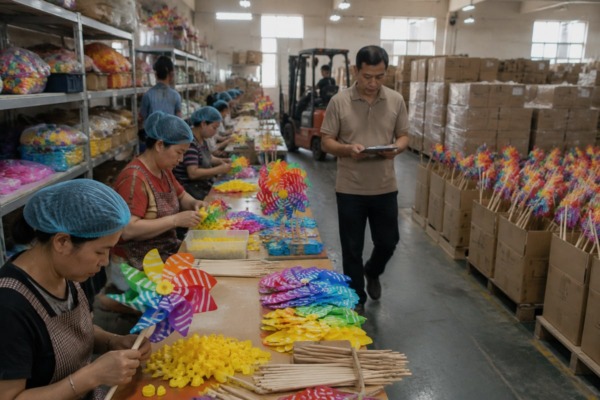
A weak pinwheel supplier looks fine until a Walmart-level order lands. On our production line in Zhejiang, I have watched buyers lose entire selling seasons to partners who overpromised.
A pinwheel supplier can handle Walmart-level orders if it proves verified factory production capacity, third-party audits like FCCA and SCS, a documented quality management system, retail-ready packaging, EDI capability, and past experience serving big-box retailers with strong OTIF performance.
That is the short answer. The longer answer is more useful. Walmart-level orders are not just big orders. They demand repeatable compliance, clean data, and distribution-center readiness 1. Below, I break down exactly what to verify, what to ask, and which red flags should end the conversation early.
How can I verify a pinwheel supplier's production capacity before placing a Walmart-level order?
Last spring, a US procurement manager video-called our Zhejiang workshop and asked one blunt question: how many pinwheels can you really make in your worst week? I respected that.
Verify a pinwheel supplier's production capacity by requesting monthly and peak-week output data, auditing production lines in person or by video, checking raw material sourcing resilience, reviewing past bulk order records, and confirming the factory can scale to multi-container monthly volumes without extending lead times.

Capacity is the first thing I tell buyers to probe, because it is the easiest thing for a supplier to exaggerate. A factory can show you one impressive production run. That proves very little. Walmart replenishment works in repeated cycles, so the real question is whether output stays stable across many cycles in a row.
Ask for Numbers, Not Assurances
Vague answers about monthly capacity are a classic red flag. When we quote a large pinwheel program, we share line-level numbers: how many petal-blade sets we die-cut per shift, how many assembly stations run, and what our peak-week ceiling is. Any serious partner should do the same.
| Capacity Signal | What to Ask For | Red Flag |
|---|---|---|
| Monthly output | Actual production records, not brochure claims | Round numbers with no documentation |
| Peak-week output | Data from last year's busiest weeks | "We can always add workers" |
| Line redundancy | Number of parallel lines or backup lines | One line, one mold, one shift |
| Lead time reliability | Lead times on the last five bulk orders | Lead times that grow with order size |
| Material sourcing | Names of backup film and dowel suppliers | Dependence on a single raw-material source |
Test Supply Chain Scalability Across Cycles
True supply chain scalability means the supplier can jump from small-batch runs 2 to multi-container monthly volumes without lead times stretching. Ask what happens if Walmart doubles a replenishment order mid-season. A ready supplier can point to backup manufacturing capacity, alternate lines, or vetted subcontracting options. Some buyers also ask about geographic redundancy, such as a China Plus One arrangement, to soften tariff spikes or regional disruptions. Finally, apply the test I use myself: ask for past实操 evidence, meaning real prior cases supplying big-box retail programs. A supplier who has already survived that pressure can describe it in detail. One who has not will speak in generalities.
What certifications should I check to confirm my supplier meets big-box retailer compliance standards?
Early in our export career, we learned a hard lesson: a beautiful sample means nothing at the audit table. Paperwork, not petals, decides who wins a big-box purchase order.
Check for third-party FCCA and SCS audit results, a valid social compliance audit, product safety certifications such as ASTM F963, CPSIA, or EN71 for toy pinwheels, plus proof the supplier meets SQEP packaging standards and can survive Walmart's vendor onboarding process.

Retailer compliance standards are where most mid-sized factories stumble. The product itself is simple. The compliance stack around it is not. When I walk a buyer through our documentation, I group everything into three layers: factory audits, product safety 3, and commercial readiness. A gap in any layer can stall the vendor onboarding process for months.
The Audit Stack Walmart Buyers Expect
| Audit or Certification | What It Covers | Why It Matters for Pinwheels |
|---|---|---|
| FCCA | Factory Capability and Capacity Assessment | Confirms the factory can actually produce at scale |
| SCS | Supply Chain Security | Verifies secure handling from factory to container |
| Social compliance audit | Labor conditions, hours, safety | Big-box retailers screen ethics before price |
| ASTM F963 / CPSIA / EN71 testing | Toy safety, small parts, chemical limits | Pinwheels with dowels and small hubs are treated as children's products in many programs |
| SQEP alignment | Barcodes, pallet configuration, retail-ready packaging | Non-compliance triggers chargebacks at the DC |
Some buyers push back here. They say certifications are just paper, and a clever factory can pass an audit and still ship poor goods. There is some truth in that, which is why I never treat a certificate as the finish line. But the objection cuts the wrong way. A supplier without current third-party audits has no external check at all. The paper is not the point. The system behind the paper is.
Financial and Legal Readiness
One layer buyers often skip is money. Walmart-scale programs commonly run on 60- to 90-day payment terms, and indemnity requirements demand high-limit product liability insurance. Ask directly whether the supplier can finance production while waiting on those terms. A financially thin factory may cut corners on materials mid-program. Also ask about traceability and ESG data readiness, since emerging Digital Product Passport rules for plastic goods will make material-level records a baseline expectation for exporters like us.
How do I evaluate a supplier's quality control process for consistent bulk pinwheel orders?
During one bulk run of rainbow petal blades, our QC team rejected a full batch over uneven white striping. That decision cost us three days and saved a client relationship.
Evaluate quality control by reviewing the supplier's documented quality management system, inspection checkpoints from incoming materials to pre-shipment AQL sampling, lot traceability records, complaint and corrective-action history, and evidence that quality stays consistent across repeated bulk pinwheel orders, not just one sample run.
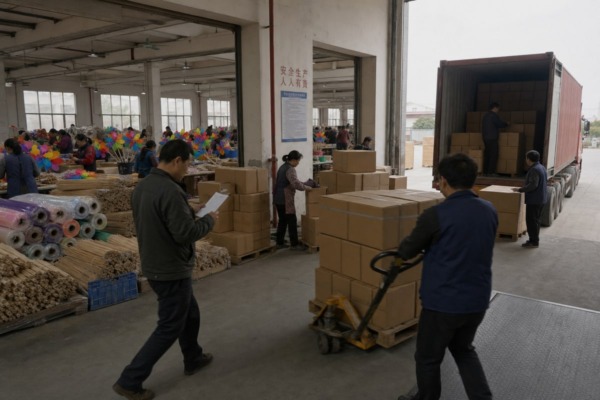
Quality at Walmart scale is a system, not an inspector with sharp eyes. Informal batch checking works for small craft orders. It collapses under bulk order fulfillment, where thousands of cartons ship every month and one bad lot can trigger returns across dozens of stores. So I tell buyers to evaluate the process, not the sample. In my own experience, the same three abilities I check when qualifying our sub-suppliers apply here: capacity, quality inspection, and documentation discipline, backed by real prior cases with large retail chains.
A structured QC flow for a garden pinwheel looks like this:
- Incoming inspection. Film, plastic petals, wooden dowels, and grommets are checked against material specs before they touch a line.
- In-process inspection. Operators check petal alignment, hub tension, and spin performance at set intervals during assembly.
- Final inspection. Finished pinwheels are tested for free rotation, secure pinning, and color consistency against the approved sample.
- Pre-shipment AQL sampling. A statistically valid sample is pulled from sealed cartons, so the check reflects what actually ships.
| QC Element | What Good Looks Like | Question to Ask |
|---|---|---|
| Documentation | Written procedures and inspection records per lot | Can I see reports from your last three bulk runs? |
| Traceability | Lot coding that links cartons to production dates and materials | How fast can you isolate a defective lot? |
| Corrective action | Root-cause reports with deadlines | Show me a real corrective-action case |
| Consistency | Stable defect rates across repeat orders | What is your defect trend over twelve months? |
One more proxy I always mention: responsiveness. If a supplier takes a week to answer a corrective-action question during sampling, it will not keep pace under retail pressure.
What should I ask about packaging and logistics to avoid delays and damage on large shipments?
Every quarter we weigh the same trade-off: cheaper cartons that save cents per unit, or heavier board that survives a conveyor belt. For big-box shipments, we choose survival.
Ask whether cartons survive conveyor handling in distribution centers, whether barcodes and pallet configurations meet SQEP standards, whether the supplier supports EDI documents like the 850, 856, and 810, and whether it can hit Must Arrive By Dates across multiple DCs.

Packaging and logistics are where Olivia-style procurement managers get burned most often, because damage and delays surface after the money is already spent. Walmart's own supplier requirements ask pointed questions here: can the case packaging move through distribution centers on conveyors without failing, do the markings and labels match spec, and does the packaging need modification to meet quality standards? Treat those questions as your template.
The Conveyor-Belt Test
A pinwheel is light but fragile in a specific way. Petal blades bend, and wooden dowels snap under point pressure. So I ask buyers to demand transit-tested case packs: correct inner-pack counts, void fill that immobilizes the dowels, and board grades proven in drop and vibration testing. SQEP-level detail matters too, including barcode placement and pallet configuration, because label errors at the DC generate chargebacks even when the product inside is perfect.
Digital Documents Decide On-Time Delivery
Logistics and distribution readiness is now a data question. Walmart's prepaid consolidation program spreads shipments across 42 regional distribution centers, so a supplier that can only ship one truck to one warehouse is not ready for that network. Strong partners run EDI for the 850 purchase order 4, 856 ASN, and 810 invoice, and hold OTIF performance around 90 percent on-time and 95 percent in-full. Some larger vendors even use RPA to manage compliance chargebacks and predictive forecasting to start components ahead of seasonal POs.
| Question to Ask | Good Answer | Warning Sign |
|---|---|---|
| Have your cartons passed transit testing? | Yes, with test reports available | "Our packaging has never had problems" |
| Can you create accurate ASNs? | Yes, via EDI or an integrated system | Manual emails and spreadsheets only |
| What is your OTIF history? | Documented rates near 90/95 or better | No records kept |
| Can you support multi-DC distribution? | Yes, with consolidation experience | Single-destination shipping only |
Conclusion
Walmart-level readiness is not about being big. It is about being disciplined. Verify capacity, audits, quality systems, and logistics data before you trust any pinwheel supplier with retail-scale volume.
Footnotes
1. Official Walmart supplier portal explaining compliance and operational expectations for global vendors. ↩︎
2. U.S. government resource providing export solutions and supply chain management guidance for manufacturers. ↩︎
3. U.S. Consumer Product Safety Commission guidance for manufacturers on mandatory safety standards and compliance. ↩︎
4. Global standards organization explaining Electronic Data Interchange (EDI) for retail supply chain efficiency. ↩︎
More Articles
You might also find these helpful.

How to Remotely Verify a Factory's Production Capabilities for Wrought Iron Plug-In Components?
Verify Walmart-level pinwheel supplier capacity: check factory audits, peak-week output data, QMS compliance, EDI readiness, and proven OTIF…
Read More →
How to Assess a Factory's Production Capacity When Sourcing Wrought Iron Inserts?
Verify Walmart-level pinwheel supplier capacity: check factory audits, peak-week output data, QMS compliance, EDI readiness, and proven OTIF…
Read More →
What Questions Should You Ask Wrought Iron Insert Suppliers to Spot Unreliable Ones Early?
Verify Walmart-level pinwheel supplier capacity: check factory audits, peak-week output data, QMS compliance, EDI readiness, and proven OTIF…
Read More → English
  Spanish
  German
  Arabic