
How Do I Verify a Pinwheel Supplier’s Environmental Compliance for the U.S. Market?

One weak document can freeze a pinwheel shipment at U.S. customs. On our Zhejiang production line, verifying a pinwheel supplier’s environmental compliance starts long before any container ships.
To verify a pinwheel supplier’s environmental compliance for the U.S. market, classify the product first, then request a Children’s Product Certificate or General Certificate of Conformity, third-party test reports from a CPSC-accepted lab, full material disclosures, and packaging declarations, and confirm every environmental claim with documented evidence.
That answer sounds simple. In practice, most compliance failures happen because buyers collect the wrong documents, or trust documents they never verified. The pain shows up later: customs holds, retailer rejections, product returns, and expensive re-testing under time pressure. The fix is a clear verification process. In this guide, I will walk you through the exact certifications to request, how to check materials against CPSIA and REACH, what to inspect during a factory audit, and how to read third-party lab reports before you ever approve a shipment.
What certifications should I ask my pinwheel supplier to provide for U.S. environmental compliance?
A procurement manager from Texas once messaged us on WhatsApp with a single question: "Send me your environmental certificate." I had to explain that no single certificate exists.
Ask for a Children's Product Certificate backed by CPSC-accepted third-party lab testing if the pinwheel is a children's product, or a General Certificate of Conformity otherwise, plus ASTM F963 test reports, California Proposition 65 documentation, and the supplier's ISO 14001 certification.

Classification decides everything. A pinwheel with flower-shaped mylar blades on a wooden dowel can be a children's toy, a garden decoration, or a promotional novelty. Each path carries a different legal burden. If your pinwheel is marketed to children, CPSIA requires testing by a CPSC-accepted accredited laboratory 1, a written Children's Product Certificate, and permanent tracking information where practicable. If it is a general consumer product, the importer generally needs a General Certificate of Conformity based on a reasonable testing program. Note who holds legal responsibility: the U.S. importer, not the overseas factory alone, is usually the party answerable for complete compliance documentation.
Must-have proof versus nice-to-have documentation
I tell every buyer to separate the two layers. Legal proof is non-negotiable. Sustainability documentation builds trust but does not replace the legal layer.
| Document | Type | What it proves |
|---|---|---|
| Children's Product Certificate | Must-have (children's products) | CPSIA compliance based on CPSC-accepted lab testing |
| General Certificate of Conformity | Must-have (non-children's products) | Conformity with applicable consumer product rules |
| ASTM F963 test report | Must-have (toys) | Mechanical and chemical safety under toy standards |
| California Proposition 65 assessment | Must-have (California sales) | Restricted substances like lead, cadmium, phthalates addressed |
| ISO 14001 certification | Nice-to-have | A functioning Environmental Management System at the factory |
| Verified Environmental Product Declaration | Nice-to-have | Independently reviewed environmental performance claims |
Some smaller factories will push back and say full third-party testing is too expensive for a low-risk novelty item. I understand the cost pressure. But the middle ground is risk-based verification, not skipping documents. Child-directed products and painted or coated parts get deep scrutiny. Simple, low-risk SKUs can run on lighter documentation. What never works is zero documentation.
How can I confirm the materials my supplier uses meet CPSIA and REACH safety standards?
During an incoming QC check last spring, our team noticed a pigment masterbatch had changed shade slightly. The supplier had switched sources without telling us. We stopped the line.
Request a full bill of materials and Full Material Disclosure for every component, then match each material against CPSIA phthalate and lead limits, REACH SVHC lists, and TSCA restrictions, and confirm the results with current third-party lab reports tied to your exact production batch.
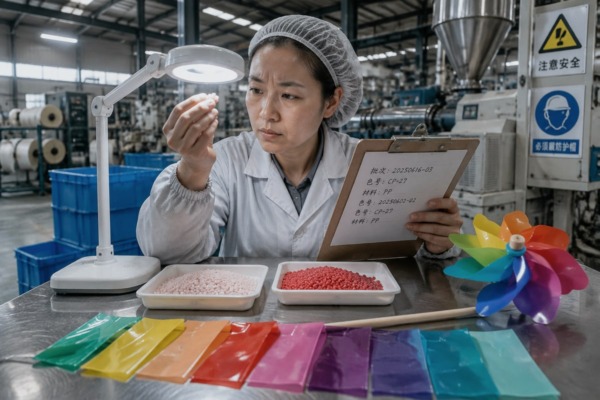
Materials are where compliance lives or dies. A typical pinwheel looks simple, but it contains more chemistry than most buyers expect. Our rainbow-petal design alone includes PP or PET blade substrates, printed white stripe patterns, a yellow plastic hub, metal pin fasteners, grommets, and a wooden dowel that may carry a finish. Every one of those inputs can hide a restricted substance.
Map every component to its chemical risk
I recommend building a simple risk map before you order. Here is how we break down our own product for buyers:
| Component | Material | Key chemical risks | Relevant rules |
|---|---|---|---|
| Petal blades | PP / PET / mylar film | Phthalates, heavy metals in pigments | CPSIA, ASTM F963, Prop 65 |
| Printed patterns | Inks and coatings | Lead, cadmium, solvent residues | CPSIA lead limits, Prop 65 |
| Hub and grommets | Molded plastic | Phthalate plasticizers, REACH SVHCs | CPSIA, REACH |
| Pin fastener | Metal | Lead content, sharp point hazards | CPSIA, ASTM F963 |
| Wooden dowel | Natural wood, possible coating | Formaldehyde, coating chemicals | TSCA, Prop 65 |
The Toxic Substances Control Act matters here because it governs chemical substances 2 entering U.S. commerce, and coated wood parts can trigger questions. REACH is technically a European regulation, but many U.S. retailers use its SVHC list as a screening benchmark, so a supplier who passes REACH screening gives you extra assurance.
Watch the emerging PFAS issue
State-level PFAS restrictions are expanding fast. My practical advice: mandate "Total Fluorine" laboratory testing on plastic and film parts now. It is a proactive, inexpensive screen against the "forever chemical" bans rolling through state legislatures. Sustainable material sourcing also starts here; you cannot claim clean inputs without disclosure data. Some buyers are even adopting Digital Product Passport data structures early, so their material records are ready if U.S. transparency mandates arrive.
What should I look for during a factory audit to verify my supplier's environmental practices?
The trade-off I weigh with every buyer is audit depth versus order size. A full on-site supply chain audit costs time and money, so I help buyers focus on what actually reveals risk.
During a factory audit, verify the supplier's ISO 14001 environmental management system in action: check waste and wastewater handling, chemical storage, material traceability records, chain-of-custody paperwork, and change-control procedures, and cross-check what you see against test reports and official disclosures.

Certificates on a wall mean little if the floor tells a different story. When buyers visit our Zhejiang facility, I encourage them to follow the material flow from incoming inspection to packed cartons. That walk exposes more truth than any document folder. Here is the audit sequence I recommend:
- Start at incoming materials. Check whether raw material lots carry supplier declarations and batch labels. Ask to trace one lot of PET film back to its source. This tests chain-of-custody documentation, which should provide a verifiable paper trail from raw material origin to your U.S. port of entry.
- Inspect chemical storage. Inks, adhesives, and coatings should be labeled, sealed, and logged. Loose, unlabeled drums are a red flag for uncontrolled substitutions.
- Review waste, water, and energy management. A supplier with real ISO 14001 certification will show documented procedures for waste segregation, wastewater handling, and energy tracking, not just a framed certificate.
- Test the change-control system. Ask a direct question: "What happens if your pigment supplier changes a masterbatch?" A good factory shows a written trigger for renewed review and re-testing. This is where our own QC caught that unannounced pigment switch.
- Verify claims against evidence. If the supplier markets "eco-friendly" or "recycled" materials, ask for substantiation that would satisfy the FTC Green Guides. Vague green language without proof is a greenwashing liability that lands on you, the importer.
For high-stakes programs, some buyers now deploy "shadow auditing," cross-referencing supplier reports with local environmental NGO data and even satellite imagery to detect undisclosed waste dumping. That level suits large contracts. For most pinwheel orders, a disciplined on-site walk plus document cross-checks catches the majority of problems. And if you also care about end-of-life, audit for circular compatibility, meaning materials that domestic upcycling programs can actually process.
How do I use third-party lab testing reports to validate my supplier's compliance before shipping?
A hard lesson from our early exporting years: a buyer once received a test report from another vendor that looked perfect, until someone checked the sample description. It described a different product entirely.
Validate third-party lab testing by confirming the lab appears on the CPSC-accepted list, matching report dates and sample descriptions to your purchase order, checking tested parameters against CPSIA, ASTM F963, and Proposition 65 limits, and requiring re-testing whenever materials or processes change.
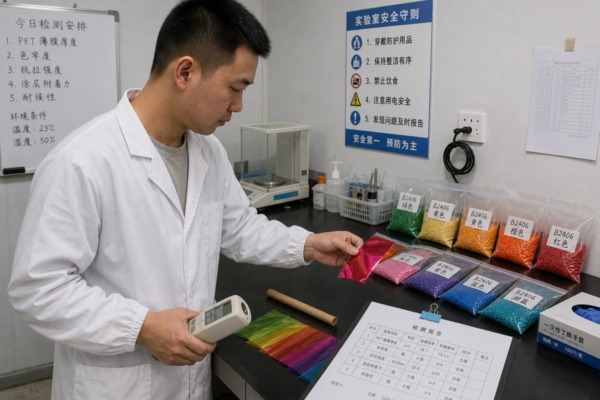
A test report is only as good as your verification of it. The U.S. market leans heavily on independent certification to protect label integrity; EPA's ENERGY STAR program requires third-party certification for covered products for exactly this reason. Apply the same logic to your pinwheel orders. A supplier's in-house test sheet is not acceptable evidence for a children's product. Third-party acceptance is the standard that matters.
Build a Minimum Viable Evidence pack
Before finalizing any purchase order, require what compliance teams call a Minimum Viable Evidence pack: current lab test reports, the applicable certificate, the supplier's legal entity details, and written confirmation that materials and processes have not changed since the last test. Here is how I teach buyers to inspect each report:
| Checkpoint | What to verify | Red flag |
|---|---|---|
| Laboratory identity | Lab is on the CPSC-accepted accredited list | Unknown lab, no accreditation number |
| Sample description | Matches your exact SKU, colors, and materials | Generic description or different product |
| Report date | Recent, and after the last material change | Report older than the current material spec |
| Tested parameters | Covers phthalate and lead limits, heavy metals, ASTM F963 clauses | Missing parameters or partial testing |
| Results versus limits | Actual values sit below regulatory thresholds | "Pass" stamps without numeric values |
| Applicant name | Matches your supplier's legal entity | Third-party trading company with no link |
One more procedural point worth knowing: EPA's small business compliance resources 3 note that certain violations can be self-disclosed within 21 days of discovery. That means your compliance program needs a remediation and disclosure procedure, not just a filing cabinet. Keep every report, certificate, and declaration in an organized compliance file for customs, retailers, and regulators. When we prepare pre-shipment documentation packages for U.S. distributors, we assemble this file before the container is booked, because fixing paperwork after a customs hold always costs more than building it right the first time.
Conclusion
Verify credentials, confirm materials and processes meet U.S. environmental rules, and re-check after every change. Evidence-based due diligence before importing beats crisis management after a customs hold.
Footnotes
1. Official CPSC directory for verifying accredited laboratories required for mandatory children’s product safety testing. ↩︎
2. EPA overview of the Toxic Substances Control Act and its role in regulating chemical safety in commerce. ↩︎
3. EPA resource for small businesses regarding environmental compliance, self-disclosure policies, and regulatory assistance. ↩︎
More Articles
You might also find these helpful.

How to Remotely Verify a Factory's Production Capabilities for Wrought Iron Plug-In Components?
Learn the exact certifications, lab tests, and audit steps to verify a pinwheel supplier's environmental compliance before shipping…
Read More →
How to Assess a Factory's Production Capacity When Sourcing Wrought Iron Inserts?
Learn the exact certifications, lab tests, and audit steps to verify a pinwheel supplier's environmental compliance before shipping…
Read More →
What Questions Should You Ask Wrought Iron Insert Suppliers to Spot Unreliable Ones Early?
Learn the exact certifications, lab tests, and audit steps to verify a pinwheel supplier's environmental compliance before shipping…
Read More → English
  Spanish
  German
  Arabic