How to Verify a Chinese Wrought Iron Supplier’s License and Export Qualifications?

I export decorative metalwork from our Zhejiang factory, and I’ve watched buyers lose deposits to a Chinese wrought iron supplier whose license and export qualifications existed only in Photoshop.
Verify a Chinese wrought iron supplier by checking its 18-digit Unified Social Credit Code on China’s National Enterprise Credit Information Publicity System, confirming import/export wording in the business scope, requesting the import-export filing receipt and Customs Registration Certificate, and ensuring the license name, contract signer, and bank account match.
That answer sounds simple. In practice, most buyers stop after seeing one license scan. That is exactly where fraud lives. This guide breaks the process into four clear steps. Follow them in order, and you will know whether your supplier holds real export rights and qualifications before a single dollar leaves your account.
What business license documents should I request from a Chinese wrought iron supplier?
A procurement manager in Texas once asked me for our export license. I sent her four documents instead, because one paper never proves a company can legally export.
Request the official business license showing the 18-digit Unified Social Credit Code, the import-export filing receipt, the Customs Registration Certificate, and the company's bank account details. Confirm the license name, the contract signing entity, and the receiving account name are identical before paying anything.

Here is a hard truth I share with every new buyer: every legally registered Chinese company has a business license. That document alone proves the company exists. It does not prove the company can export wrought iron gates 1, fences, or garden décor. Export authority is a separate layer of paperwork.
The four documents that matter
| Document | Chinese Name | What It Proves | Red Flag If Missing |
|---|---|---|---|
| Business license | 营业执照 | Legal identity, 18-digit Unified Social Credit Code, business scope | Company may not exist at all |
| Import-export filing receipt | 进出口备案回执 | Foreign trade rights registered with authorities | Supplier cannot export directly |
| Customs Registration 2 Certificate | 海关注册登记证 | Authorization to clear goods through China Customs | No legal customs declaration ability |
| Company bank account details | 对公账户 | Payment goes to the same legal entity | Money may go to an unrelated party |
Check the Chinese legal name, not the English one
English trade names carry no legal weight in China. A supplier called "Golden Iron Art Co." might be registered under a completely different Chinese entity. Always get the exact Chinese legal name 3 and the 18-digit code. That is the only searchable legal identity, and it is the foundation of every Business License Authenticity check that follows.
The three-name match rule
This is the rule I trust most from years of export work. The business license name, the contracting entity on your purchase agreement, and the receiving bank account name must all be identical. If the payment account belongs to an individual or a different company, your risk rises sharply. A legitimate wrought iron exporter with ornamental ironwork manufacturing in its business scope has no reason to route payments elsewhere.
Also read the business scope line by line. It should explicitly include import/export or foreign trade wording 4, plus manufacturing or sale of metal products. Missing language there is a genuine warning sign.
How can I verify a supplier's export qualifications through official Chinese government databases?
Years of answering buyer audits taught me one thing: screenshots convince nobody. Official database records convince everyone, and checking them costs you nothing but twenty minutes.
Search the supplier's Chinese legal name or Unified Social Credit Code on the National Enterprise Credit Information Publicity System (gsxt.gov.cn), confirm active status and business scope, then verify MOFCOM foreign trade registration and the 10-digit customs registration code through China Customs records.
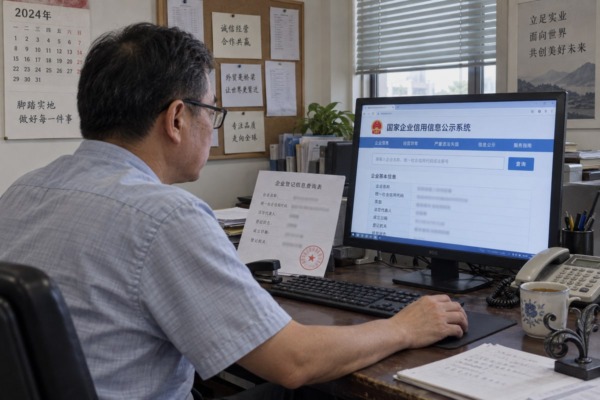
The National Enterprise Credit Information Publicity System, often called GSXT or NECIPS, is the official registry run by China's market regulator. It is free and public. This is exactly where I tell my own buyers to verify us, because the record there cannot be faked by a supplier. Here is the process I recommend, step by step.
- Enter the Chinese legal name or the 18-digit Unified Social Credit Code into the GSXT search bar.
- Compare the registry record against the license scan: company name, legal representative, registered address, registered capital, business scope, and operating status must all match.
- Confirm the company is not on the Abnormal Operations list. A listing there usually means missed filings, unreachable addresses, or worse.
- Verify the MOFCOM Registration for foreign trade. This filing is what legally grants export rights and qualifications, and the supplier should provide the filing receipt on request.
- Ask for the 10-digit customs registration code and check that it belongs to the same legal entity that will sign your contract.
Databases worth bookmarking
| Platform | What You Verify | Why It Matters |
|---|---|---|
| GSXT (gsxt.gov.cn) | Legal identity, status, business scope | Confirms Business License Authenticity against the official record |
| Provincial credit platforms | Corporate Social Credit Rating (A through D) | Aggregates tax, environmental, and labor compliance |
| Third-party customs data services | Actual shipment history and destinations | Confirms real export volume matches claimed capacity |
| National pollutant permit platform | Pollutant Discharge Permit status | Flags foundries at risk of sudden environmental shutdown |
One nuance matters here. Some genuine factories export through a licensed agent instead of holding direct rights. That is legal and common. The absence of a customs registration does not automatically mean fraud; it means you must identify who actually files the declaration and appears on shipping documents. Expect basic registry checks to take a few business days if you want everything documented in writing.
What certifications should I check to confirm a supplier meets international export standards?
Every year we weigh certification costs against market access at our Zhejiang plant. Skipping a certificate saves money short-term but can lock our metal décor out of Europe.
Check ISO 9001 quality management certification, Mill Test Certificates for the steel used, product safety marks required by your market such as CE or REACH compliance for Europe, the Pollutant Discharge Permit, and CBAM carbon-tracking readiness for EU-bound iron goods.

Certifications answer a different question than licenses do. Licenses tell you the supplier may export. Certifications tell you the product should survive scrutiny once it lands. For iron and steel goods, that scrutiny is getting tougher every year, and trade compliance now reaches beyond quality into environment and carbon.
The certification checklist for iron products
| Certification or Document | What It Covers | How to Verify |
|---|---|---|
| ISO 9001 | Quality Management System across production | Check the certificate number with the issuing body |
| Mill Test Certificate (MTC) | Heat numbers and chemical composition of the steel | Contact the producing mill's quality department directly |
| Pollutant Discharge Permit (排污许可证) | Environmental compliance of the foundry or coating line | National pollutant permit management platform |
| MOFCOM Export License (出口许可证) | Mandatory for specific iron and steel categories under 2026 trade regulations | Request the license and confirm the product category |
| CBAM carbon documentation | Embedded carbon emissions tracking for EU imports | Ask for the supplier's emission tracking protocols |
Where buyers get burned
Mill Test Certificates are the most frequently forged document in the steel trade. Middlemen copy real MTCs and attach them to unrelated batches. The fix is direct: call or email the producing mill's quality department and verify the heat numbers yourself. In our own coating workshop, the powder and substrate specs on paper must match what we can demonstrate on the line, and a serious wrought iron supplier should welcome the same scrutiny.
Two newer issues deserve attention. First, most decorative wrought iron items are ordinary steel exports, but some steel-related categories now require a product-specific export license from MOFCOM, so confirm which side of that line your goods fall on. Second, if you sell into the EU, the Carbon Border Adjustment Mechanism 5 makes carbon data a purchasing requirement, not a nice-to-have. Also ask about anti-dumping exposure in your jurisdiction: named, white-listed manufacturers often carry lower individual duty rates than generic trading companies, which directly affects your landed cost.
Should I hire a third-party inspection company to validate a supplier's licenses before placing an order?
Third-party auditors have walked our production floor many times. The good ones spot in an hour what a buyer overseas could never see through a video call.
Yes. For first orders beyond a small sample, hire a third-party inspection company to verify licenses, conduct a factory audit, and confirm the supplier actually manufactures wrought iron products. Basic verification takes only days and costs little compared with a lost deposit.
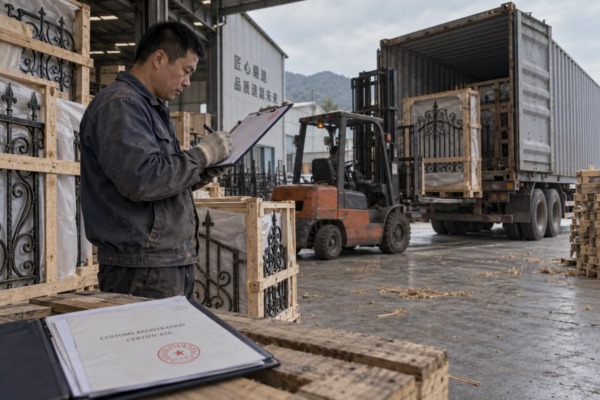
Document checks catch fake companies. They do not catch a real trading company posing as a factory. That distinction matters enormously for wrought iron, because pricing, production control, and quality assurance all depend on who actually bends and welds the metal. This is where third-party due diligence earns its fee.
Factory, trader, or agent: know who you are dealing with
| Entity Type | What They Actually Do | Impact on Your Order |
|---|---|---|
| Manufacturer | Owns the forge, welding, and coating lines | Best pricing and direct quality control |
| Trading company | Buys from factories, resells with markup | Legitimate, but less production visibility |
| Export agent | Handles customs declarations for others | Legal channel when a factory lacks direct export rights |
A good Factory Audit Report covers the registered address versus the real production site, machinery, workforce, output capacity, and whether the plant genuinely produces gates, railings, or decorative ironwork rather than subcontracting everything. Ask the auditor to photograph the business license displayed on-site and match it against your GSXT findings. Basic license verification typically takes several business days; a full audit with certification checks takes longer, so build that into your sourcing timeline.
Before you commission anything, run this red-flag list yourself. Any two of these together should stop the order:
- English name only, with no Chinese legal name provided
- Cropped, blurry, or watermark-stripped license scans
- Address mismatch between the license and the claimed factory
- No import/export wording in the business scope
- No customs filing proof and no named export agent
- Pushback on live video walkthroughs or document requests
- Bank account name that differs from the license name
- Marketplace badges offered as the sole proof of legitimacy
One fairness note from my side of the table: a small workshop that exports through a licensed agent is not automatically unreliable. Many excellent craft producers work that way. What matters is that the export pathway is transparent and every name on the paperwork checks out.
Conclusion
Verify the Chinese legal identity, business scope, customs capability, and real factory before discussing price or deposits. Match license, contract, and bank account names, then order with confidence.
Interested in sourcing the products mentioned in this article? See details and request a quote here:
Footnotes
1. Authoritative overview of wrought iron material properties and traditional applications. ↩︎
2. The World Customs Organization sets international standards for customs registration and identification. ↩︎
3. US government guide on identifying and verifying Chinese business entities. ↩︎
4. The WTO provides the framework for international trade regulations and terminology. ↩︎
5. Official EU portal detailing carbon-tracking requirements for iron and steel imports. ↩︎
More Articles
You might also find these helpful.
How to Remotely Verify a Factory's Production Capabilities for Wrought Iron Plug-In Components?
Verify a Chinese wrought iron supplier's license and export qualifications with a 4-step check: credit code, business scope,…
Read More →
How to Assess a Factory's Production Capacity When Sourcing Wrought Iron Inserts?
Verify a Chinese wrought iron supplier's license and export qualifications with a 4-step check: credit code, business scope,…
Read More →
What Questions Should You Ask Wrought Iron Insert Suppliers to Spot Unreliable Ones Early?
Verify a Chinese wrought iron supplier's license and export qualifications with a 4-step check: credit code, business scope,…
Read More → English
  Spanish
  German
  Arabic