How to Tell if a Wrought Iron Accessories Supplier Is a Factory or Trading Company?
Buyers keep telling me they paid factory prices to a wrought iron accessories supplier 1—then learned their factory was a reseller. From our Zhejiang production floor, we see the fallout.
To tell if a wrought iron accessories supplier is a factory or trading company, check the business license for manufacturing scope, verify the address is in an industrial zone, request live workshop video, ask specific process questions, and review production schedules. Trading companies fail multiple checks at once.
No single test settles it. Real verification means stacking several checks together. Below, I walk you through the exact questions, documents, red flags, and video-call steps we recommend to every buyer who wants proof, not promises.
What questions should I ask to check if my wrought iron accessories supplier is a factory or trading company?
A US buyer once forwarded me a rival quote for garden stakes. I asked one question: had the seller explained their tube-cutting process? Silence. That silence said everything.
Ask questions only a maker can answer: which machines cut and bend the tube, what powder coating process and cure temperature they use, daily workshop capacity, current production schedule, and raw material grade. Factories answer with specifics; trading companies give vague, delayed, or generic replies.
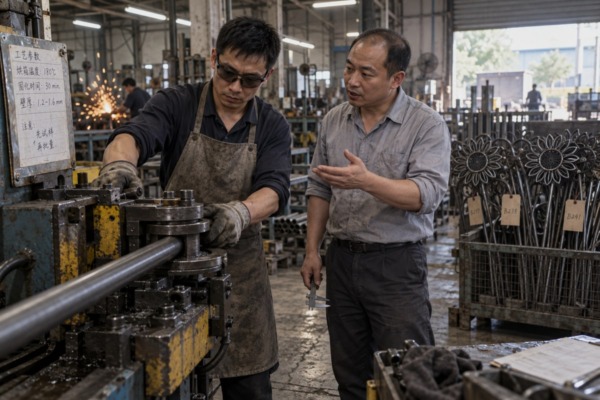
A direct manufacturer lives inside its own processes. When someone asks me how we cut steel tube for our metal flower stakes, I can answer in one message. I can name the machine, the cut tolerance, and the daily output. A middleman has to forward your question to an upstream plant and wait. That delay is your first data point.
Process Questions That Expose a Middleman
Use questions tied to the actual work behind ornamental iron 2 components. Here is the comparison table I share with buyers:
| Question to ask | Typical factory answer | Typical trading company answer |
|---|---|---|
| Which machine cuts and bends your steel tube? | Names the equipment, states tolerance and shift output | "Advanced equipment," no model, no numbers |
| Describe your powder coating steps | Pre-treatment, spray booth, cure oven temperature and time | "We do powder coating," then sends a finished-product photo |
| What is your daily workshop capacity for this item? | A concrete number tied to lines and shifts | "It depends," reply arrives a day later |
| Can I see this week's production schedule sheet? | Photographs the workshop scheduling board on request | Stalls, or sends a generic spreadsheet |
| Can your engineer mark up my CAD drawing? | Structural feedback within a day or two | A vague "yes, we can customize" |
The Production Schedule Test
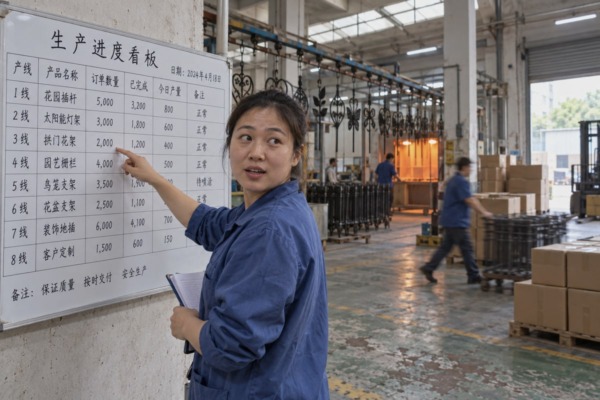
My favorite check is the last row. Ask for the workshop production schedule sheet. Every real factory runs one, because lines must be booked. A trader cannot produce it, because the schedule belongs to someone else. The CAD test works the same way: real custom fabrication capabilities mean an engineer can push back on your drawing, suggest a wall thickness, or explain why a change forces new tooling and a higher minimum order quantity. Vague agreement to everything is not flexibility. It is distance from the workshop.
How can I verify a supplier's business license and factory certificates before I place an order?
We audit our own steel and powder suppliers every year, and one lesson stuck: paperwork lies less than people, but only when you read the registered business scope carefully.
Verify the Chinese business license for terms like production, processing, or manufacturing in its registered scope; trading-only scopes list wholesale or import/export. Then request a factory audit report, ISO 9001 certification, environmental permits, and cross-check the registered production address on maps before paying any deposit.

Business license verification is the strongest single document check, and in China it is easy because company registration records are publicly searchable. Here is the order I recommend working through:
- Read the registered business scope. Look for manufacturing terms such as production or processing. If the scope only lists wholesale, retail, or import/export trading, you are almost certainly looking at a trading company.
- Cross-check both addresses on a map. A real factory sits in an industrial park or manufacturing zone. A downtown office tower registration is a trading signal. Ask for the exact production site, not just the legal office address.
- Request certificates that offices cannot hold. An environmental discharge permit is required for a coating line, so a pure office cannot obtain one. ISO 9001 certification and a third-party factory audit report add further weight.
- Ask for the Mill Test Report. A direct maker holds MTRs from its steel supplier proving the iron's grade and carbon content. Traders rarely have them on file.
- Check export paperwork alignment. Ask whether the company is the export license holder itself and whether it can issue the relevant VAT invoice for the goods. Treat this as a supporting clue, not standalone proof, since some genuine factories legally export through agents.
| Document | What to look for | What it actually proves |
|---|---|---|
| Business license | Production, processing, or manufacturing in scope | Legal permission to manufacture |
| Environmental discharge permit | Matches the coating or welding site address | A physical production facility exists |
| Factory audit report | Third-party name, date, photos, findings | Audit readiness and process records |
| ISO 9001 certification | Certified site address matches the workshop | A documented quality system, not factory status alone |
| Mill Test Report | Steel grade and carbon content per batch | Direct raw material purchasing |
One caution from our side of the table: a certificate PDF is easy to borrow. Audit readiness—inspection records, process documents, and a willingness to be examined—matters more than any single stamped page.
What red flags should I watch for that suggest my supplier is just a middleman?
I flag one trade-off to every buyer who visits our Zhejiang workshop: a polished catalog saves time today, but polish hides a middleman until the first delayed shipment.
Red flags include a catalog spanning unrelated categories, an office-tower address, refusal of live workshop video, vague answers to process questions, finished-product photos only, inconsistent sample quality, generic excuses for delays, and lead times that shift because an upstream factory controls production.
Trading companies have become skilled at looking like factories. They use curated videos, branded decks, and selective partner claims. So judge evidence, not presentation quality. Here is how I rank the warning signs:
| Red flag | What it suggests | Severity |
|---|---|---|
| Sells iron decor plus electronics, toys, and textiles | Sourcing from many unrelated plants | High |
| Registered in an office tower or residential block | No owned production site | High |
| Avoids live workshop video or a visit | Nothing of their own to show | High |
| Only finished-product photos, never process shots | No access to the production floor | Medium-high |
| Vague or delayed answers on tube cutting or coating | Questions being relayed upstream | Medium-high |
| Quotes shift and production lead time keeps sliding | Delivery is hostage to another factory's queue | Medium |
| Delay excuses are always "logistics issues" | Cannot name the real bottleneck | Medium |
| Samples show different welds and finishes | Multiple sub-contractors, mixed quality control standards | Medium |
The lead time flag deserves emphasis. In my experience, a trader's schedule is controlled by its upstream factory, which will always prioritize its own direct orders. When peak season hits, your order slips first. A factory explains delays with specific technical reasons—an oven maintenance window, a coating batch redo. A trader offers generic excuses.
But Is a Trading Company Always Bad?
Buyers push back on me here, and fairly. A good trader can offer consolidation, smoother English communication, multiple factory options, and a flexible minimum order quantity. That value is real for small, mixed orders. But the wholesale pricing structure 4 carries their margin, and for custom wrought iron accessories with strict QC needs, you want the party who controls welding, coating, and packing. The question is not good versus bad. It is whether the supplier controls production of your exact item.
Should I request a factory visit or video call to confirm my supplier's manufacturing capabilities?
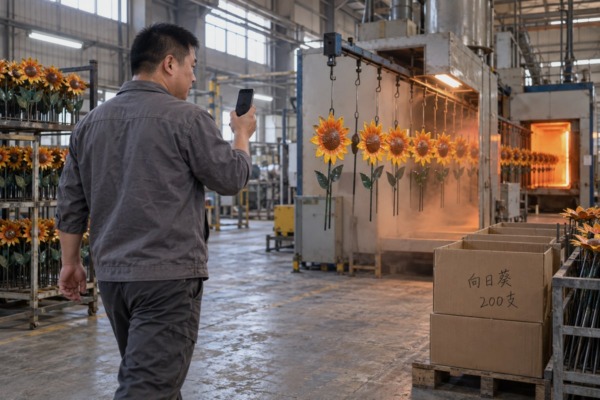
Last week our team walked a WhatsApp video call past the bending machines, the powder coating line, and racks of stock blanks. The buyer confirmed her order within an hour.
Yes. Request a live video call or on-site inspection before ordering. Ask to see the main gate, company signage, bending machines, powder coating line, stock blanks, and the workshop production schedule. Live, unedited footage of your exact product being made is the strongest single proof.
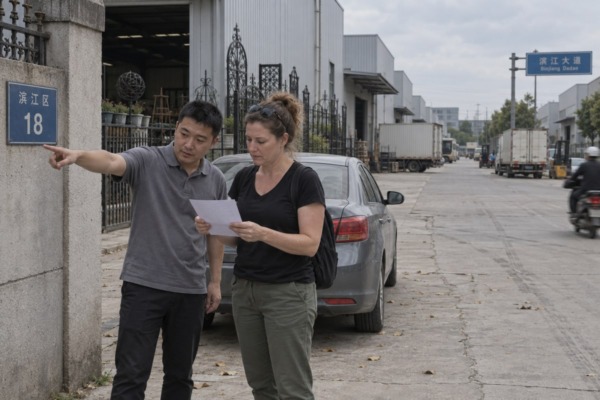
International buyers now rely on remote verification calls and third-party audits far more than catalogs, because they want lower-risk ordering before wiring deposits. We welcome this. A live walkthrough costs a factory nothing and costs a pretender everything.
How to Run the Video Call
Follow this sequence and do not let the supplier reorder it:
- Start at the main gate. The company signage should match the name on the business license you already checked.
- Walk the full line. Ask to see tube cutting, the bending machines, welding stations, the powder coating booth, and the cure oven—in one continuous shot, not edited clips.
- Inspect stock blanks and raw material. Racks of uncoated iron blanks and steel tube prove ongoing production, not staged displays.
- Find your product. Ask to see the exact item you plan to order, mid-process if possible—half-welded frames or freshly coated petals.
- End at the scheduling board. Ask them to show today's production schedule sheet on camera, and have a worker hold up the day's date for time-specific proof.
Trading companies sometimes borrow a partner factory's footage or arrange a guided tour of someone else's plant. Continuous live video, matching signage, and date-specific proof defeat that trick. If budget allows, a third-party on-site inspection adds an independent record of machines, headcount, and quality control standards.
The Hybrid Supplier Question
Some suppliers are hybrids: a small owned workshop plus overflow orders sourced elsewhere. That is not automatically a problem. But you must confirm the line you saw will make your item. Ask directly: will this order run in this workshop, and can I verify during production?
Conclusion
No single clue proves everything. Triangulate: license, address, process questions, live video, and schedules. Do this before the deposit, and your wrought iron accessories supplier will earn the word factory.
Interested in sourcing the products mentioned in this article? See details and request a quote here:
Footnotes
1. Technical background on the material properties and historical manufacturing of wrought iron products. ↩︎
2. Leading industry body providing technical data and standards for global steel production and manufacturing. ↩︎
3. Authoritative trade organization providing resources on international procurement and supply chain management. ↩︎
4. Global trade organization providing context for international commerce, pricing, and trade regulations. ↩︎
More Articles
You might also find these helpful.
How to Remotely Verify a Factory's Production Capabilities for Wrought Iron Plug-In Components?
Learn to verify a wrought iron accessories supplier as factory or trader using license checks, process questions, and…
Read More →
How to Assess a Factory's Production Capacity When Sourcing Wrought Iron Inserts?
Learn to verify a wrought iron accessories supplier as factory or trader using license checks, process questions, and…
Read More →
What Questions Should You Ask Wrought Iron Insert Suppliers to Spot Unreliable Ones Early?
Learn to verify a wrought iron accessories supplier as factory or trader using license checks, process questions, and…
Read More → English
  Spanish
  German
  Arabic