
How Do I Verify Pinwheel Packaging Meets U.S. Recyclability Standards?
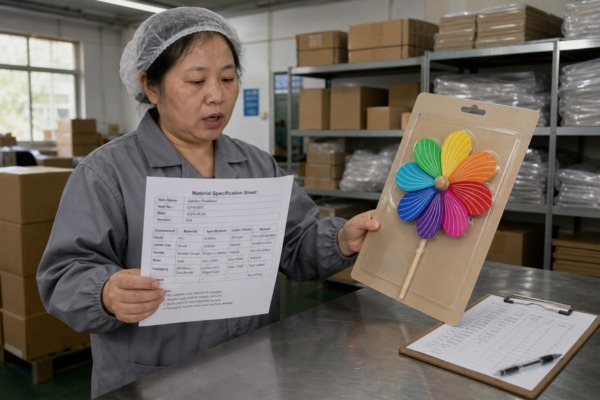
A U.S. buyer once returned an entire pinwheel shipment over one wrong recycling symbol. Verifying pinwheel packaging against U.S. recyclability standards now sits at the top of our export checklist.
To verify pinwheel packaging meets U.S. recyclability standards, confirm the material is designed for recycling, accepted by programs serving at least 60% of consumers, sortable at material recovery facilities, and supported by end markets—then document compliance with FTC Green Guides and state laws like California SB 343.
That answer sounds simple. In practice, it means collecting the right paperwork, running the right inspections, and knowing which state laws apply. This guide walks through each step in order.
What Certifications Should I Request from My Pinwheel Supplier for Recyclable Packaging?
A procurement manager in Ohio once messaged me on WhatsApp with one blunt question: can you prove this blister card is recyclable? Paperwork, not promises, closed that deal.
Request a How2Recycle label assessment, APR Design Guide recognition letters for plastic parts, FSC certification for paperboard, post-consumer recycled content certificates, and full material declarations covering inks, adhesives, and coatings. Third-party certification documents give you defensible proof for U.S. recyclability claims.

There is no single certificate called "U.S. recyclable." Instead, you build a file of documents that together substantiate a claim. When we prepare export documentation for American distributors, we organize it around four questions: what is the package made of, is it designed for recycling, will recycling systems accept it, and can anyone prove the recycled material has a buyer.
The Core Documents to Request
| Document | What It Proves | Who Provides or Issues It |
|---|---|---|
| Packaging bill of materials | Every component: card, film, adhesive, ink, insert | Your supplier |
| How2Recycle label assessment | Whether the format is Widely Recyclable, Check Locally, or Not Yet Recyclable | Sustainable Packaging Coalition |
| APR Design Guide alignment letter | Plastic parts are compatible with North American recycling infrastructure | Association of Plastic Recyclers framework, via supplier or lab |
| FSC certified paperboard chain-of-custody | Fiber sourcing and paper quality for header cards and cartons | FSC-accredited certifier |
| Post-consumer recycled content certificate | Claimed PCR percentages are verified, not estimated | Accredited third-party auditor |
Why Third-Party Certification Beats Supplier Promises
A supplier saying "this is PET, so it recycles" is not evidence. The How2Recycle label, administered by the Sustainable Packaging Coalition, is valuable precisely because it is data-backed and tiered. The APR Design Guide goes further: it requires that a package satisfy design, access, acceptance, and end-market criteria before it counts as recyclable. Ask your supplier which criteria each component clears, and get the answer in writing. Our own approach is to attach the full component declaration to every OEM quotation, because buyers who resell across state lines need that file long after the goods arrive.
How Can I Check If My Pinwheel Packaging Materials Meet FTC Green Guides Requirements?
Early in our U.S. exports, we learned a hard lesson: a resin code on the back of a header card is not evidence under American advertising law.
Check your pinwheel packaging against the FTC Green Guides by confirming that recycling programs serving at least 60% of U.S. consumers accept the specific material and format. If access falls below that threshold, use a qualified claim such as Check Locally instead of an unqualified recyclable label.
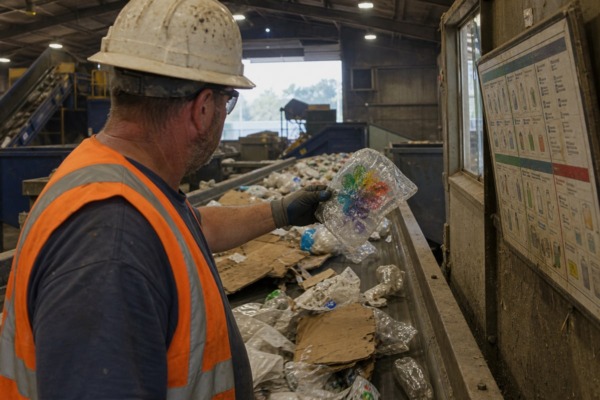
The FTC Green Guides 1 are the baseline for every recyclability claim printed on packaging sold in the United States. Their logic is strict: a package must actually be collected, sorted, and used to make another item. Technical recyclability is not enough. The scale of the issue explains the strictness—the EPA estimated 14.5 million tons of plastic containers and packaging were generated in 2018, and only a fraction moved through real recovery systems.
The Substantial Majority Rule in Practice
| Claim Type | Access Requirement | Example Wording |
|---|---|---|
| Unqualified claim | Programs serving at least 60% of U.S. consumers accept the format | "Recyclable" |
| Qualified claim | Access exists but falls below the substantial majority threshold | "Recyclable in limited areas—check locally" |
| Store drop-off claim | Only retail take-back accepts the material, such as flexible film | "Recycle at store drop-off" |
Here is the objection I hear most from design teams: "the tray is PET, so it is recyclable by definition." The FTC disagrees. A thermoformed blister can be made of a recyclable resin yet still fail the claim because most curbside programs 2 reject that format. Design-for-recycling and actual recyclability are two different tests, and the Green Guides only care about the second one.
One more trap: do not confuse recyclable with compostable. Materials meeting ASTM D6400 or D6868 compostability standards 3 do not satisfy recyclability requirements. Worse, they can contaminate the recycling stream if labeled carelessly. Keep the two claims fully separate on your artwork.
What Should I Look for During QC Inspections to Confirm Packaging Recyclability?
On our Zhejiang packing line, inspectors pull cartons at random every shift. Recyclability checks now sit beside blade-spin tests and dowel-strength checks on the same QC sheet.
During QC inspections, verify mono-material construction, confirm the packaging matches the approved bill of materials, check that labels, inks, and adhesives are recycling-compatible, test dark pigments against NIR sorting, and confirm printed recycling symbols match the documentation your supplier provided.
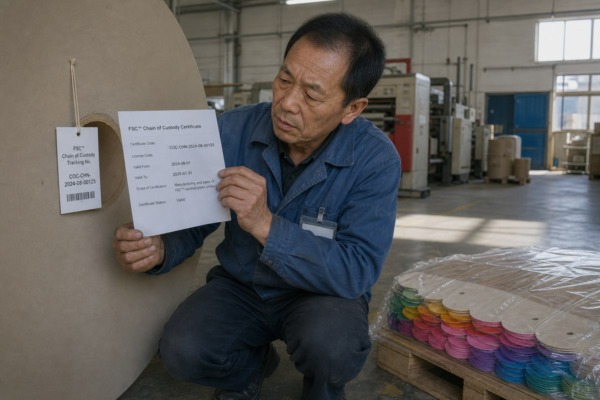
Recyclability fails at the component level, not the package level. A pinwheel with mylar-film blades ships in a paperboard carton 4; the carton may recycle perfectly, but a laminated plastic window glued onto it can sink the whole claim. Our QC process treats every attached element as a potential contaminant. Here is the sequence we run before containers leave the factory.
- Match the physical package to the approved BOM. Substituted films and switched adhesives are the most common silent changes between sample approval and mass production. Any deviation voids your documentation.
- Confirm mono-material design where the spec requires it. A 100% paperboard header card or 100% PE bag is far more likely to pass U.S. standards than a paper-plastic laminate. Check that no metallized layer crept in for shine.
- Inspect labels, inks, and adhesives. Heavy ink coverage, incompatible pressure-sensitive adhesives, and full-body shrink sleeves interfere with reprocessing even when the base material is fine.
- Screen for sortation risk. MRF sortability testing matters because Near-Infrared scanners misread carbon-black pigments and complex folded shapes. Our rainbow-colored petal blades taught us this early—dark packaging trays get sorted as waste.
- Verify printed symbols against substantiation. The chasing arrows, the How2Recycle label tier, and any PCR percentage must match the certificates on file, character for character.
- Check safety-marking overlap. For DIY pinwheel kits containing an assembly pin, confirm the warning panel and any child-resistant packaging compliance features—classified under ASTM D3475 standards where applicable—do not add non-recyclable layers to the pack.
For our craft kits with loose pins, grommets, and dowels, step six regularly catches issues: a safety blister added late in development can quietly turn a recyclable carton into a mixed-material reject.
How Do I Ensure My Supplier's Packaging Complies with U.S. State-Specific Recycling Laws?
Every quotation we prepare involves a trade-off: one national packaging design keeps costs low, but fifty states do not share one recycling rulebook.
Map every state where the pinwheels will sell, then confirm the packaging meets California SB 343 before printing chasing arrows, register formats under Oregon and Colorado EPR programs, and keep written substantiation files so labels survive state-level truth-in-labeling audits.

Federal compliance is the floor, not the ceiling. A package can satisfy the FTC Green Guides and still break California law. Distributors buying from us usually sell nationally, so we design packaging to clear the strictest state first. In practice, that state is California.
The State Rules That Matter Most
| State Framework | Core Requirement | Practical Effect on Pinwheel Packaging |
|---|---|---|
| California SB 343 | Chasing arrows allowed only if the material meets statewide collection and sorting criteria, or a demonstrated recycling-rate benchmark | Remove or qualify the symbol on films, laminates, and small-format blisters |
| Oregon Recycling Modernization Act | EPR fees with eco-modulation that penalize hard-to-recycle designs | Mono-material cartons pay lower fees than mixed-material packs |
| Colorado Producer Responsibility Program | Producer-funded recycling with modulated fee tiers | Financial audits become a de facto recyclability verification step |
How Brands Reconcile the Fragmentation
The tension is real: buyers want one label for the whole country, but state rules keep diverging. Three tools help. First, qualified claims—wording like "check locally"—travel across state lines more safely than unqualified symbols. Second, Digital Product Passports using QR codes let consumers see real-time, location-specific recyclability instead of a fixed printed promise. Third, third-party certification files answer state auditors quickly. Our own rule follows the principle we apply to every U.S. order: confirm the packaging material meets American recyclable-labeling standards, and make sure both the substrate and the label comply with the recycling regulations of each destination market before a single carton is printed.
Conclusion
Recyclability in the U.S. is a systems question. Verify design, access, sorting, and end markets, collect certifications, inspect at the line, and match every label to state law.
Footnotes
1. Official federal guidelines for substantiating environmental marketing claims like recyclability in the U.S. ↩︎
2. Overview of the U.S. national recycling strategy and challenges with curbside collection infrastructure. ↩︎
3. EPA guidance on composting standards and their role in sustainable materials management. ↩︎
4. International standards for responsible forest management and certification of paper-based packaging materials. ↩︎
More Articles
You might also find these helpful.

How to Remotely Verify a Factory's Production Capabilities for Wrought Iron Plug-In Components?
Verify pinwheel packaging meets U.S. recyclability standards with our certification checklist covering How2Recycle, APR guidelines, and state law…
Read More →
How to Assess a Factory's Production Capacity When Sourcing Wrought Iron Inserts?
Verify pinwheel packaging meets U.S. recyclability standards with our certification checklist covering How2Recycle, APR guidelines, and state law…
Read More →
What Questions Should You Ask Wrought Iron Insert Suppliers to Spot Unreliable Ones Early?
Verify pinwheel packaging meets U.S. recyclability standards with our certification checklist covering How2Recycle, APR guidelines, and state law…
Read More → English
  Spanish
  German
  Arabic