
What Is the Complete Logistics Chain for Windmills from China to the US Warehouse?
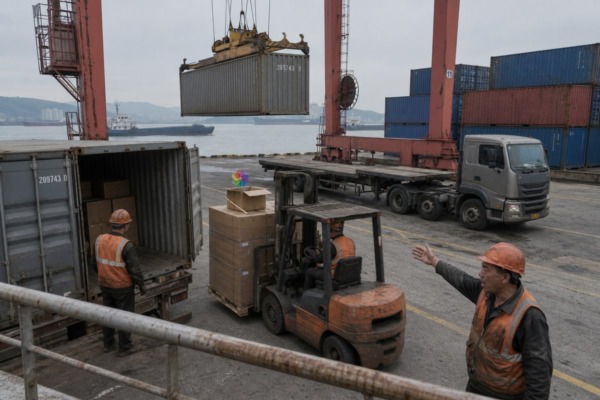
Every spring rush, our Zhejiang pinwheel lines run at full speed—yet buyers still lose sales when the logistics chain for windmills from China to the US warehouse breaks down.
The complete logistics chain for windmills from China to the US warehouse runs: factory production, domestic warehouse consolidation, export customs declaration, ocean or air freight, US customs clearance, and final delivery to the US warehouse. Standard containerized pinwheel orders complete this chain in roughly 30–45 days door to door.
One missed handoff can turn a [spring bestseller](https://zhufengpinwheels.com/?p=1041) into summer clearance stock. The fix is simple in principle: know each stage, know its time node, and know where things go wrong. In this article, I will walk through the full chain the way we map it for our own US distributors—stage by stage, with the timelines, quality checks, packaging methods, and customs steps you should expect.
How long does it take for my pinwheel order to travel from a Chinese factory to my US warehouse?
A procurement manager in Texas messaged me on WhatsApp last March: her seasonal display date was fixed, and she needed exact time nodes for every leg of the journey.
A typical pinwheel order takes 30–45 days door to door by ocean freight: 10–15 days for production, 2–3 days for export customs, 14–18 days sailing to a US West Coast port, and 5–10 days for clearance plus inland trucking. Air freight cuts transit to 5–8 days.
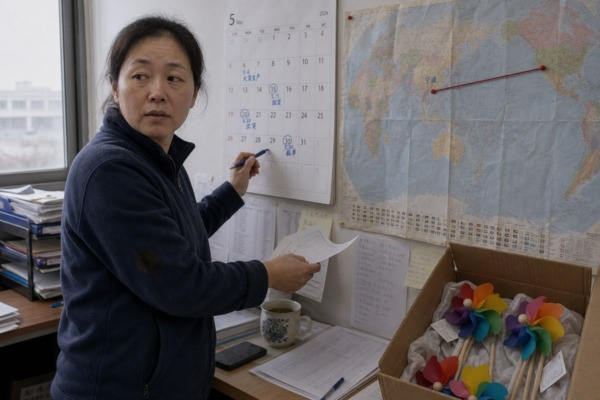
Our export team maps every order against the same six-stage chain: factory production, domestic warehouse, export customs declaration, ocean or air freight, US customs clearance 1, and the US local warehouse. We track a time node for each handoff, because a slip at any single stage pushes every downstream date.
Mapping Every Time Node in the Chain
| Stage | Typical time | What happens |
|---|---|---|
| Factory production | 10–15 days | Petals die-cut, dowels prepared, units assembled or kitted |
| Domestic warehouse consolidation | 1–3 days | Cartons counted, labeled, and staged for booking |
| Export customs declaration | 1–2 days | Export documents filed at the Chinese port |
| Ocean freight (Ningbo to LA/Long Beach) | 14–18 days | Container sails the trans-Pacific route |
| US customs clearance | 1–5 days | Entry review, duty payment, possible exam |
| Inland trucking to warehouse | 2–7 days | Drayage from port, then delivery to your dock |
The table assumes a standard containerized shipment 2 leaving Ningbo, the port closest to our Zhejiang facility. Production can be compressed for rush orders, but sailing time is set by the carrier schedule, so we protect the front of the chain hardest.
Why Pinwheel Windmills Skip the Project Cargo Headaches
Search for windmill shipping and half the results describe wind turbine logistics. That world is different. Turbine blades now stretch 65 to 76 meters, and one recent shipment moved nearly 1,000 tonnes of blades from Tianjin to Burns Harbor. Cargo that size demands breakbulk shipping on heavy lift vessels and full project cargo management from the first route survey.
It also needs inland heavy haulage with escort vehicles and specialized laydown yards near the port. None of that applies to garden pinwheels. Our cartons ride in standard 20-foot or 40-foot containers, so the chain stays predictable. For inland destinations like Chicago or Dallas, we quote multimodal transport solutions—ocean to Los Angeles, then rail or truck inland.
Some buyers push for air freight on every order. I usually advise against it. Air makes sense for launch samples or urgent replenishment; ocean protects your margin on the main volume. Most of our distributors run both in parallel.
What quality control checks happen before my windmills leave China to prevent defects reaching my warehouse?
Years ago, one batch of petal blades came off our die-cutting machine with hairline cracks near the pin hole. Our QC team caught it before a single carton was sealed.
Before windmills leave China, factories run incoming material inspection, in-process checks on blade cutting and hub assembly, spin-function testing, and a final pre-shipment inspection to an AQL sampling standard. Defective units are pulled and reworked, so faulty pinwheels never reach your US warehouse.
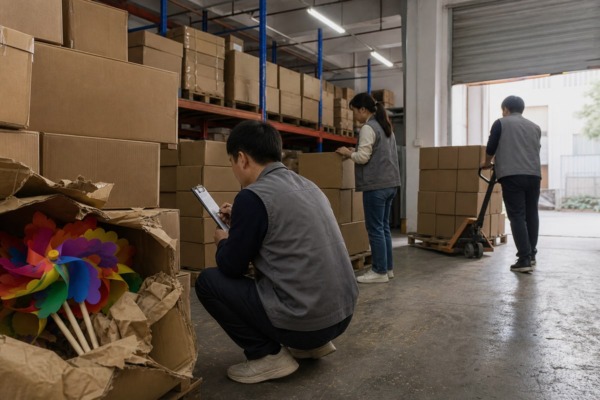
Quality control issues and product returns are the two pain points US distributors mention to me most often. The math behind strict QC is blunt: a defect caught in Zhejiang costs cents to fix, while the same defect caught in your warehouse costs return freight, restocking labor, and lost shelf time.
The Four Checkpoints Before a Carton Is Sealed
| Checkpoint | What gets inspected | Typical rejects |
|---|---|---|
| Incoming materials | Mylar film gauge, petal color consistency, dowel straightness and moisture | Warped dowels, off-shade petals |
| In-process | Die-cut petal edges, drilled pin holes, grommet fit | Rough edges, misaligned holes |
| Assembly and function | Spin test on pin and hub, petal attachment strength | Blades that stick or wobble |
| Pre-shipment | AQL sampling across sealed cartons, labels, counts | Mixed colors, short shipments |
The spin test matters most for this product. A pinwheel that does not turn freely in a light breeze is, to the end customer, simply broken. So we pull samples from every production run, mount them, and spin them before the run continues. Color matters almost as much: our rainbow-gradient petals must match across a batch, because a retail display with one off-shade unit looks like a defect wall.
Building QC Into Supply Chain Risk Assessment
I also encourage buyers to book their own third-party inspection 3 before loading. It is not a sign of distrust; it is basic supply chain risk assessment. One rejected batch caught in China protects the entire downstream timeline. For buyers who cannot fly in, we send inspection photos and short videos over WhatsApp before we authorize loading, so sign-off happens in hours rather than days.
How is my pinwheel shipment packaged to survive international transit without damage?
Damaged packaging taught us our hardest lesson: a distributor once received crushed corner cartons because a freight consolidator stacked heavy machinery on top of our shipment.
Pinwheel shipments survive international transit through layered packaging: individual polybags protect mylar petals, partitioned inner boxes separate assembled units, double-wall master cartons with edge protectors resist stacking pressure, and desiccants control ocean humidity. Cartons are drop-tested and palletized or floor-loaded to prevent shifting.
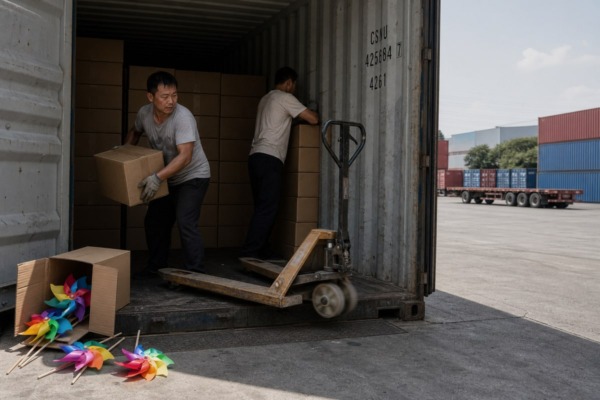
After that crushed-carton incident, we rebuilt our packing spec from scratch. Today, five protective layers stand between our production line and your receiving dock:
- Polybags. Each unit or kit goes into a sealed polybag that keeps dust and moisture off the mylar film petals.
- Partitioned inner boxes. Dividers stop assembled hubs from pressing into neighboring petals during handling.
- Double-wall master cartons. Corner and edge protectors carry the stacking load inside a packed container.
- Heat-treated pallets or planned floor-loading. Export-compliant pallets speed up your unloading; floor-loading fits more cartons when volume matters more than speed.
- Container-level protection. Desiccant strips fight condensation—the container rain that forms on a three-week ocean crossing—and our loading plan keeps light cartons away from heavy freight in shared containers.
We also drop-test every new master carton spec from carry height, on corners and edges, before it enters production.
Assembled Units vs. Flat-Packed Kits
Fully assembled pinwheels display beautifully but expose the hub and petals to crushing. Flat-packed DIY kits—die-cut petals, dowel sticks, pins, and grommets packed separately—cut damage claims sharply and fit more units per carton, which lowers freight cost per piece. Many of our US distributors now split orders: assembled units for retail display, kits for volume.
For perspective, giant turbine blades cross the Pacific as out of gauge cargo, sometimes with embedded fiber-optic sensors monitoring micro-fractures from ocean vibration. A pinwheel carton needs no sensors—just disciplined layering and a loading plan someone actually checks.
What customs clearance and import steps should I expect once my windmills arrive at my US warehouse?
Every quote we prepare forces a choice: file paperwork perfectly and sail through clearance, or rush documents and gamble on inspection holds that cost far more than the freight savings.
Expect five steps: ISF filing before the vessel departs China, entry submission with commercial invoice, packing list, and bill of lading, HS classification under toy codes with applicable Section 301 tariffs, possible CBP examination, then duty payment and release for trucking to your warehouse.
Customs clearance and tariffs decide whether your delivery date holds, so this is the stage where preparation pays off most. In the full logistics chain for windmills from China to the US warehouse, clearance is where paperwork—not distance—controls the clock.
Toys, Not Turbines: Get the HS Code Right
Search results about windmill imports often cite HS 8502.31. That code covers wind-powered generating sets—industrial turbines. Decorative pinwheels clear under toy and festive-article headings within chapter 95 instead. The distinction matters. Misclassification can trigger the wrong duty rate, the wrong Section 301 tariff line, or scrutiny meant for industrial steel components. Most Chinese-origin consumer goods carry Section 301 tariffs 4 on top of the base duty, so have your broker confirm the current rate for your exact code before you price your season. If your pinwheels are marketed to children, expect your buyer's compliance team to ask for children's product safety documentation as well.
The Documents CBP Will Check
| Document | Who prepares it | What must match |
|---|---|---|
| Commercial invoice | Supplier | Value, quantity, and product description |
| Packing list | Supplier | Carton counts and weights against the invoice |
| Bill of lading | Carrier/forwarder | Consignee details and container numbers |
| Certificate of origin | Supplier | Chinese origin declaration for tariff treatment |
| ISF (10+2) filing | Importer/broker | Filed at least 24 hours before loading in China |
| Customs bond | Importer | Active continuous or single-entry bond |
Where Delays Actually Happen
In our experience shipping to the US for years, the ocean leg almost never causes clearance trouble. Paperwork mismatches do. If the invoice quantity disagrees with the packing list, or the description is vague, CBP can flag the entry for exam. Meanwhile, port of discharge operations keep running, and every extra day at the terminal risks demurrage charges. Once released, your container moves by drayage truck to the warehouse. Unload promptly, count cartons against the packing list, and photograph any damage the same day so claims stay valid.
Conclusion
The logistics chain for windmills from China to the US warehouse is predictable when every handoff is planned. Map your time nodes early, and your pinwheels arrive on schedule.
Footnotes
1. Official US Customs and Border Protection portal for trade regulations and import clearance procedures. ↩︎
2. The World Shipping Council provides authoritative information on global container shipping standards and logistics. ↩︎
3. Wikipedia entry explaining the role of independent inspections in verifying product quality before international shipment. ↩︎
4. Official USTR page detailing Section 301 trade actions and tariff schedules for Chinese imports. ↩︎
More Articles
You might also find these helpful.
How to Remotely Verify a Factory's Production Capabilities for Wrought Iron Plug-In Components?
Discover the complete logistics chain for windmills from China to the US warehouse, covering production, shipping, and customs…
Read More →
How to Assess a Factory's Production Capacity When Sourcing Wrought Iron Inserts?
Discover the complete logistics chain for windmills from China to the US warehouse, covering production, shipping, and customs…
Read More →
What Questions Should You Ask Wrought Iron Insert Suppliers to Spot Unreliable Ones Early?
Discover the complete logistics chain for windmills from China to the US warehouse, covering production, shipping, and customs…
Read More → English
  Spanish
  German
  Arabic