How to Evaluate If a Wind Turbine Supplier Supports Product Improvement?
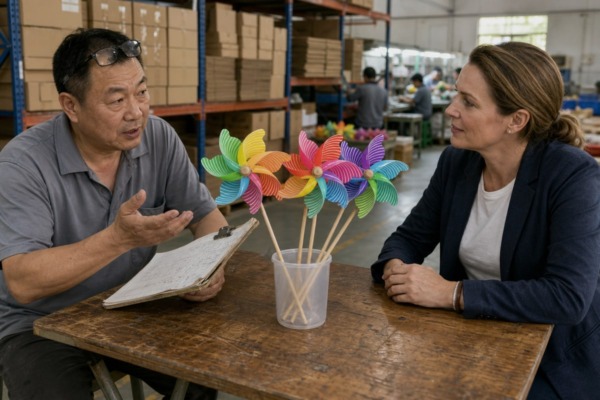
Choosing a wind turbine supplier who truly supports product improvement is hard. I learned this running our Zhejiang pinwheel line, where buyers kept asking one question: can you improve this?
Evaluate a wind turbine supplier’s product improvement support by verifying documented OEM/ODM processes, willingness to adjust designs from your feedback, structured quality methods like PDCA and root cause analysis, transparent KPIs, and fast, costed responses to change requests, including clear sampling fees and timelines.
That answer sounds simple. In practice, most buyers only discover the truth after the first defective shipment arrives. So I break the evaluation into four practical questions below. You can use them before signing any order, whether you source utility-scale machines or decorative wind turbines like our garden pinwheels.
What Should I Ask to Confirm My Supplier Offers Real OEM/ODM Support?
Last spring, a US procurement manager messaged me on WhatsApp: does your factory do real ODM, or just relabeling? Her skepticism came from three suppliers who had over-promised.
Ask for recent OEM/ODM case studies, a feasibility review process for your design, in-house tooling or mold capability, sample lead times with quoted prototyping costs, and named engineering contacts. Real OEM/ODM support shows up as documents and samples, not just a fast yes.
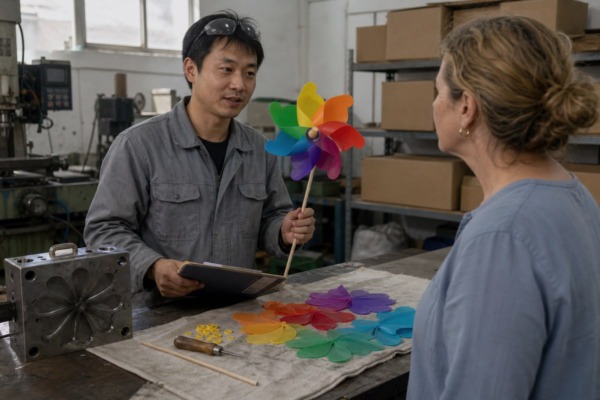
Real OEM/ODM support means the supplier can carry your idea through design, tooling, sampling, and mass production. Fake support means they buy generic parts and stick your logo on the package. The difference shows up fastest when you talk about modification feasibility. In our Zhejiang facility, every custom pinwheel project starts with a feasibility discussion. Can the petal shape be die-cut cleanly? Will the mylar film hold the rainbow gradient print? What will the revised die and the first samples cost? We put those answers in writing before we cut anything. A supplier who cannot discuss design changes, process adjustments, and sampling costs in the first conversation probably does not control its own production.
Questions That Expose Real Capability
| Question to ask | Weak answer | Strong answer |
|---|---|---|
| Can I see a recent ODM case? | "We customize everything" | Drawings, photos, and a revision history for a real project |
| Who owns the tooling? | Vague, or fully outsourced | In-house dies and molds with stated modification lead times |
| What does a redesign sample cost? | "Free, no problem" | An itemized quote covering tooling change, material, and labor |
| How do you manage risk early? | Silence | A structured pre-production review, similar to APQP4Wind-style early risk identification used in the wind industry |
| What is on your R&D investment roadmap? | Nothing documented | Planned materials, new designs, and product lifecycle management milestones |
Why Honest Sampling Costs Matter
This is the point I stress most with new buyers. A supplier who quotes an honest prototyping cost has actually calculated the work. A supplier who promises free samples for a complex redesign will usually recover that cost somewhere else, often in your unit price or in skipped quality steps. When we quote a petal reshaping job, we separate die modification, film waste, and assembly trial time. That transparency is itself evidence of real OEM/ODM depth.
How Can I Tell If My Supplier Is Willing to Adjust Designs Based on My Feedback?
Our team once reworked a pinwheel petal mold after a distributor reported blades loosening in coastal wind. That single redesign taught us how feedback should flow into engineering.
A supplier willing to adjust designs will discuss modification feasibility openly, quote sampling costs for revised versions, show past examples where customer feedback changed a design or process, and maintain field performance feedback loops that turn complaints and warranty data into engineering updates.
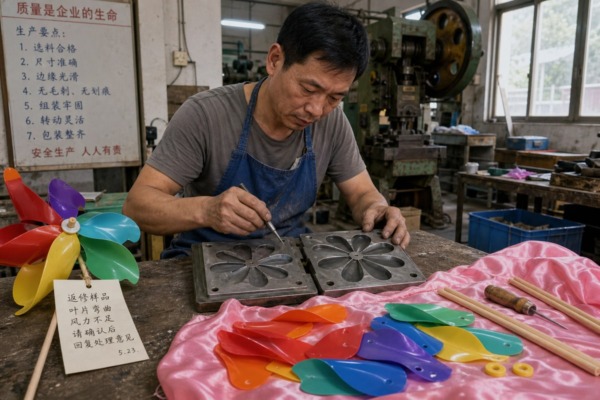
Willingness is not a personality trait. It is a process you can test before you commit. Here is the five-step test I recommend to every procurement manager who visits our workshop.
- Send a small, specific change request. Ask for a different petal curve, a longer dowel, or a new color gradient. Keep it minor on purpose.
- Watch how they answer. A serious wind turbine supplier discusses feasibility, trade-offs, and cost. A weak one just says yes to everything, which usually means nothing will actually change.
- Ask for a documented example. Request one case where customer feedback led to a design or process change. When our distributor reported loose blades, we added a second yellow grommet and adjusted hub tension, then shared the root cause analysis 1 with the buyer. Suppliers who share findings openly help prevent the same failure across every client's fleet.
- Check the feedback infrastructure. Utility-scale turbine makers rely on SCADA system analytics 2 and O&M data integration to feed operating data back into engineering. At consumer scale, the equivalent is a structured complaint log, return-rate analysis by SKU, and regular review calls with distributors. Both are field performance feedback loops; only the tools differ.
- Ask about retrofit and upgrade availability. Modular architecture matters at every scale. Large turbines increasingly support plug-and-play component retrofits so upgrades do not require a full nacelle replacement. Our craft kits follow the same logic: petals, grommets, pins, and dowels are separate replaceable parts, so an improved petal design can upgrade existing stock instead of scrapping it.
If a supplier passes all five steps, feedback will not die in an inbox. It will become the next, better version of your product.
Which Quality Control Practices Show Me a Supplier Is Committed to Continuous Improvement?
Early in our export business, we shipped a batch with inconsistent grommet tension. The costly returns taught me that quality control must prevent problems, not just catch them.
Look for PDCA, Six Sigma, or Kaizen cycles, 8D problem-solving, updated Failure Mode and Effects Analysis, corrective and preventive action records, component reliability testing, and tracked KPIs like defect rates and OTIF delivery bands. These practices prove improvement is systematic, not occasional.
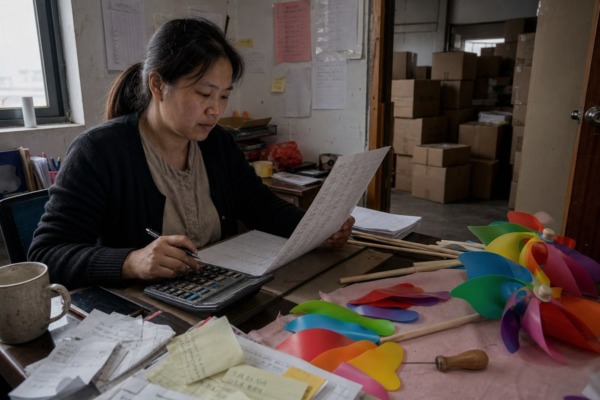
Certification alone tells you very little. A factory can hold a certificate and still repeat the same mistake every quarter. What you want is evidence of a living system: documents that get updated, metrics that get reviewed, and failures that stop recurring. Wind-industry due diligence guidance makes the same point, recommending buyers examine historical performance, product program maturity, and warranty remedies rather than stopping at the certificate.
Documents That Prove a Living System
Ask to see a recent 8D report or root cause analysis. Ask when the Failure Mode and Effects Analysis 3 was last revised and why. Ask how a defect triggers a control plan update. After our grommet tension problem, we added a spin-test station and a torque check to the assembly line, and both now appear in our control documents. That paper trail is what separates prevention from firefighting. It also supports supply chain transparency, because you can trace exactly which change fixed which problem.
Metrics Worth Requesting
| KPI | What it reveals | Good sign |
|---|---|---|
| Defect rate | Process stability | Falling trend across consecutive quarters |
| On-time in-full (OTIF) delivery | Planning discipline | A or B band under an A–D grading system, the approach Nordex applies to its suppliers |
| Field failure rate / MTBF | Design durability | Mean time between failures rising after each design revision |
| Complaint closure time | Corrective action speed | Measured in days, not months |
| Warranty claim frequency | Real-world quality | Declining with each product generation |
One more marker: component reliability testing 4 tied to recognized standards. Utility turbine performance claims are verified against standards such as IEC 61400-12. For decorative products, the equivalent is documented spin, UV, and colorfastness testing with pass criteria. Either way, the principle is identical. A supplier committed to continuous improvement measures, tests, and shows you the trend line.
How Do I Evaluate a Supplier's Responsiveness When I Request Product Changes?
Every change request forces a trade-off in our workshop: quote fast and risk errors, or verify carefully and seem slow. How a supplier balances this tells you everything.
Evaluate responsiveness by timing the supplier's first technical reply, requesting a written feasibility answer with sampling cost and lead time, and scoring five dimensions: responsiveness, root-cause discipline, data transparency, implementation speed, and proven improvement results, weighted higher for critical components.

Speed alone is a trap. I have seen competitors reply to a WhatsApp message in two minutes and then take two months to produce a corrected sample. Technical support responsiveness must be measured on substance: how quickly you receive a written answer that covers feasibility, sampling cost, and a delivery date. In our factory, we target a meaningful technical reply within one working day and a costed feasibility answer shortly after, because a change request cannot move until engineering has actually reviewed it.
A Simple Scoring Matrix
| Dimension | Suggested weight | What to score |
|---|---|---|
| Responsiveness | 20% | Time to first substantive technical reply, not first chat message |
| Root-cause discipline | 20% | Evidence of RCA and 8D behind past changes |
| Data transparency | 20% | Willingness to share KPIs, failure data, and cost breakdowns |
| Implementation speed | 20% | Actual sample and change lead times versus promises |
| Proven improvement results | 20% | Documented before-and-after gains, such as lower return rates |
For critical or high-volume items, raise the weight on implementation speed and proven results. A wind turbine supplier that scores well here protects your whole product lifecycle management plan, from first sample to end-of-line retrofit.
The Cost-First Objection, Answered
Many buyers push back at this point. One supplier-selection study in the wind sector even found that cost ranked as the most important criterion, ahead of quality and risk. I understand the budget pressure. But my honest position, after years of shipping pinwheels to the US, South America, and Europe, is this: the cheapest quote from a supplier who cannot prevent repeat failures becomes the most expensive line on your books. Returns, damaged packaging claims, and lost shelf space all land on you, not the factory. Improvement capability is not a soft extra. It is risk reduction you can price.
Conclusion
A weak supplier will cost you repeat failures and lost customers. Evaluate improvement capability early, demand evidence, score responsiveness, and partner with factories that treat your feedback as fuel.
Footnotes
1. Authoritative guide on root cause analysis, a key method for systematic product and process improvement. ↩︎
2. IEEE is a leading authority on the technical standards and analytics systems used in utility-scale energy infrastructure. ↩︎
3. Detailed explanation of FMEA, a critical tool for identifying and preventing potential failures in manufacturing. ↩︎
4. The IEC provides the international standards for wind energy generation systems and component testing. ↩︎
More Articles
You might also find these helpful.
How to Remotely Verify a Factory's Production Capabilities for Wrought Iron Plug-In Components?
Verify wind turbine supplier product improvement support through documented OEM/ODM cases, transparent sampling costs, and structured quality processes...
Read More →
How to Assess a Factory's Production Capacity When Sourcing Wrought Iron Inserts?
Verify wind turbine supplier product improvement support through documented OEM/ODM cases, transparent sampling costs, and structured quality processes...
Read More →
What Questions Should You Ask Wrought Iron Insert Suppliers to Spot Unreliable Ones Early?
Verify wind turbine supplier product improvement support through documented OEM/ODM cases, transparent sampling costs, and structured quality processes...
Read More → English
  Spanish
  German
  Arabic