
How to Specify Quality Inspection Sampling Ratios and Standards in a Contract?
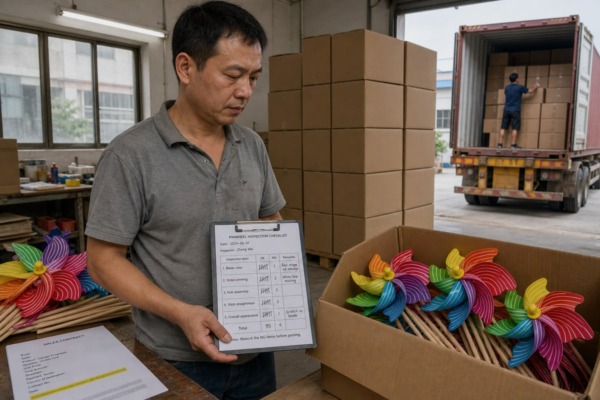
A vague inspection clause once trapped a full container of our pinwheels in a month-long dispute. Quality inspection sampling ratios and standards belong in the contract itself—written precisely.
Specify quality inspection sampling ratios and standards by naming the standard (ISO 2859-1 or ANSI/ASQ Z1.4), the inspection level, tiered AQL values for critical, major, and minor defects, exact acceptance and rejection numbers, and the agreed remedy path when a lot fails inspection.
In my own contracts, I follow one simple rule: write the sampling ratio, the AQL quality standard, the exact non-conformance criteria 1, and the handling plan for excess defect rates directly into the agreement. This article walks through each piece. I will use our pinwheel production line as the running example, because that is what we build and ship every day from Zhejiang.
What AQL Level Should I Choose for Pinwheel Quality Inspections?
During a pre-shipment inspection 2 last spring, an inspector flagged three pinwheels with loose petal grommets out of 125 sampled. Whether that lot passed depended entirely on one number: the AQL.
For pinwheels and similar consumer products, use AQL 0 for critical defects, AQL 2.5 for major defects, and AQL 4.0 for minor defects, applied under General Inspection Level II of ISO 2859-1. Tighten the levels or lower the AQL for children's safety features like exposed pins.

AQL stands for Acceptable Quality Level. It is the worst tolerable process average that a sampling plan 3 will still accept most of the time. It is not a promise that every unit is perfect. That distinction matters, and I explain it to every new buyer who contacts us.
Start With Defect Classification Criteria
Before you pick a number, you must define what counts as a defect. Our contracts split defects into three tiers. Here is how that looks for a garden pinwheel with plastic petals, a yellow hub, and a wooden dowel:
| Defect Class | Pinwheel Examples | Typical AQL | Why This Tier |
|---|---|---|---|
| Critical | Exposed sharp pin point; broken dowel splinters; detachable small parts on a children's item | 0 (zero accepted) | Safety and legal risk |
| Major | Spinner does not rotate; petal detaches from hub; grommet missing; wrong color gradient | 2.5 | Product is unsellable or returned |
| Minor | Slight print misalignment on white stripes; small scuff on dowel; faint color variation | 4.0 | Cosmetic; unlikely to cause returns |
This tiered approach is standard practice in consumer goods sourcing, and it lets one contract enforce risk-proportionate thresholds. A safety issue gets zero tolerance. A cosmetic scuff does not sink a shipment.
Then Pick the Inspection Level
ISO 2859-1 and ANSI/ASQ Z1.4 offer General Inspection Levels 4 I, II, and III. Level II is the default for most of our export orders 5 to the United States and Europe. Level I cuts the sample size for low-risk, low-value goods. Level III increases the sample for high-risk items or new suppliers. In our experience, buyers who sell into children's retail channels often specify Level III for the first three orders, then relax to Level II once trust is established. That is a reasonable ask, and we accept it.
One buyer objection I hear often: "Doesn't AQL 2.5 mean you can ship me 2.5% defective goods on purpose?" No. The AQL is a decision rule for accepting or rejecting lots, not a warranty threshold for individual units. Our internal target defect rate sits well below the contractual AQL, because tightened inspection kicks in fast when lots fail.
How Do I Word a Sampling Ratio Clause So My Supplier Can't Dispute It?
A procurement manager from Texas once sent me a draft that said only "buyer may reasonably inspect goods before shipment." I sent it back. That sentence protects nobody—including her.
Word the clause by defining the lot, citing ISO 2859-1 or ANSI/ASQ Z1.4 by edition, stating the inspection level, the AQL per defect class, the sampling plan type, and explicit acceptance and rejection numbers—never a bare percentage—plus random sampling methodology and reinspection rights.

Here is the core problem with writing "inspect 10% of the goods." Statistical sampling tables do not work on flat percentages. They work on sample size code letters tied to lot size. A 10% sample of 500 units and a 10% sample of 50,000 units give wildly different statistical confidence. The standards fix this by scaling the sample with batch size determination rules, so confidence stays consistent as order quantities change.
How Sample Size Actually Gets Determined
Under ANSI/ASQ Z1.4 at General Inspection Level II, the lot size maps to a code letter, and the code letter maps to a sample size with acceptance (Ac) and rejection (Re) numbers. For a major-defect AQL of 2.5, the single sampling plan looks like this:
| Lot Size | Code Letter | Sample Size | Accept (Ac) | Reject (Re) | Effective Ratio |
|---|---|---|---|---|---|
| 501–1,200 | J | 80 | 5 | 6 | ~7–16% |
| 1,201–3,200 | K | 125 | 7 | 8 | ~4–10% |
| 3,201–10,000 | L | 200 | 10 | 11 | ~2–6% |
Notice the "sampling ratio" falls as the lot grows. That is deliberate and statistically sound. Your contract should reference the table logic, not a fixed percentage, unless you truly intend a flat percentage for a specific reason.
A Clause Structure That Ends Arguments
When we draft quality assurance clauses with distributors, we include, in order:
- Product scope and the golden sample reference.
- Lot definition (one purchase order, one shipment, or one production run).
- The standard and edition: ISO 2859-1 or ANSI/ASQ Z1.4.
- Inspection level (II by default) and sampling type (single, double, or multiple).
- AQL per defect class, with defect classification criteria attached as an annex.
- Random sampling methodology: samples drawn randomly across cartons, not from one pallet.
- Explicit Ac/Re numbers, so pass or fail is binary and data-driven.
- Who inspects, where, and when, including destructive-testing sample replacement.
With that structure, my team and the buyer's inspector test the same thing, the same way, and reach the same decision. There is nothing left to argue about, which is exactly the point.
Can I Require Third-Party Inspection Standards Like ISO 2859 in My Contract?
There is a trade-off I weigh on every order: third-party inspection services add cost and one to two days of lead time, but they remove the "your inspector versus my inspector" argument entirely. For export orders, I almost always recommend them.
Yes. Contracts can require third-party inspection services to apply named standards: ISO 2859-1 for lot-by-lot AQL sampling, ISO 2859-2 for isolated lots using limiting quality, ISO 2859-3 for skip-lot programs, and ISO 28598 for coordinated supplier, customer, and third-party inspection. Always cite the edition.

ISO 2859-1 standards describe a complete system of single, double, and multiple sampling plans indexed by AQL for deciding whether a lot passes or fails from a statistical sample. That system assumes a continuing series of lots—which fits a distributor placing repeat pinwheel orders. Different situations call for different parts of the family:
| Standard | Purpose | Best Fit |
|---|---|---|
| ISO 2859-1 / ANSI/ASQ Z1.4 | Lot-by-lot attribute sampling indexed by AQL | Repeat orders, ongoing supplier relationships |
| ISO 2859-2 | Isolated lot inspection indexed by limiting quality (LQ) | One-off orders, trial purchases, closeouts |
| ISO 2859-3 | Skip-lot procedures with frequencies of 1/2, 1/3, 1/4, and 1/5 | Proven suppliers with a strong track record |
| ISO 28598-1 / 28598-2 | Coordinated supplier, customer, and third-party inspection | Multi-party supply chains and certification programs |
Switching Rules Reward Good Suppliers
The standards include switching rules: normal, tightened, and reduced inspection. Consistent passing shifts a supplier to reduced inspection with smaller samples. Failures force tightened inspection. This creates a contractual "trust but verify" model. From our side of the table, we like these rules—they give a supplier with clean lots a real, automatic reward instead of a vague promise.
Modern Additions Worth Writing In
Two trends are showing up in the supplier quality agreements we sign now. First, buyers reference cloud-stored digital golden samples so a third-party inspector compares against an immutable reference, not a faded physical sample that drifts over two years of reorders. Second, some contracts link sampling intensity to production data, such as automated optical inspection results, and a few now use AI pre-screening to steer part of the random sample toward high-risk units. Pre-shipment inspection remains the anchor, but these tools make it sharper.
What Happens If My Shipment Fails the Agreed Inspection Standards?
Early in our export business, I learned this lesson the hard way: a failed inspection without a pre-agreed remedy path turns into weeks of emails. Now every contract we sign answers "what happens next" before production even starts.
When a lot fails, the pre-agreed remedy path activates: the inspector issues a non-conformance report, the supplier sorts, reworks, or replaces the lot at its own cost, reinspection follows under tightened inspection, and repeated failures trigger cost-recovery, price reductions, or cancellation rights.

A rejection is not the end of the deal. It is the start of a predetermined procedure. This is exactly what I mean when I say the contract must define the non-conformance criteria and the handling plan for defect rates that exceed the threshold. Here is the escalation ladder we build into our agreements:
- Document. The inspector issues a non-conformance report the same day, with photos, the sampling record, and the exact Ac/Re result. No report, no valid rejection.
- Disposition. The supplier chooses, at its own cost, between 100% sorting of the lot, rework of defective units, or full replacement. For our pinwheels, rework usually means re-seating grommets or replacing damaged petal sets—fast and cheap if caught before packing.
- Reinspect. The corrected lot is reinspected under tightened inspection, following the standard's switching rules. The buyer does not pay twice.
- Cost recovery. If the failure required a third-party re-inspection, the fee shifts 100% to the supplier. This clause is a powerful deterrent against "ship and hope" behavior, and honestly, we accept it willingly—it signals confidence in our own line.
- Escalate. Two consecutive failures, or three in any six-month window, trigger buyer options: price reduction, order cancellation, or a mandatory corrective-action audit with recordkeeping and audit rights.
Handle the Edge Cases in Writing
Cover destructive testing (the buyer pays for consumed samples, or the supplier adds overage units), mixed lots (each production run is a separate lot for batch size determination), and partial shipments (each partial shipment is inspected as its own lot). These three edge cases cause most reinspection conflicts I have seen in ten-plus years of shipping to the US, South America, and Europe.
Conclusion
Vague inspection language invites disputes. Precise contracts prevent them. Write the sampling standard, AQL thresholds, defect criteria, Ac/Re numbers, and failure remedies in advance—then inspection becomes a decision, not an argument.
Footnotes
1. WTO resource on technical barriers and standards relevant to non-conformance in trade. ↩︎
2. Authoritative Wikipedia overview of the pre-shipment inspection process mentioned in the article. ↩︎
3. Authoritative definition of sampling plans from the American Society for Quality. ↩︎
4. Official ISO page for the ISO 2859-1 standard governing inspection levels. ↩︎
5. U.S. government resource for managing international export orders and trade compliance. ↩︎
More Articles
You might also find these helpful.

How to Remotely Verify a Factory's Production Capabilities for Wrought Iron Plug-In Components?
Set precise quality inspection sampling ratios and standards in your contract using AQL tiers, ISO 2859-1 levels, and…
Read More →
How to Assess a Factory's Production Capacity When Sourcing Wrought Iron Inserts?
Set precise quality inspection sampling ratios and standards in your contract using AQL tiers, ISO 2859-1 levels, and…
Read More →
What Questions Should You Ask Wrought Iron Insert Suppliers to Spot Unreliable Ones Early?
Set precise quality inspection sampling ratios and standards in your contract using AQL tiers, ISO 2859-1 levels, and…
Read More → English
  Spanish
  German
  Arabic