How to Find Reliable Wrought Iron Accessories Suppliers to Contact?
Finding reliable wrought iron accessories suppliers nearly stalled our first garden stake line. One bad batch of bent prongs taught our Zhejiang workshop how costly a wrong supplier can be.
Find reliable wrought iron accessories suppliers by searching Alibaba International, Made-in-China, and 1688, attending trade shows like the Canton Fair, and verifying each candidate’s ISO 9001 certification, factory ownership, physical address, sample quality, and export track record before sending a Request for Quote.
That short answer hides a lot of detail. The wrought iron accessories market 1 mixes real factories, stockists, and thin resellers. This guide walks through verification, quality questions, sourcing channels, and logistics, step by step.
How can I verify a wrought iron accessories supplier's reliability before placing an order?
Every quarter, our sourcing team weighs a tempting low quote against hard proof of capability. Cheap ornamental iron components that fail inspection cost us far more than the savings.
Verify a wrought iron accessories supplier by checking business licenses, ISO 9001 certification, years in operation, physical factory address, and in-house production capability. Then order paid samples, request client references or project photos, and confirm export experience to your market before committing to a purchase order.
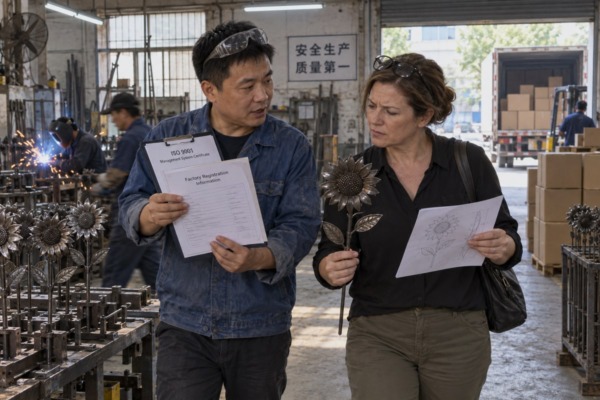
Reliability is not a feeling. It is a set of checkable facts. When we screen a new iron parts vendor for our sunflower stakes and wind spinners, we run through the same list every time. The strongest players in this industry make verification easy. Some established architectural metalwork suppliers openly advertise over 50 years of operation. Others highlight more than 45 years of in-stock, in-house production. Parveen Metal Works, for example, states it was established in 1999 and holds ISO 9001:2015 2 certification. FH Brundle positions itself as the UK's primary stockist of wrought iron components. These are the kinds of concrete claims you want, because you can test them.
Trust Signals That Separate Real Suppliers From Thin Listings
| Signal | What to check | Red flag |
|---|---|---|
| Years in business | Registration records match the claimed history | Registered last year, claims decades of experience |
| Manufacturer quality certifications | Valid ISO 9001 certificate number you can look up | The word certified with no document |
| In-house production | Live factory video call, machinery in use | Only showroom shots or stock photos |
| Physical presence | Address, landline, trading hours, email | Chat-app-only contact |
| Catalog depth | Named parts: balusters, finials, collars, gate and fence accessories | Vague we make all metal products |
The Low Price Objection
Buyers often tell me a cheaper unverified quote is worth the gamble. I push back on that. No public database compares defect rates or shipment performance across these suppliers, so you cannot outsource the risk check. A documented factory that costs slightly more usually saves you a failed container. Verify first, negotiate second.
What questions should I ask to check a supplier's quality control process for wrought iron accessories?
A US procurement manager once grilled us for an hour about coating adhesion on our sunflower stakes. Her questions were so sharp that we now ask suppliers the same ones.
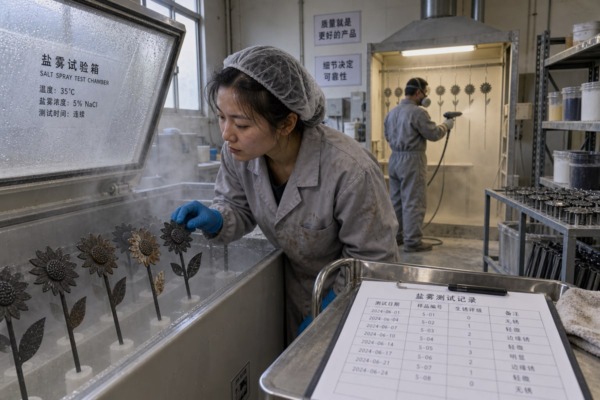
Ask suppliers how they inspect raw materials, what welding and finishing tolerances they hold, which powder coating specifications and salt-spray standards they follow, how they document ASTM material standards compliance, their defect-rate targets, and whether they allow third-party pre-shipment inspections before every container loads.
Good QC questions do two jobs. They get you real answers, and they show the supplier you are a serious buyer. In my experience exporting decorative metal products to the United States and Europe, suppliers quote more honestly once they know you will inspect. Here are the questions that reveal the most, along with what a strong answer sounds like.
The Six Questions We Always Ask
| Question | Strong answer | Warning sign |
|---|---|---|
| How do you verify incoming steel or iron? | Mill certificates checked against ASTM material standards | We trust our supplier |
| What surface treatment do you use? | Written powder coating 3 specifications, or a galvanized iron finish with coating thickness stated | Standard paint, no details |
| How do you test rust resistance? | Salt-spray test reports available on request | Our products never rust |
| What is your defect-rate target? | A stated AQL level with inspection records | We check everything |
| Can I send a third-party inspector? | Yes, anytime before loading | Inspections slow us down |
| Do you offer samples first? | Paid samples from the actual production line | Samples only after deposit |
Why Samples Beat Promises
Always request a physical prototype before any bulk order. Hold it. Check the hand-forged texture, weld seams, and edge finishing. Scratch-test the anti-rust coating. When we developed our ombre-painted sunflower stakes, the sample stage exposed a coating that chipped at the petal tips. The factory fixed the pre-treatment before mass production. Also ask about environmental practices. More buyers now require low-VOC powder coating and recycled scrap metal content, so a supplier's ESG answers signal how modern their process really is. Put every agreed spec into your Request for Quote so nothing rests on memory.
Where can I find trustworthy wrought iron accessories manufacturers for bulk or custom orders?
Our best iron stake partner came from a peer referral at the Yiwu crafts fair, not a search bar. That lesson reshaped how our team builds supplier shortlists.
Find trustworthy wrought iron accessories manufacturers on Alibaba International, Made-in-China, and 1688, at trade shows like the Canton Fair and Yiwu crafts fair, through peer referrals, and in directories such as Thomasnet. Prioritize factories that specialize in garden ironwork over general hardware plants.
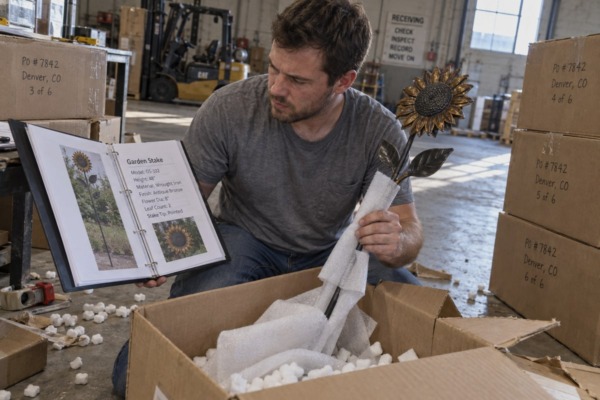
Here is the channel map we actually use when sourcing ornamental iron components for our garden decor lines.
| Channel | Best for | Practical tip |
|---|---|---|
| Alibaba International | Broad supplier discovery, export-ready factories | Filter for verified status and factory-type listings |
| Made-in-China | Comparing export manufacturers side by side | Cross-check company names against registration records |
| 1688 | Screening true source factories at domestic pricing | Look for workshops posting real production videos |
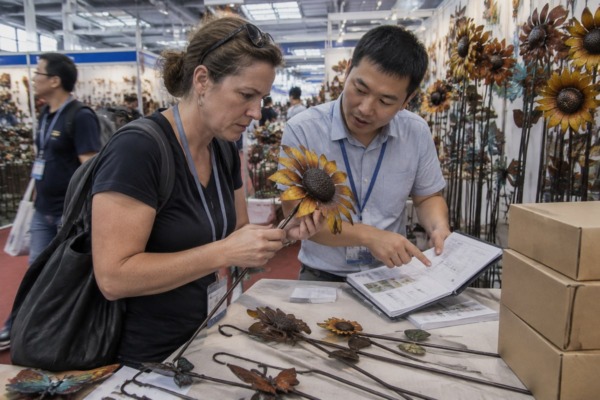
| Canton Fair | Meeting trade show exhibitors face to face | Inspect samples on the spot and meet the owner |
| Yiwu crafts fair | Decorative and garden-focused metal specialists | Ask which peers they already supply |
| Peer referrals | Pre-vetted, proven partners | The fastest shortcut to reliability |
| Thomasnet and buying guides | US-based architectural metalwork suppliers | Useful for domestic backup sourcing |
Specialists Beat Generalists
My strongest advice: choose a factory whose main business is garden and decorative ironwork, not an all-purpose hardware plant. The craft match matters. Decorative stakes, scrolls, and finials need painting lines, forming tools, and finishing skills that a generic wholesale metal hardware factory rarely maintains. A general plant can bend steel. A specialist makes it beautiful and consistent across 10,000 pieces.
Manufacturer or Distributor?
Buyers often ask whether a distributor is safer. Distributors offer speed and variety. Indital, for instance, advertises access to over 30,000 components distributed worldwide. But for bulk or custom iron fabrication 4, a manufacturer gives you direct pricing, design control, and OEM flexibility. My resolution: use distributors for urgent small fills, and build long-term custom programs directly with factories. Sourcing is also global now. Credible suppliers operate in China, India, the US, the UK, and Australia, and some forward-looking factories even offer BIM files or pre-engineered housings for smart sensors, which helps architectural buyers specify parts faster.
How do I avoid shipping delays and damaged packaging when sourcing wrought iron accessories from overseas suppliers?
Last spring, a container of wind spinners reached Los Angeles with crushed corner cartons. We rebuilt our packaging spec that week, and the fix now protects every iron shipment.
Avoid delays and damage by agreeing on realistic lead times in writing, adding buffer weeks before peak seasons, specifying export-grade packaging with drop-test proof, booking pre-shipment inspections, choosing suppliers with documented shipping experience, and confirming Incoterms, insurance, and claims procedures before paying any deposit.
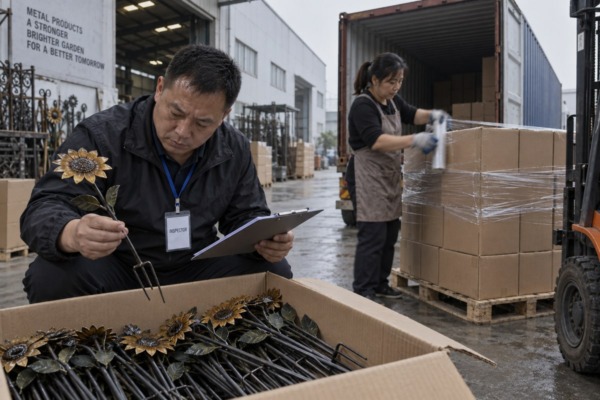
Shipping is where good sourcing deals die. Iron parts are heavy, pointed, and coated, which makes them their own worst enemy inside a moving container. Here is the process we follow for every export order, refined over years of shipping garden stakes, spinners, and seasonal lawn ornaments to the US and Europe.
- Lock lead times in the contract. State the production days, the buffer, and a late-delivery remedy.
- Plan around peak seasons. Holiday decor must leave China by late summer. Q4 bookings jam ports and rates spike.
- Specify the packaging, not just the product. Write the carton grade, inner protection, and pallet method into the PO.
- Demand a drop test. Ask for photos or video of the packed carton surviving corner and edge drops.
- Book a pre-shipment inspection. A third party checks quantity, finish, and packing before the container seals.
- Confirm Incoterms and insurance. Know exactly where risk transfers and how claims get filed.
Packaging Layers That Actually Work
| Layer | Purpose |
|---|---|
| Foam or honeycomb paper wrap per piece | Stops coating scratches and chipped paint |
| Reinforced double-wall cartons | Survives stacking and handling shocks |
| Corner boards and pallet strapping | Prevents crushed cartons like my Los Angeles disaster |
One more objection I hear often: overseas sourcing is too risky, so buy domestic. Domestic supply cuts transit time, but overseas factories win on cost and range for bulk procurement logistics. A smarter hedge is a China Plus One strategy, keeping a vetted backup supplier in Vietnam, India, or Mexico against tariffs and bottlenecks.
Conclusion
Reliable wrought iron accessories suppliers exist, but you must earn them through verification, sharp QC questions, the right channels, and airtight logistics. Vet hard once, then reorder with confidence.
Interested in sourcing the products mentioned in this article? See details and request a quote here:
Footnotes
1. Wikipedia entry for wrought iron, providing technical background on the material used in these accessories. ↩︎
2. Official ISO page for the quality management standard used to verify supplier reliability. ↩︎
3. Detailed information on the powder coating process mentioned for finishing and environmental compliance. ↩︎
4. US government resource for international trade, relevant to sourcing and fabrication from overseas manufacturers. ↩︎
More Articles
You might also find these helpful.
How to Remotely Verify a Factory's Production Capabilities for Wrought Iron Plug-In Components?
Find reliable wrought iron accessories suppliers by verifying ISO 9001 certification, factory ownership, and samples before ordering—avoid costly…
Read More →
How to Assess a Factory's Production Capacity When Sourcing Wrought Iron Inserts?
Find reliable wrought iron accessories suppliers by verifying ISO 9001 certification, factory ownership, and samples before ordering—avoid costly…
Read More →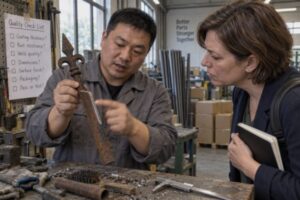
What Questions Should You Ask Wrought Iron Insert Suppliers to Spot Unreliable Ones Early?
Find reliable wrought iron accessories suppliers by verifying ISO 9001 certification, factory ownership, and samples before ordering—avoid costly…
Read More → English
  Spanish
  German
  Arabic