
How to Spot Hidden or Omitted Charges in Wrought Iron Fittings Price Quotes?

Our Zhejiang workshop powder-coats thousands of metal garden stakes monthly, so I read wrought iron fittings price quotes weekly—and I keep seeing buyers ambushed by surcharges at shipment.
To spot hidden or omitted charges in wrought iron fittings price quotes, demand a fully itemized cost estimate covering materials, coatings, tooling, packaging, pallets, freight, customs declaration, labor, permits, and taxes. Any quote missing one of these lines is incomplete, and the missing item usually becomes a pre-shipment surcharge.
The gap between a quoted price and a final invoice is where deals go sour. A number that looks great on day one can grow painfully by loading day. Below, I break down the fees that vanish from quotes, the export costs suppliers quietly omit, the exact questions that expose them, and a simple method for comparing quotes fairly.
A US distributor once forwarded me a competitor's quote that looked far cheaper than ours. We read it line by line together and found five cost items simply missing.
Watch for freight and delivery fees, hot-dip galvanizing or powder coating billed as add-ons, minimum order surcharges, custom fabrication charges, taxes, environmental compliance levies, and market fluctuation clauses tied to steel indices. These items sit outside most base prices and appear later as line-item extras.

Most published price lists show only the base list price of the fitting itself. The trouble starts with everything wrapped around that number. In my experience quoting decorative metalwork for export, hidden fees fall into two buckets.
Factory-side add-ons
The surface treatment process is the classic one. Hot-dip galvanizing, primers, and any protective anti-corrosion coating 1 often sit outside the published base price. Industry price sheets confirm this pattern: special linings and coatings are additional cost items, not standard inclusions. Watch also for minimum order or small-batch surcharges on custom fittings, custom fabrication charges for non-catalog shapes, and even environmental compliance levies tied to disposing of the pickling acids used in pre-treatment. Some suppliers now add market fluctuation clauses linked to global steel indices, which let them adjust your final invoice if raw material prices spike between quoting and delivery.
Project-side extras
If your scope includes installation, the fitting price is only the start. Public cost guides show how quickly the extras stack up:
| Cost item | Typical published range | How it hides in quotes |
|---|---|---|
| Generic iron fittings | $2–$25 each | Quoted as the headline number |
| Black iron fittings | $2–$15 each | Often confused with wrought iron |
| Installation labor rates | $40–$150 per hour | Listed as "basic installation" with no hours |
| Permits and inspections | $0–$350 | Marked "if required" with no estimate |
| Delivery and disposal | $0–$150 | "Curbside drop-off" instead of delivery to site |
Notice that labor can exceed material cost on small jobs. Also check whether site preparation requirements, old-fence removal, and on-site welding are included, because many quotes cover only shop labor, not field assembly.
How can I tell if my supplier omitted packaging or tooling costs from the quote?
Tooling is where quotes get murky. When we open a new stamping die for a custom sunflower stake, that mold fee must appear somewhere—so I know the hiding spots.
Compare the quote against a standard export checklist: sampling fees, mold and tooling fees, packaging upgrades, pallet fees, commodity inspection, storage, and separate boxing or shipping-mark charges. If none of these appear anywhere—included or excluded—the supplier has omitted them, not absorbed them.

Here is a rule I follow on every inquiry I send and every quote I issue: ask the supplier to list all fees in writing before you talk price. In my own sourcing, I specifically screen for eight charges, because these are the ones that low quotes most often leave out and then add back right before shipment.
The eight charges I always ask suppliers to list
| Fee | When it triggers | What to confirm |
|---|---|---|
| Sampling fee | Before mass production | Amount, and whether it is refunded against the order |
| Mold / tooling fee | Any custom fabrication charges for new shapes | One-time or amortized into unit price |
| Mold modification fee | Design changes after tooling | Who pays for revisions |
| Packaging upgrade fee | Export cartons, foam, protective anti-corrosion wrap | Exact packaging spec in the quote |
| Pallet fee | Palletized sea or truck freight | Pallet type, fumigation, and cost per pallet |
| Commodity inspection 2 fee | Export inspection requirements | Included or billed at cost |
| Delayed storage fee | Buyer postpones shipment | Free storage window in days |
| Separate boxing / shipping-mark fee | Split SKUs or multiple marks per shipment | Cost per extra carton or mark |
Many low prices look attractive precisely because they exclude pallets and export customs declaration. Then, days before loading, the supplier adds those charges when you have no leverage left. The fix is contractual. I tell buyers like our US distribution partners to insert one sentence into the contract: the quoted price includes all fees, with no hidden charges. A supplier who resists that sentence is telling you something important.
What questions should I ask before confirming a wrought iron fittings price?
There is a real trade-off I weigh on every order: interrogate a supplier upfront and slow things down, or sign fast and gamble on surcharges. Questions are always cheaper.
Ask what the price includes: material grade and steel gauge thickness, surface treatment process, hardware and mounting accessories, delivery point, tooling and sampling fees, pallets, export customs declaration, and validity period. Then request written confirmation that the quote covers all costs with no hidden fees.
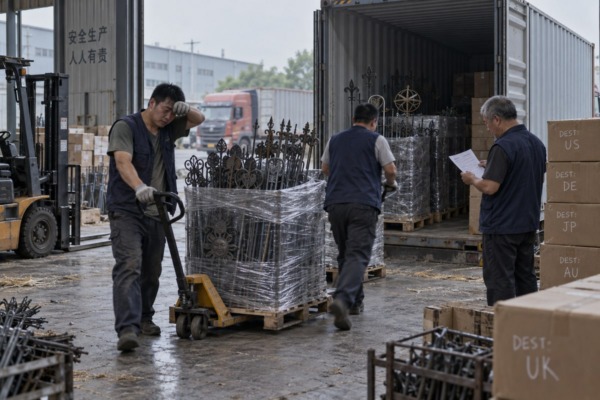
When we develop a new garden décor line with an overseas brand, the kickoff call is mostly questions. I recommend buyers run the same play. Split your questions into two groups and get every answer in writing, even if it is just a WhatsApp message you can screenshot.
Questions about the product
- What exact material grade am I getting? Confirm steel gauge thickness 3 and whether components are solid or hollow. This blocks the classic bait-and-switch to lighter stock.
- What are the powder coating specifications—film thickness, color code, and pre-treatment steps? "Standard coating" means nothing without a spec.
- Does the price include hardware and mounting accessories such as hinges, masonry anchors, and decorative collars, or are those separate line items?
- Is on-site welding and grinding covered, or does the quote stop at pre-fabricated shop labor?
- Is a post-installation touch-up kit included for weld points and shipping scuffs?
Questions about the money
- Is delivery to my site or curbside drop-off? Who moves heavy pieces to the installation point?
- Are sampling, mold, and mold-modification fees listed, with amounts?
- Are pallets, packaging upgrades, commodity inspection, and export customs declaration included?
- How long is the quote valid, and is there any market fluctuation clause tied to steel indices?
- Will you confirm in the contract that the price includes all fees, with no hidden charges?
Any vague answer to questions six through ten is your cue to pause. Clear suppliers answer these in minutes.
How do I compare quotes to make sure I'm not missing extra charges?
Early in our export business, I lost a bid because my honest all-in price looked expensive next to a stripped-down quote. That lesson taught me how to normalize bids.
Force every supplier to price the same defined scope: exact fitting type, quantity, finish, packaging, freight, labor, permits, taxes, and contingencies. Build a comparison sheet with one row per cost item. If a quote leaves any row blank, it is incomplete and cannot be compared fairly.

Suppliers will tell you a low base quote is normal because freight, finish, and labor vary by project. That is partly fair—an installer genuinely cannot fix labor before seeing site access, and installed railing work is often bundled into linear foot pricing 4 that mixes rails, posts, fittings, and finish. But "it varies" is not a license to stay silent. A professional supplier can still name every excluded item and attach an estimate. That is the difference between a list price and your real net price. Procurement teams that insist on all-in, itemized numbers consistently avoid surprise costs, even when the headline figure looks higher.
Build a landed-cost comparison sheet
Put every quote into one table and fill every row. Here is a simplified example of how a "cheap" quote loses:
| Line item | Quote A (stripped-down) | Quote B (itemized cost estimate) |
|---|---|---|
| Unit price × quantity | Included | Included |
| Hot-dip galvanizing / coating | Not mentioned | Included, spec attached |
| Tooling and sampling | Not mentioned | Listed, one-time fee |
| Packaging and pallet fee | Not mentioned | Included |
| Export customs declaration | Not mentioned | Included |
| Freight to destination | "To be advised" | Fixed estimate |
| Contingency / rework terms | None | Defined in contract |
Every "not mentioned" row in Quote A is a future invoice. Price the blanks yourself using the ranges from earlier in this article, add them to Quote A, and compare totals—not headlines. In my experience, the transparent quote wins that math more often than not.
Conclusion
A cheap quote is only cheap until the surcharges land. Itemize everything, question everything, and put no hidden fees in the contract—that is how we protect margins.
Interested in sourcing the products mentioned in this article? See details and request a quote here:
Footnotes
1. ISO provides international standards for protective paint systems and anti-corrosion coatings on steel structures. ↩︎
2. The World Customs Organization manages international standards for commodity inspection and global trade procedures. ↩︎
3. ASTM International develops technical standards for materials, including precise specifications for steel gauge and thickness. ↩︎
4. NOMMA is the primary trade association providing industry standards for ornamental metal fabrication and pricing. ↩︎
More Articles
You might also find these helpful.

How to Remotely Verify a Factory's Production Capabilities for Wrought Iron Plug-In Components?
Ask for an itemized breakdown covering coatings, freight, permits, and labor before signing—these five overlooked fees in wrought…
Read More →
How to Assess a Factory's Production Capacity When Sourcing Wrought Iron Inserts?
Ask for an itemized breakdown covering coatings, freight, permits, and labor before signing—these five overlooked fees in wrought…
Read More →
What Questions Should You Ask Wrought Iron Insert Suppliers to Spot Unreliable Ones Early?
Ask for an itemized breakdown covering coatings, freight, permits, and labor before signing—these five overlooked fees in wrought…
Read More → English
  Spanish
  German
  Arabic